
Physical AI
NVIDIA Omniverse
Build simulation-ready worlds for physical AI with agent-ready tools for rendering, physics, sensors, and validation.
Overview
What is NVIDIA Omniverse?
NVIDIA Omniverse™ libraries, part of NVIDIA Agent Toolkit, provides prebuilt capabilities for building simulation-ready worlds that physical AI teams can use to train, test, and validate systems before real-world deployment. Developers can integrate libraries, APIs, and services for OpenUSD data interoperability, rendering, physics, sensor simulation, validation, and runtime workflows into existing applications, where AI agents can use them as tools to build those worlds faster.
Technology
Core Omniverse Libraries and Services
Use Omniverse libraries and services to add physical AI simulation capabilities into applications, tools, and agent-ready workflows.

OpenUSD Data and Interoperability
Connect, organize, and exchange 3D scene data across applications and simulation pipelines.
- Use it when: You need durable scene structure, asset handoff, or application interoperability.
- Agent-ready role: Agents can inspect, organize, convert, and route scene data.

RTX Rendering and Simulation
Preview scenes, generate sensor outputs, and produce visual evidence from simulation-ready worlds.
- Use it when: You need visual preflight, synthetic sensor output, or simulation-ready scene review.
- Agent-ready role: Agents can trigger renders, simulate sensors, and return visual evidence.

Physics Simulation
Simulate motion, contacts, and physically grounded behavior for robotics and digital twin workflows.
- Use it when: You need to test collisions, motion, dynamics, or physics readiness.
- Agent-ready role: Agents can run physics-readiness checks and route issues for review.

Simulation-Ready Asset Validation
Check OpenUSD assets against simulation-ready requirements before downstream training, testing, or deployment.
- Use it when: You need acceptance gates before moving assets into physical AI simulation workflows.
- Agent-ready role: Agents can run validation checks and return pass/fail evidence.
Starting Options
Choose How to Build With Omniverse
Start with libraries, agent-ready tools, blueprints, or sample workflows, based on what you want to build.
Use Cases
How Teams Use Omniverse for Physical AI
-
Industrial Facility Digital Twins
-
Robot
Simulation -
Robot
Learning -
Synthetic Data Generation
-
Autonomous Vehicle Simulation
Industrial Facility Digital Twins
Prepare industrial environments for testing, optimizing, and validating physical AI workflows before real-world deployment.
- Connect OpenUSD scene data across design, engineering, and simulation workflows.
- Add RTX rendering, physics, sensors, and validation to make facilities simulation-ready.
- Inspect environments, surface issues, and return evidence for review with agent-ready tools.

Delta Electronics
Robot Simulation
Test robot behavior, perception, motion, and sensor interaction in simulation-ready environments before deployment.
- Prepare OpenUSD scenes with materials, physics properties, colliders, sensors, and semantic data.
- Run visual, sensor, and physics preflight to check scene readiness.
- Inspect scenes, call simulation capabilities, and route issues for review with agent-ready tools.

Robot Learning
Create physically grounded simulation environments for robot learning, testing, and policy iteration.
- Set up task-ready worlds with sensors, physics, scene variation, and validation.
- Generate scenarios for robot learning, testing, and policy evaluation workflows.
- Check scene readiness and return evidence from simulation steps.

Agility, Apptronik, Fourier Intelligence, Unitree
Synthetic Data Generation
Generate physically grounded synthetic data from simulation-ready worlds to train and test physical AI models.
- Configure scene variation, sensor layouts, lighting, materials, and rendering outputs.
- Produce synthetic data with physically based rendering and sensor simulation.
- Trigger data-generation tasks, inspect outputs, and flag issues for review.

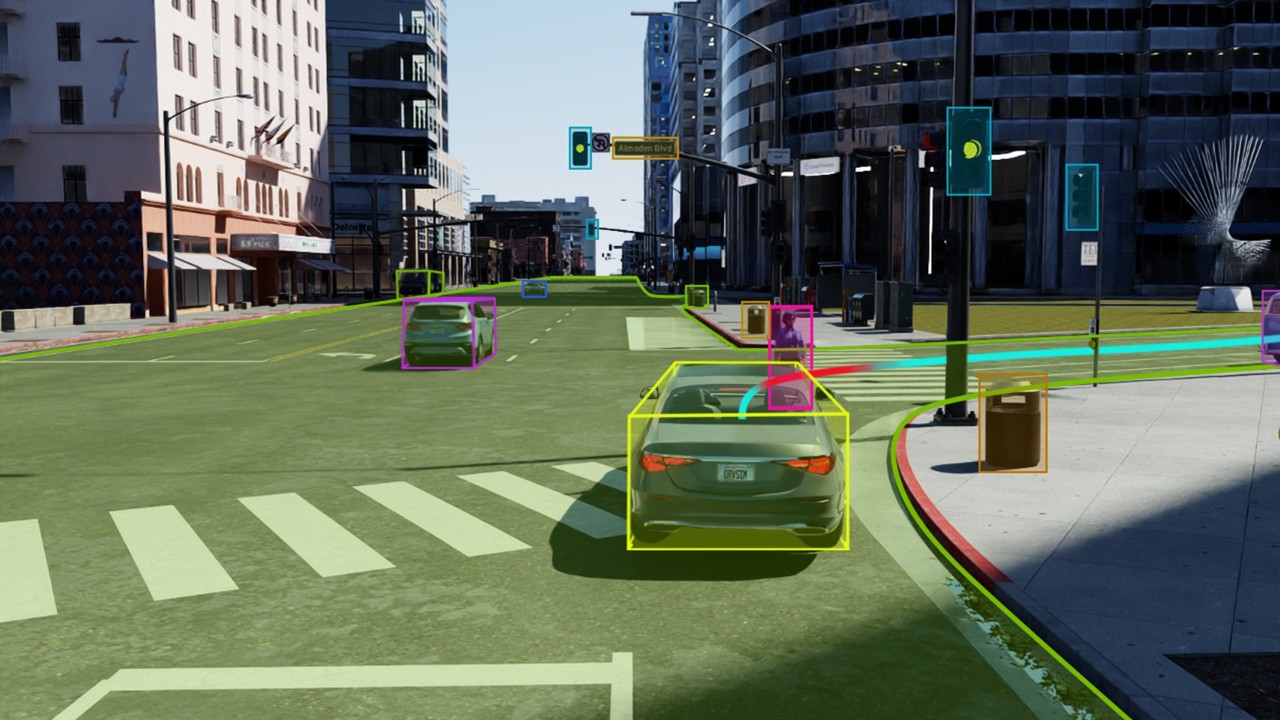
Autonomous Vehicle Simulation
Prepare simulation-ready environments for testing perception systems, sensors, and autonomous vehicle scenarios.
- Structure road, facility, and scenario data with sensor-ready OpenUSD assets.
- Simulate cameras, lidar, radar, and visual preflight for perception workflows.
- Inspect sensor setup and flag readiness issues before downstream testing.
Success Stories
Physical AI Workflows in Practice


Ecosystem
Omniverse Across the Physical AI Ecosystem
See how partners and developers are connecting Omniverse capabilities into applications and workflows for physical AI, digital twins, robotics, and simulation.


Resources
The Latest From Omniverse
Frequently Asked Questions
NVIDIA Omniverse provides libraries, APIs, services, and agent-ready tools for building physical AI applications and simulation-ready 3D workflows. Developers use Omniverse to integrate OpenUSD data interoperability, RTX rendering, physics, sensor simulation, validation, and runtime capabilities into existing applications and workflows.
Developers can build physical AI simulation applications, industrial digital twins, robotics simulation workflows, synthetic data pipelines, and tools for preparing 3D worlds for simulation. Omniverse helps teams connect 3D data, simulate sensors and physics, validate assets, and move from visual 3D content toward simulation-ready environments.
AI agents can use Omniverse capabilities as tools inside reviewable workflows. An agent can inspect a 3D scene or application state, call Omniverse tools for OpenUSD operations, rendering, physics, sensor simulation, or validation, and return evidence for a developer or technical artist to review before the workflow moves forward.
Yes. Omniverse libraries and services help developers and software makers add simulation capabilities into existing tools, services, and workflows. This lets teams use Omniverse for rendering, physics, sensor simulation, OpenUSD interoperability, and validation without replacing their differentiated applications or user experiences.
Start with Omniverse libraries when you want to integrate rendering, physics, sensor simulation, OpenUSD operations, or validation into an application or service. Use agent skills when you want AI agents to call Omniverse tools for defined tasks. Start from blueprints when you want reference workflows that show how NVIDIA technologies fit together for physical AI development.
Developers can use Omniverse documentation, GitHub repositories, sample content, and select NVIDIA NGC resources for development, research, testing, and evaluation where available. Some Omniverse libraries on GitHub are pre-release and not enterprise-supported. For production or enterprise use, support is available through NVIDIA Enterprise Support when a customer has an applicable NVIDIA support entitlement. Review each resource’s documentation for its license, support level, and intended use.
NVIDIA Omniverse helps developers build and simulate 3D worlds, applications, and workflows for physical AI. NVIDIA Cosmos™ provides world foundation models and open data processing, training, and evaluation frameworks for physical AI model development. Teams can use them together when simulation-ready environments from Omniverse support data generation, testing, or evaluation workflows for Cosmos-powered physical AI systems.
NVIDIA Omniverse Launcher (Deprecated)
Legacy Omniverse tools, including Omniverse Launcher, are available through NVIDIA’s legacy tools and documentation paths where supported. Developers starting new projects should use current Omniverse developer resources, documentation, GitHub repositories, and supported tools.
Visit Omniverse Legacy Tools and NVIDIA Developer Forums for more details.
NVIDIA Cosmos is a world model (WFM) development platform. At its core are Cosmos WFMs that generate world states as videos using multimodal input.
Developers can input Omniverse simulations as instructional videos to the Cosmos Transfer WFM to generate controllable, photorealistic synthetic data.
Together, Omniverse provides the simulation environment before and after training, while Cosmos photoreal controllable synthetic data to train physical AI models.
Next Steps
Join the Omniverse Community
Connect with Omniverse developers, share feedback, explore samples and learning resources, and stay current on OpenUSD, simulation, and physical AI workflows.
Start Building With Omniverse
Explore accelerated libraries, microservices, and skills for physical AI simulation and agentic workflows.
Omniverse GitHub
Explore Omniverse repositories, samples, and open-source resources for building with OpenUSD, rendering, physics, sensors, and validation.