DLSS 5 With 3D-Guided Neural Rendering Comes To Hogwarts Legacy On November 5th, War Thunder & Where Winds Meet Later This Month
DLSS 5 with 3D-Guided Neural Rendering uses AI to infuse game scenes with lifelike lighting and materials, tuned by developers.
Powered by a 2X faster AI model released last month for GeForce RTX 50 Series and RTX Spark systems, DLSS 5 is bringing lifelike lighting and materials to Hogwarts Legacy, War Thunder, and Where Winds Meet this November.
On Thursday, November 5th, in collaboration with Warner Bros. Games and Avalanche Software, Hogwarts Legacy is updating to integrate DLSS 5 technology to enhance lighting and materials, and to use DLSS 5’s model controls to boost environmental uplift while preserving character identity.
In mid-November, War Thunder will add DLSS 5 support, bringing enhanced visuals to Gaijin Entertainment’s popular free-to-play military combat game. The update delivers improved highlights and shadows, enriching lighting and atmosphere across air, ground, and naval combat.
And in Where Winds Meet, Everstone Studio and NetEase Games maximized DLSS 5’s settings to elevate the stunning enhancements it brings to the game’s Wuxia world. There was high demand from players to add DLSS 5, and they can experience it from November 23rd.
Additionally, there are new DLSS Super Resolution and Dynamic Multi Frame Generation games and updates coming soon and available now, including GRAVHOUNDS, Hunting Simulator 3, and Call of Duty®: Modern Warfare 4® Season 1.
Read on to learn more.
DLSS 5 Explained
DLSS evolves beyond performance to transform visual fidelity as well. DLSS 5 introduces 3D-Guided Neural Rendering, which uses AI to generate rich lighting and material details for developers to better realize their original artistic vision.
3D-Guided Neural Rendering uses the game engine’s rendered frame, complete with its artist-designed geometry, textures and lighting buffers as an unyielding foundation. DLSS 5 becomes the final rendering stage of the graphics pipeline, infusing scenes with lifelike lighting and materials while ensuring the engine frame defines what must remain, and the artist directs what may change.
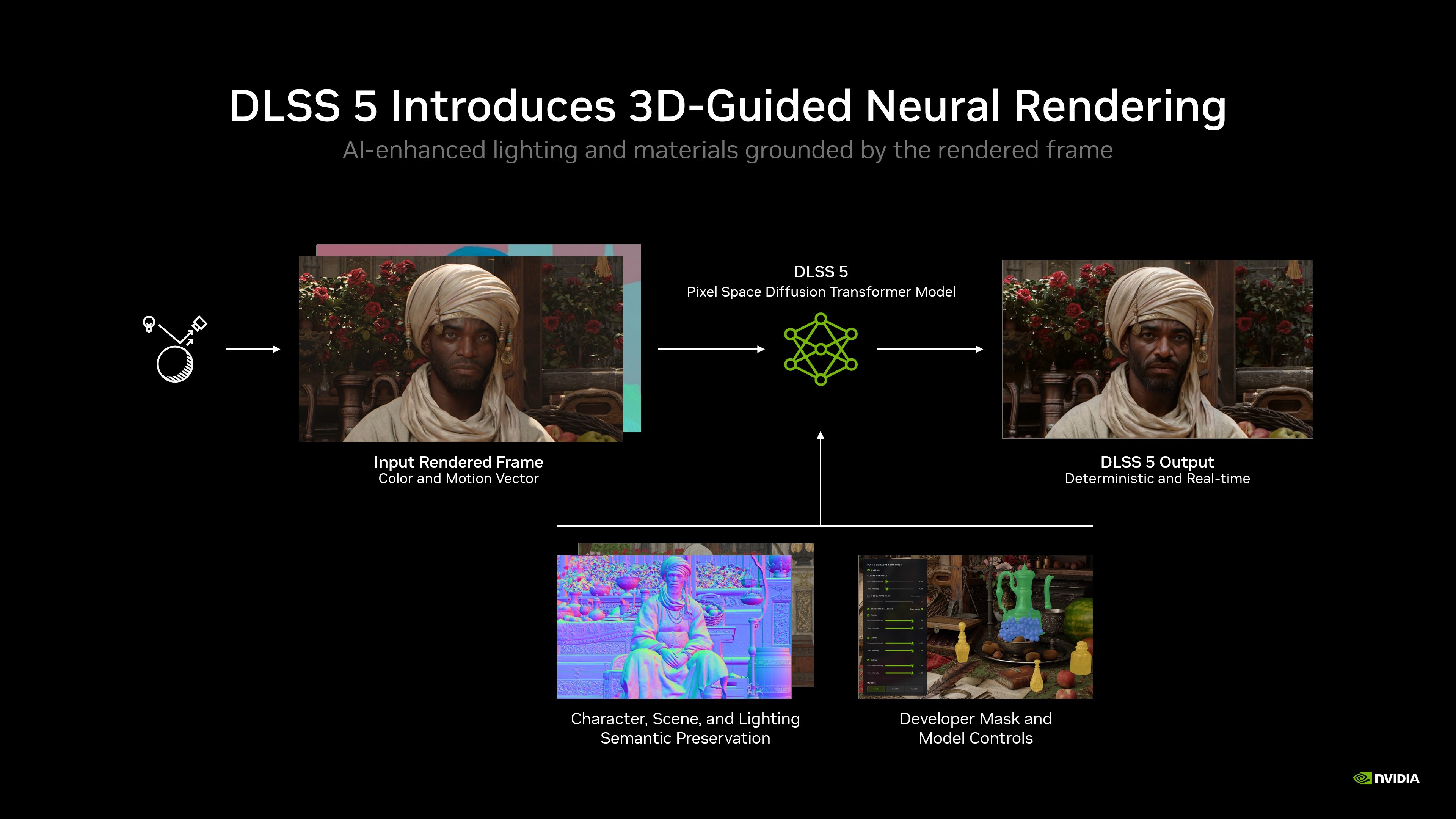
DLSS 5 takes a frame’s color and motion vectors as input to deliver lifelike lighting and materials that are deterministic, temporally stable and anchored to the game’s content
Making an image more realistic is ultimately a creative decision, which is why DLSS 5 puts art-direction tools directly into the hands of developers. DLSS 5 empowers teams to add photoreal detail that their compute and VRAM budgets would never let them model and render explicitly. It also adds different models and controls to let them art-direct how and where it is applied. For gamers, it is a simple on or off toggle.

In this example with the ramen chef, the underlying facial proportions and geometry remain exactly as the artists designed them. When enabled, DLSS 5 enhances light responses and material detail. Ambient occlusion adds defined depth around his headband, while light transmits naturally through his ears via enhanced subsurface scattering. These subtle additions elevate the character and scene without altering his core identity.


Click here to load a fullscreen 4K comparison
Through the DLSS 5 SDK, developers have several models to choose from, with different parameter weights that produce different outputs, allowing them to pick the model that works best for their game.
This model choice can be applied to the entire game, or they can mix-and-match the models in different scenes. For example, artists can select one model for dense outdoor foliage, and another model for dramatic indoor scenes. They can also mix-and-match different models for gameplay and cutscenes, whichever fits their artistic vision.
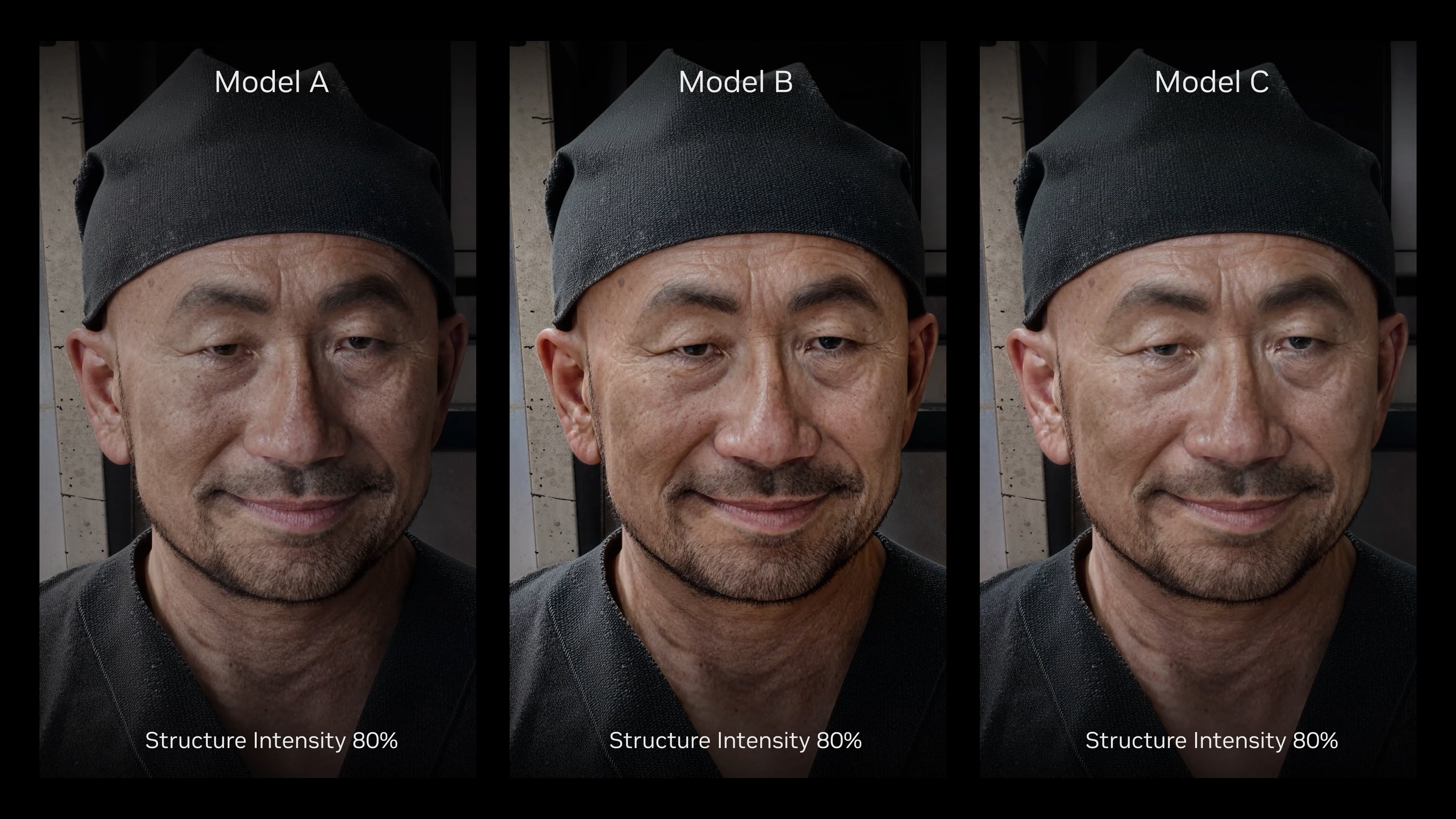
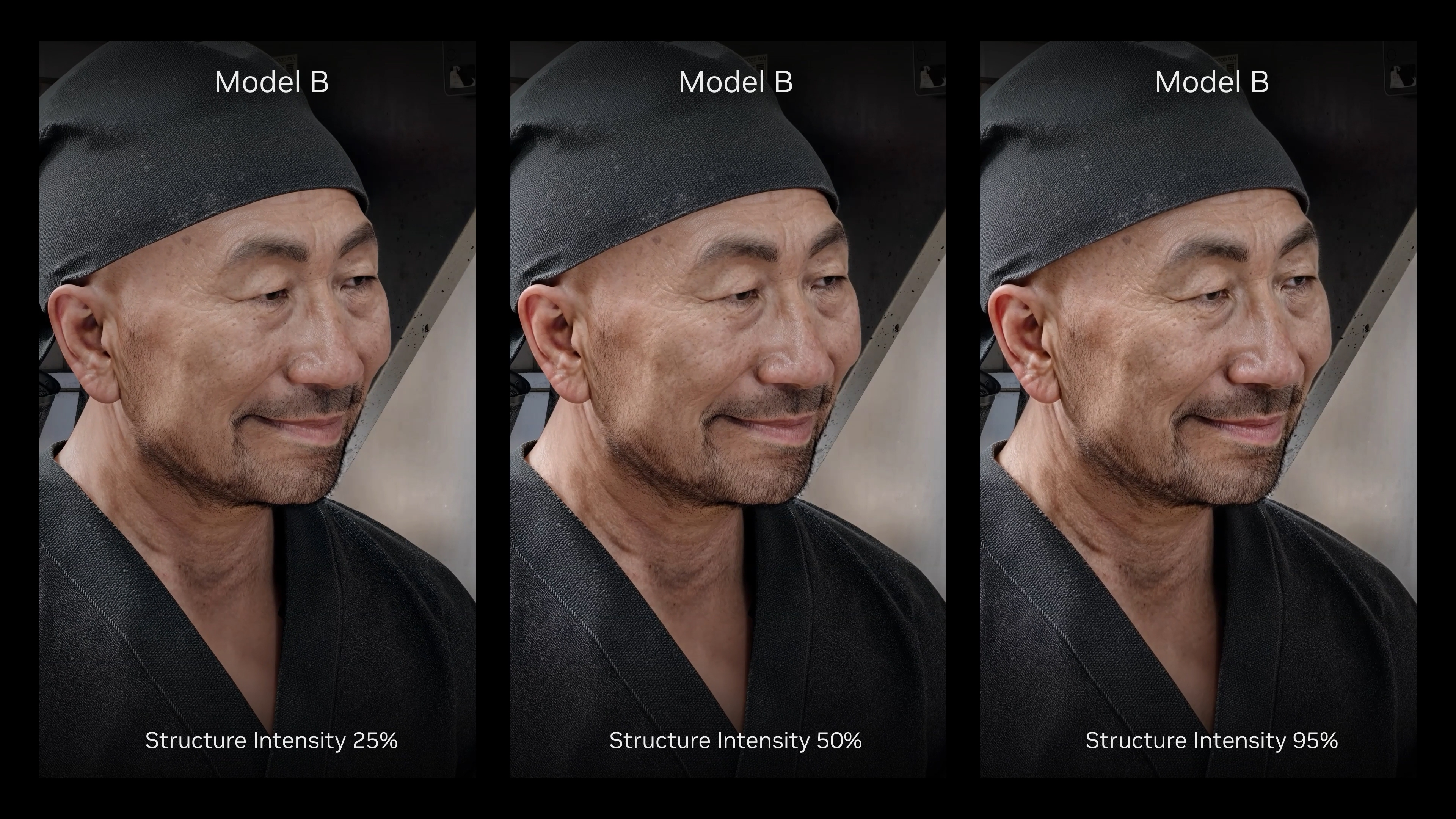
DLSS 5 also offers Structure Intensity and Tone Intensity adjustments. Structure Intensity controls high-frequency details such as ambient occlusion, reflections, and subsurface scattering. This control enables developers to have a big lever to increase realism in their games.
With Tone Intensity, developers can control the low-frequency details such as broader lighting and color response. This allows the developer to decide to show the exact colors from the rendered frame by setting this value to zero, or increase the setting to make tonal adjustments based on the scene. Together, they let the artists decide how much enhancement is applied to the output.
To ensure enhancements are applied only where intended, DLSS 5 features semantic AI masking that recognizes scene objects automatically, allowing developers to boost the environmental uplift while holding back on characters, or vice versa.
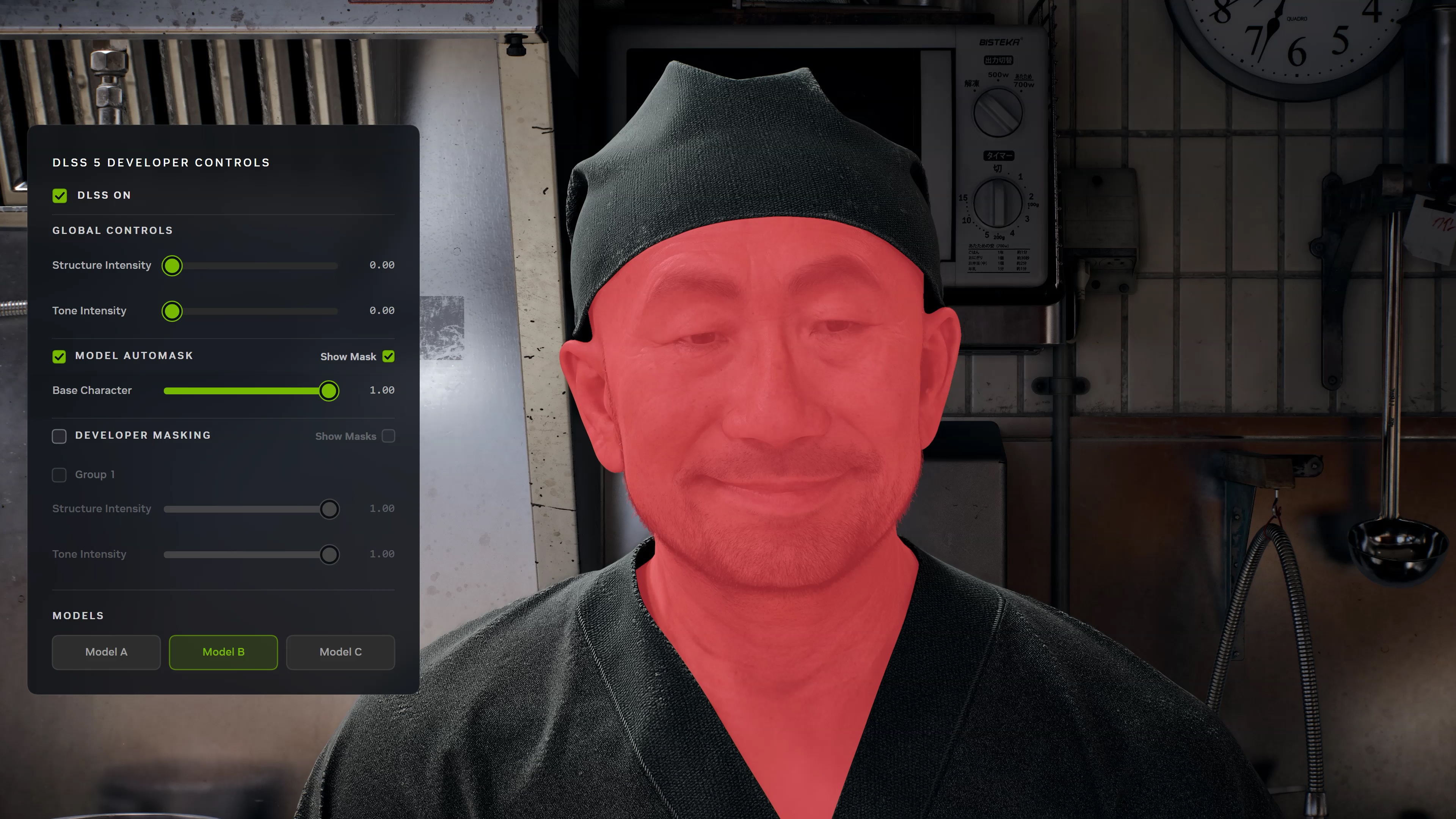
Furthermore, engine-level masking allows artists to isolate specific props or asset groups, such as glassware, water droplets, or foliage, and apply custom neural lighting tweaks to specific elements of a game without altering surrounding elements.

As we work in close partnership with studios, developer feedback continues to directly shape how we refine the technology and expand our suite of models and controls.
DLSS 5 Comes To Hogwarts Legacy This Thursday
DLSS 5 with 3D-Guided Neural Rendering will be available starting November 5th in Hogwarts Legacy for all GeForce RTX 50 Series GPUs and laptops, RTX Spark PCs, and GeForce NOW Ultimate. Simply download the new update, head to the in-game options, and activate the “Neural Rendering” option.
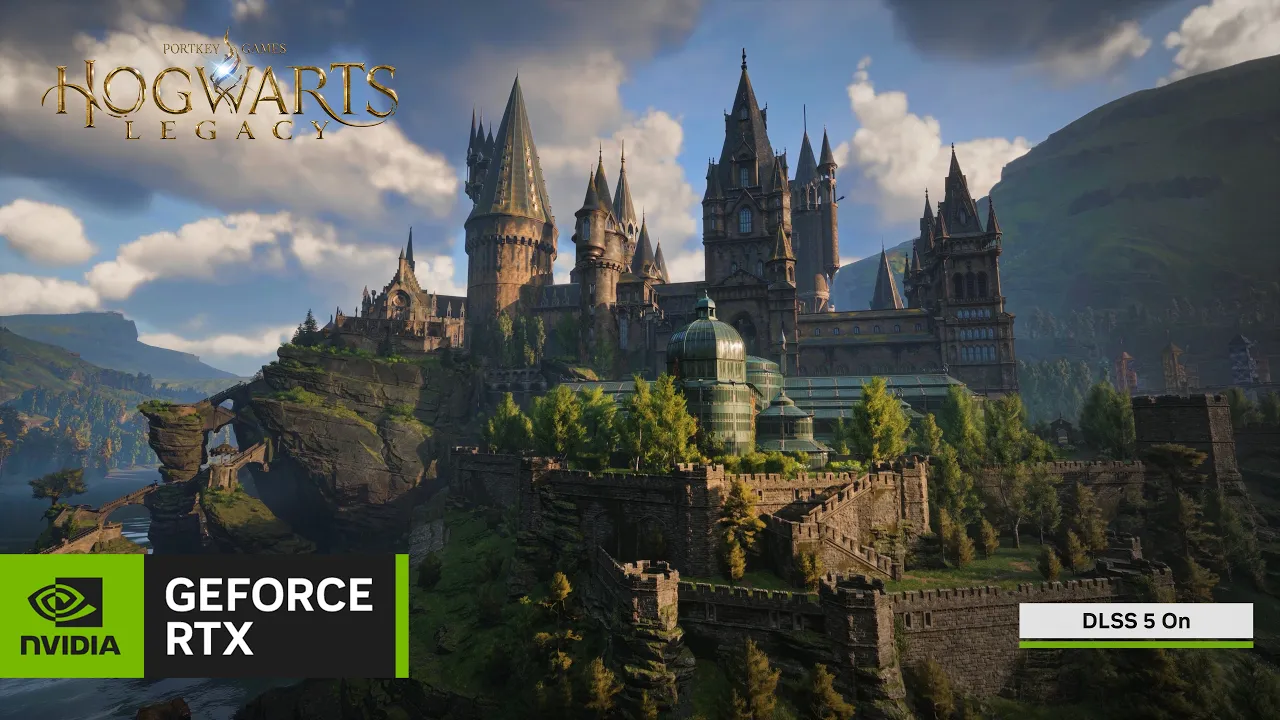
“The team at Avalanche Software worked closely with NVIDIA to add DLSS 5 Neural Rendering technology into Hogwarts Legacy for PC to ensure the best visual results while maintaining our artistic intent,” said Jose Villeta, Director of Software Engineering at Avalanche Software. “This allowed us to iterate and tune environments, tone and skin structural parameters in a manner that keeps the game true to the original vision. We’re excited for players to jump back into the game and experience it in a new way.”
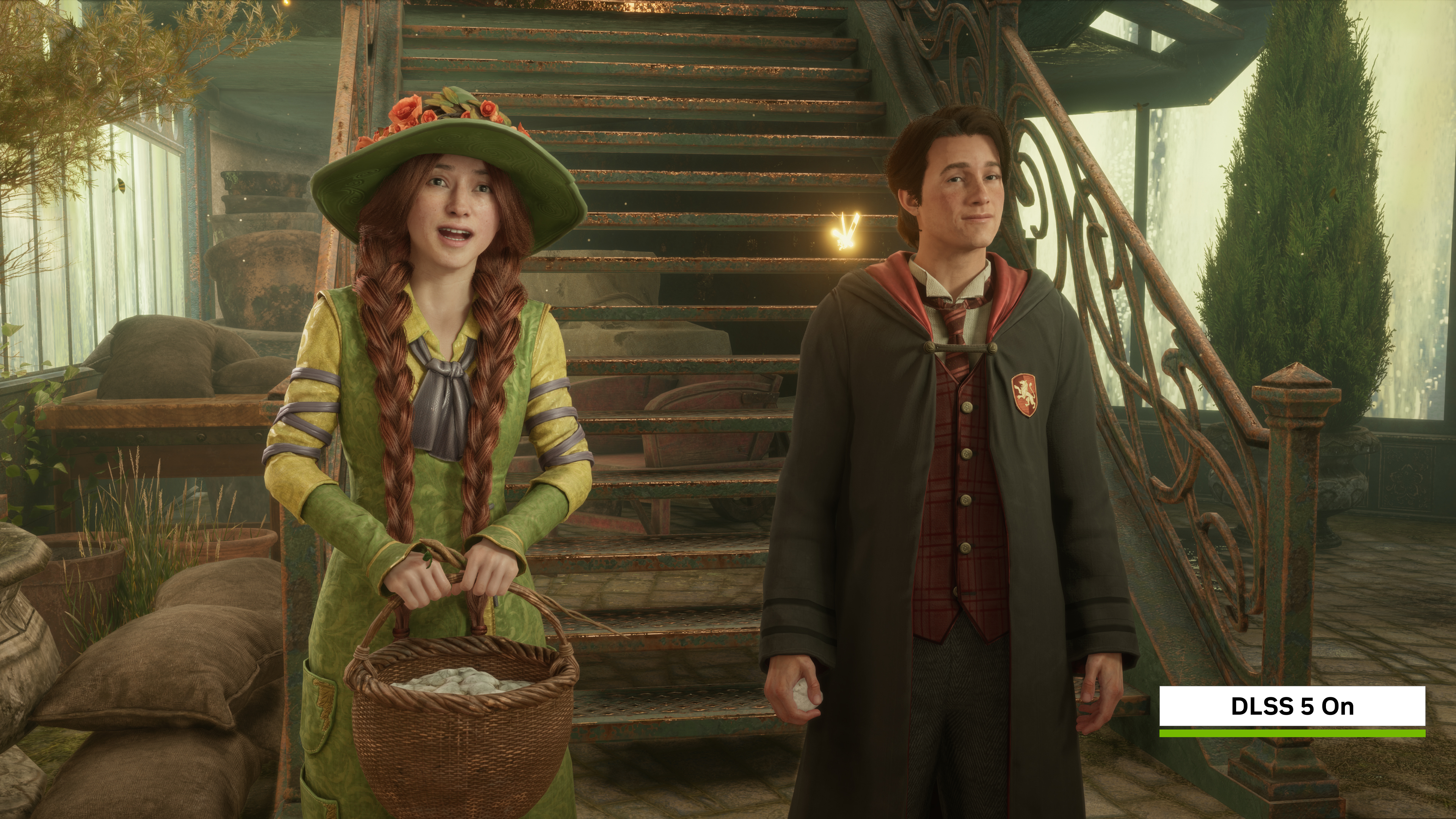
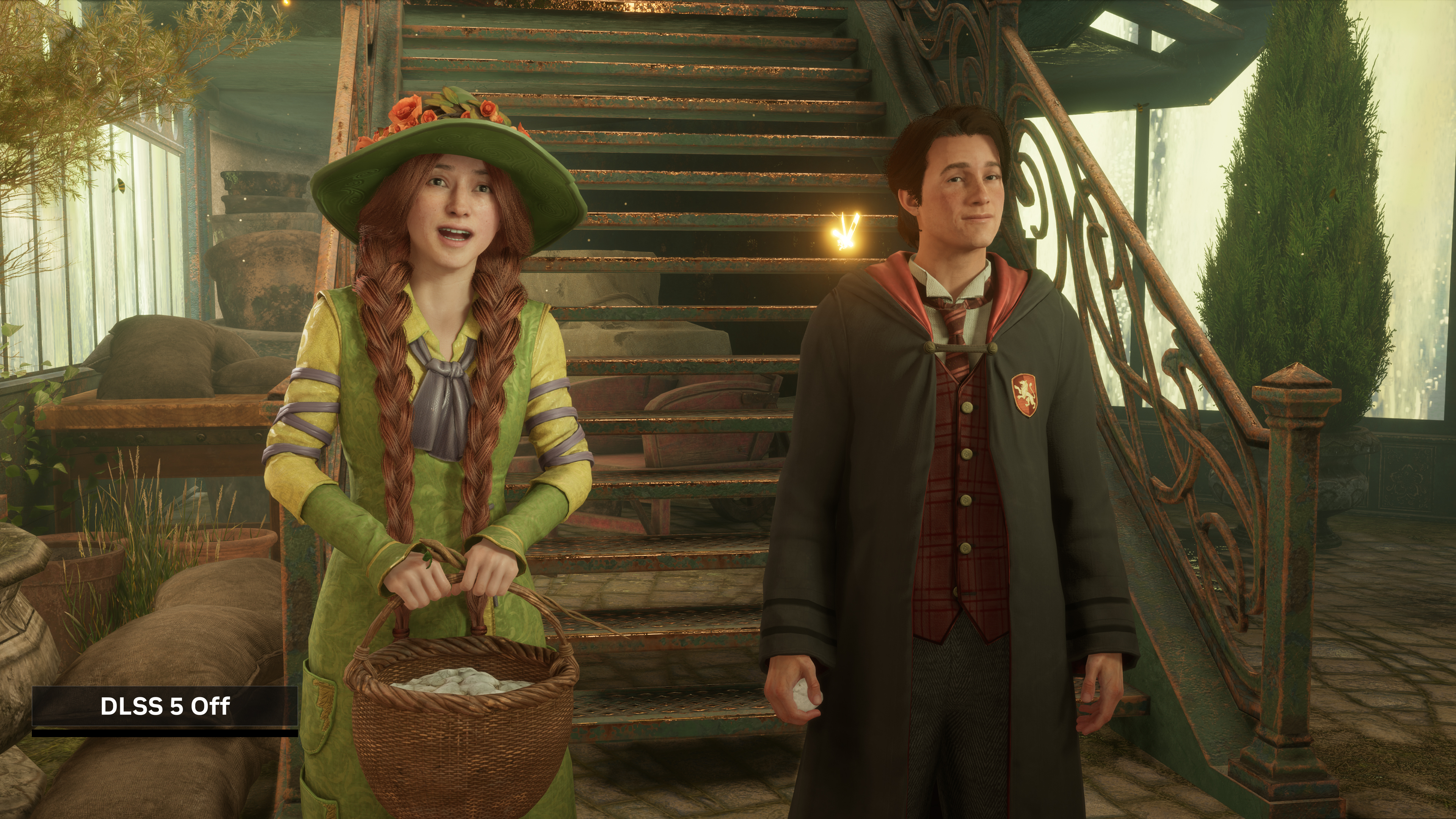
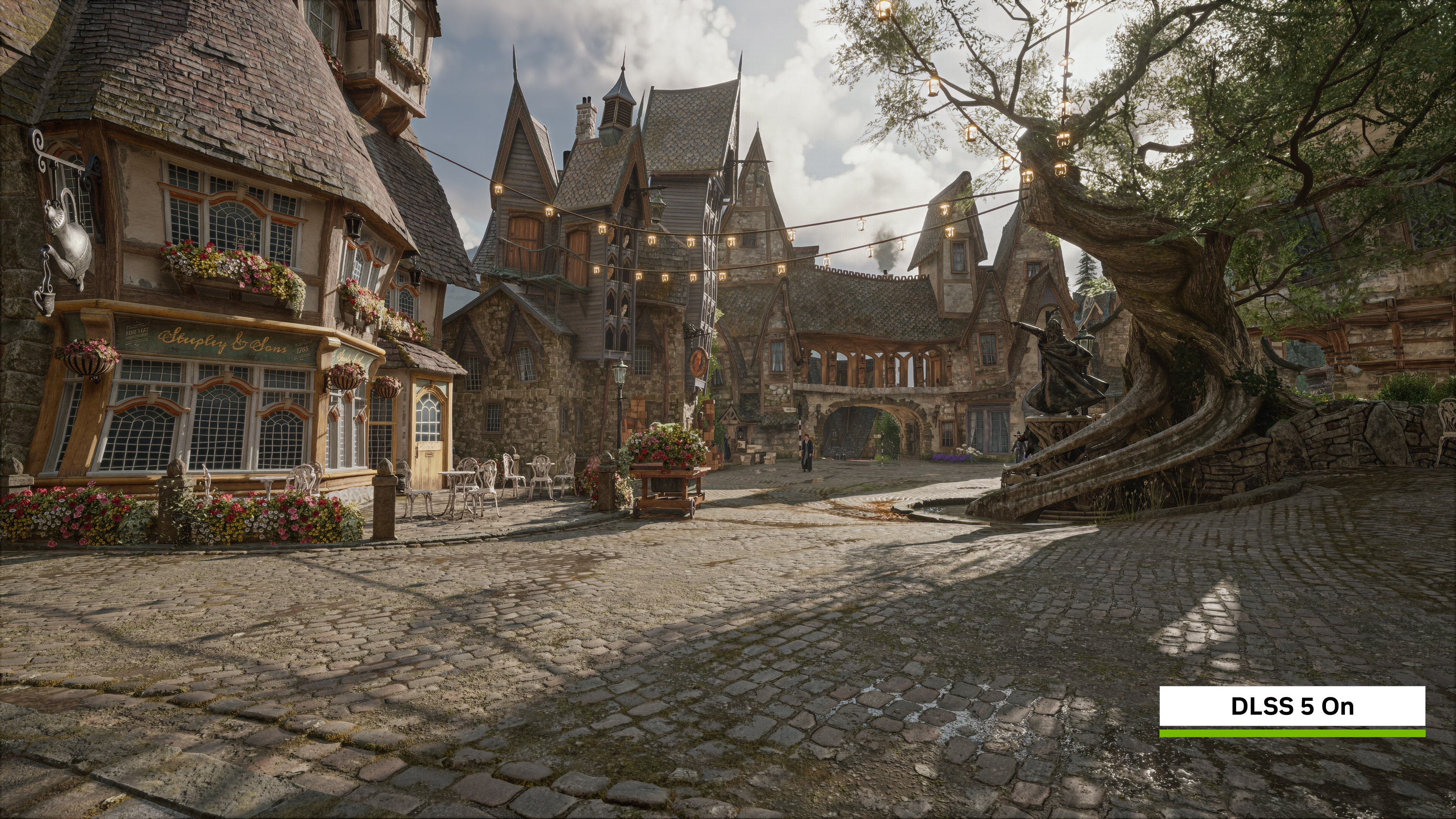
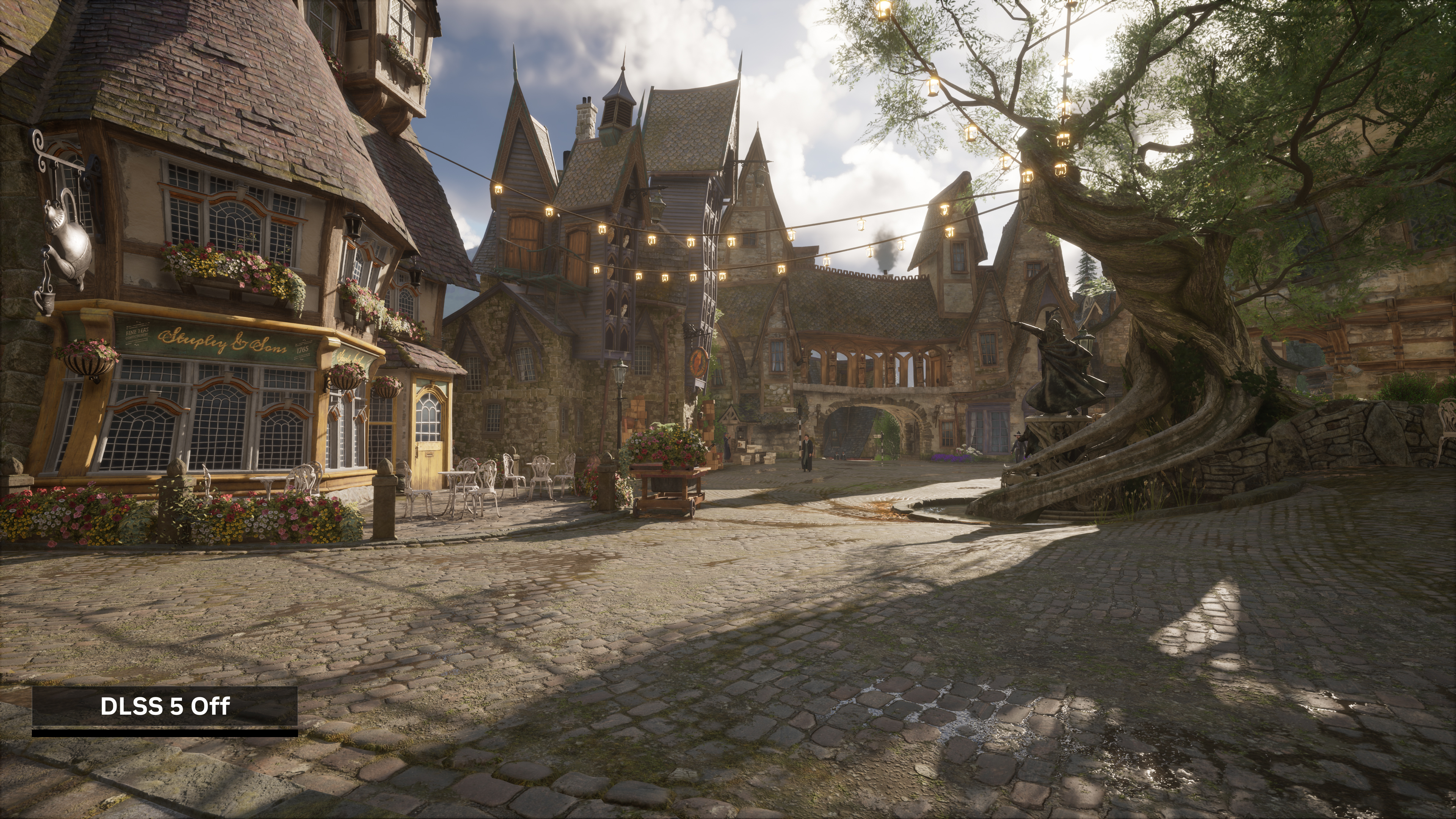
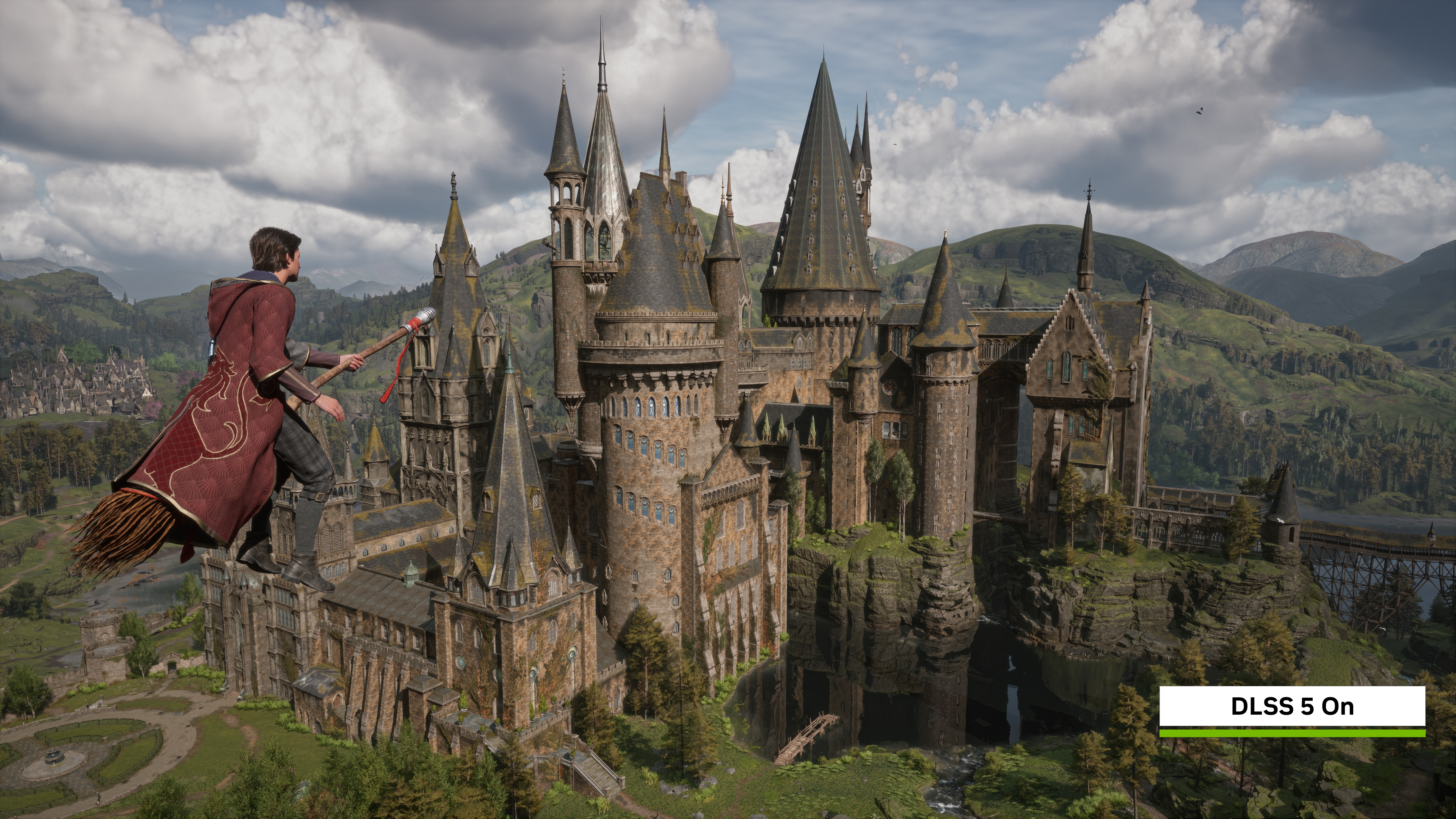
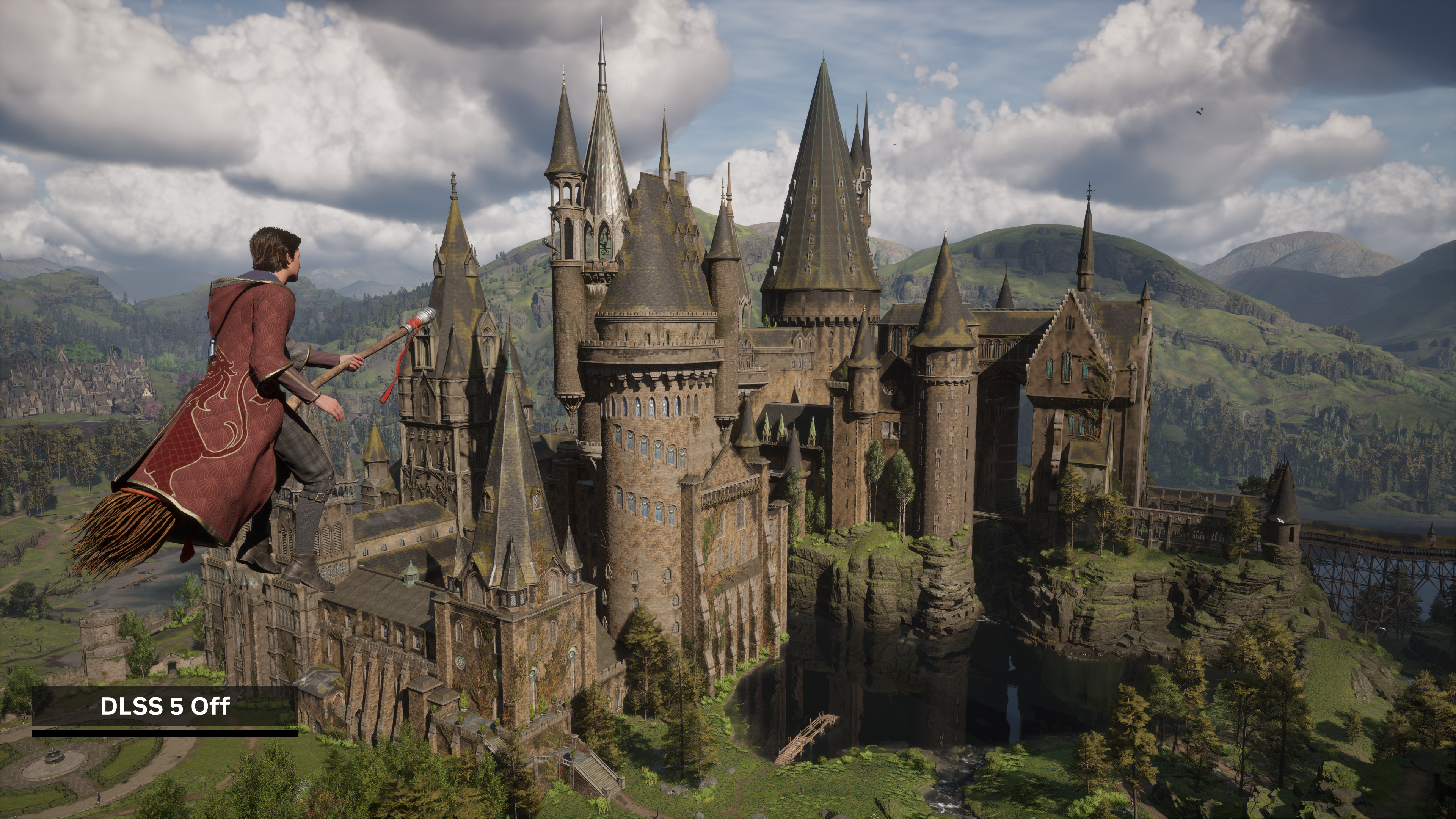
With the Neural Rendering option enabled, detail and shadows in environments are enhanced, texture detail on characters is improved, shading and lighting is refined, and reflections are more vibrant, as you can see in the interactive comparisons below.
Click here to load a fullscreen 4K comparison
In this scene of Hogsmeade, enabling DLSS 5 introduces more realistic lighting and materials in the entire scene. The steep, weathered roofs exhibit significantly enhanced texture clarity, allowing elements like the creeping moss to physically pop out against the shingles with realistic structural depth. Furthermore, the vibrant window boxes and potted flowers benefit from improved localized lighting, adding localized shadows that grounds the delicate foliage within the sunlit environment.
Click here to load a fullscreen 4K comparison
Enabling DLSS 5 introduces natural spatial depth with richer contact shadows inside recessed archways and deeper internal shading across the foliage. The sunlit stone walls exhibit enhanced local contrast within their crevices, making the structural masonry look physically grounded and highly textured.
Click here to load a fullscreen 4K comparison
Accelerate Your Hogwarts Legacy Experience With DLSS
With the addition of DLSS 3D-Guided Neural Rendering to Hogwarts Legacy, our complete suite of DLSS technologies will now be supported, enabling you to accelerate and enhance your experiences in the wizarding world.
For an optimal experience, we also recommend enabling DLSS Super Resolution under “Upscale Type”, DLSS Multi Frame Generation under “Frame Generation”, NVIDIA Reflex under “Low Latency Mode”, and “DLSS Ray Reconstruction” if you’re also activating Hogwarts Legacy’s immersive ray-traced effects.
Activating DLSS 3D-Guided Neural Rendering, 6X Multi Frame Generation, Ray Reconstruction, NVIDIA Reflex, and ray tracing, sees max setting Hogwarts Legacy run at 4K at up to 300 frames per second on the GeForce RTX 5090 delivering the definitive Hogwarts Legacy PC experience:

At 2560x1440, GeForce RTX Series gamers can experience max setting, ray-traced, DLSS 5-enhanced Hogwarts Legacy at up to 370 frames per second:
And at 1920x1080, GeForce RTX 50 Series gamers can experience Hogwarts Legacy with ray tracing, max settings, and DLSS 5 with 3D-Guided Neural Rendering:
Combined, DLSS 3D-Guided Neural Rendering, Ray Reconstruction, and Multi Frame Generation deliver higher frame rates and dramatically improved image quality for GeForce RTX gamers.
DLSS 5 Coming To War Thunder in Mid-November
Gaijin Entertainment’s War Thunder features thousands of high-fidelity, accurately rendered tanks and other ground military vehicles, planes, warships, and more, which players take command of in a variety of PvP and PvE arcade and realistic game modes. First released in 2013, War Thunder has been constantly updated, adding new technologies, effects, and enhancements, including DLSS 4.5 Multi Frame Generation, Super Resolution, Ray Reconstruction, DLAA, Reflex, ray tracing, and path-traced global illumination.
In just a few weeks, War Thunder’s Eagle's Shadow major update goes live, adding DLSS 5 with 3D-Guided Neural Rendering, dozens of new planes, ships, and tanks, along with cluster bombs for planes, and visual effect enhancements, increasing the realism and dynamism of battle.
With DLSS 5, Gaijin Entertainment was able to achieve even higher visual realism with improved highlights, refined shadows, and a new level of microcontrast that hadn’t been possible previously. The result is a more natural, lifelike image, with finer detail and a stronger sense of realism. Learn more in our interview with Gaijin.
Below, DLSS 5 significantly enhances ambient occlusion in this tank scene, casting deeper, more realistic shadows beneath the tank's tracks and draped camouflage netting. Lighting and material details are elevated throughout the image, from the heavy tank armor to the reflective, rain-soaked mud. Ultimately, these refinements grant the vehicle greater visual weight and depth under natural lighting, firmly grounding it within the atmospheric environment.
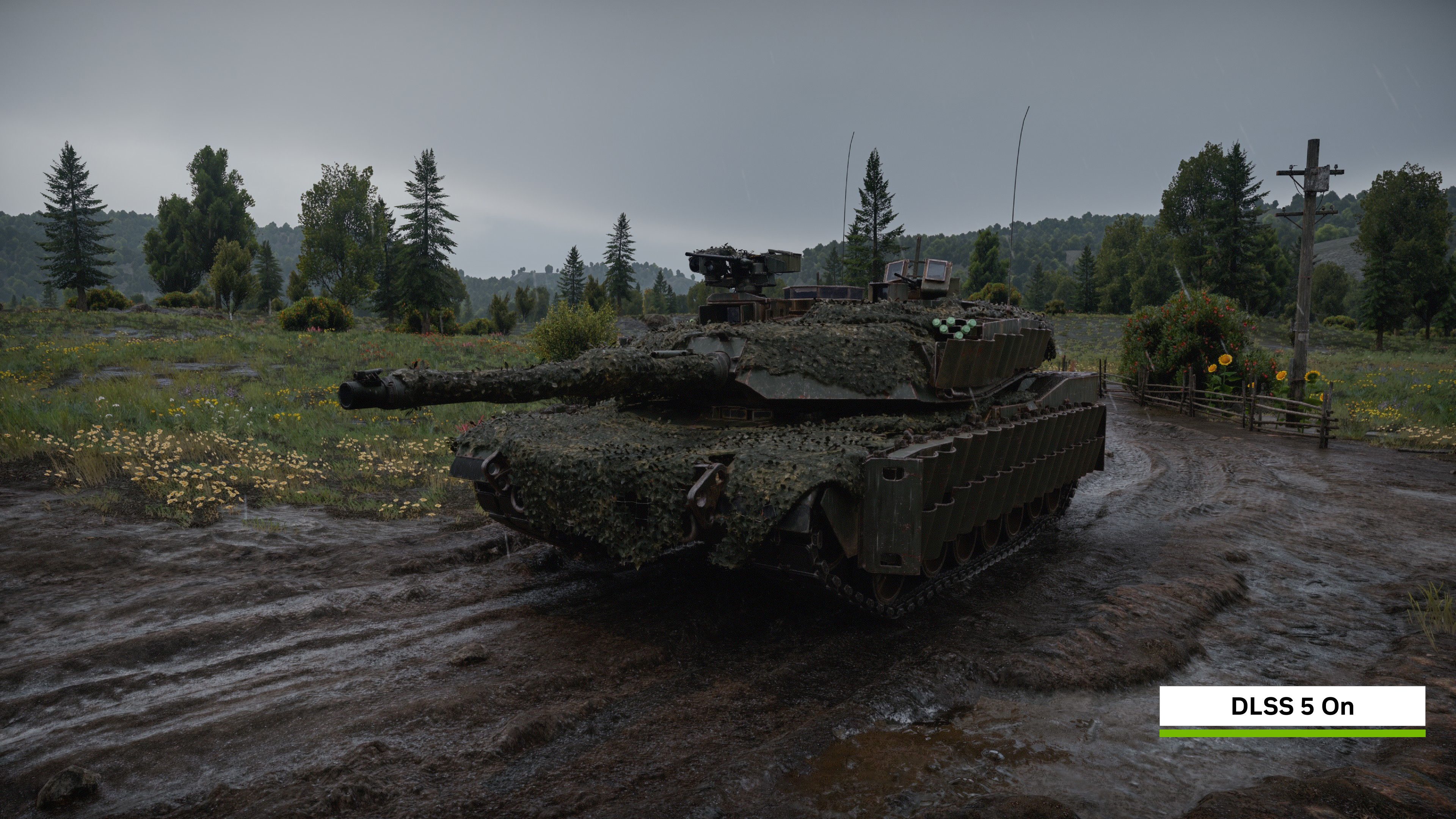
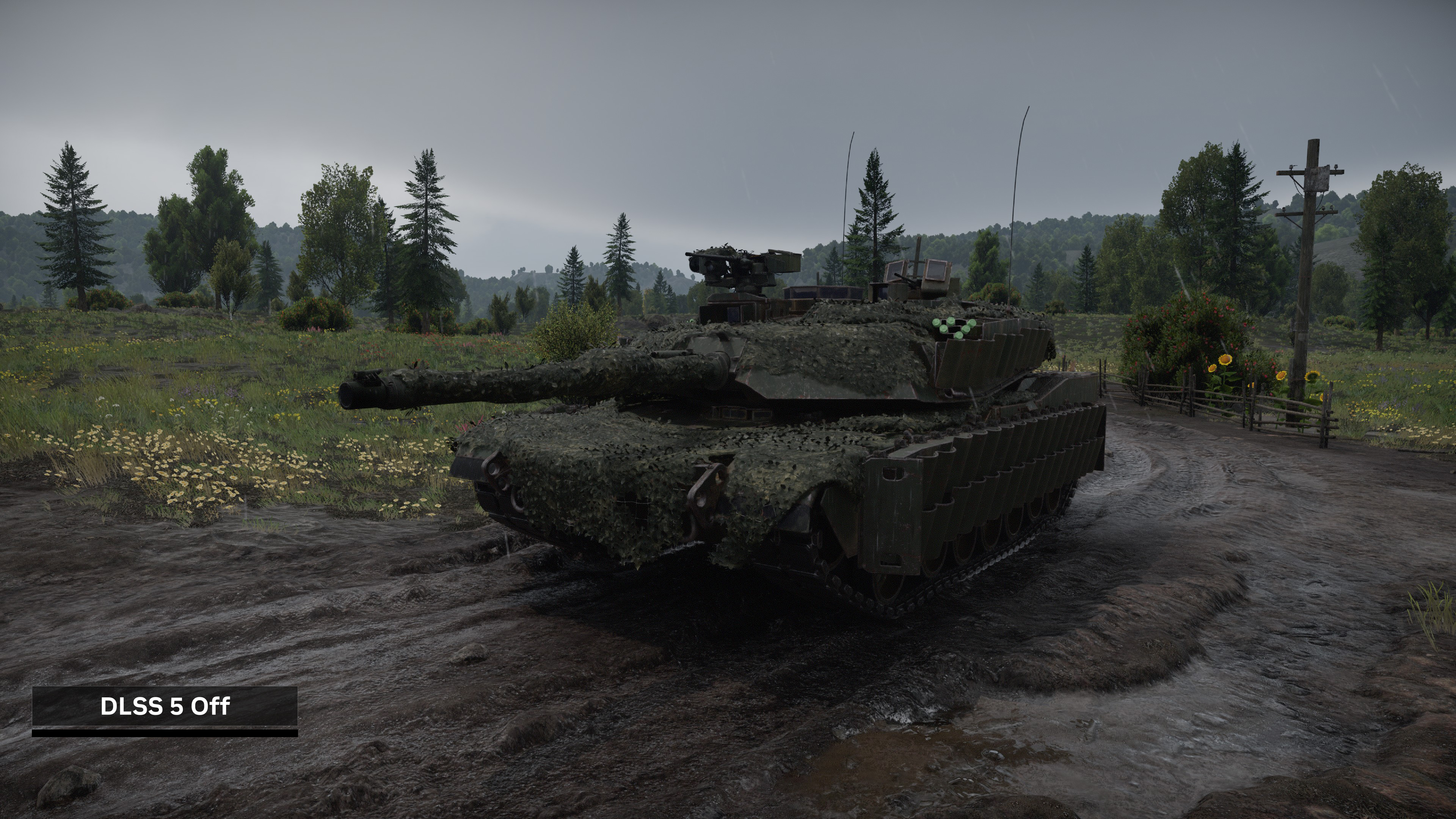
Click here to load a fullscreen 4K comparison
DLSS 5 elevates the visual fidelity of this naval scene, casting deeper, more accurate shadows across the destroyer's complex superstructure, deck fittings, and gun turrets. The lighting is especially striking during combat, as the intense anti-aircraft muzzle flash casts highly realistic reflections that catch the crests of the choppy ocean water. Altogether, these advanced lighting and shadow upgrades give the warship a heavier, more tangible presence, dramatically enhancing the overall realism of the game.

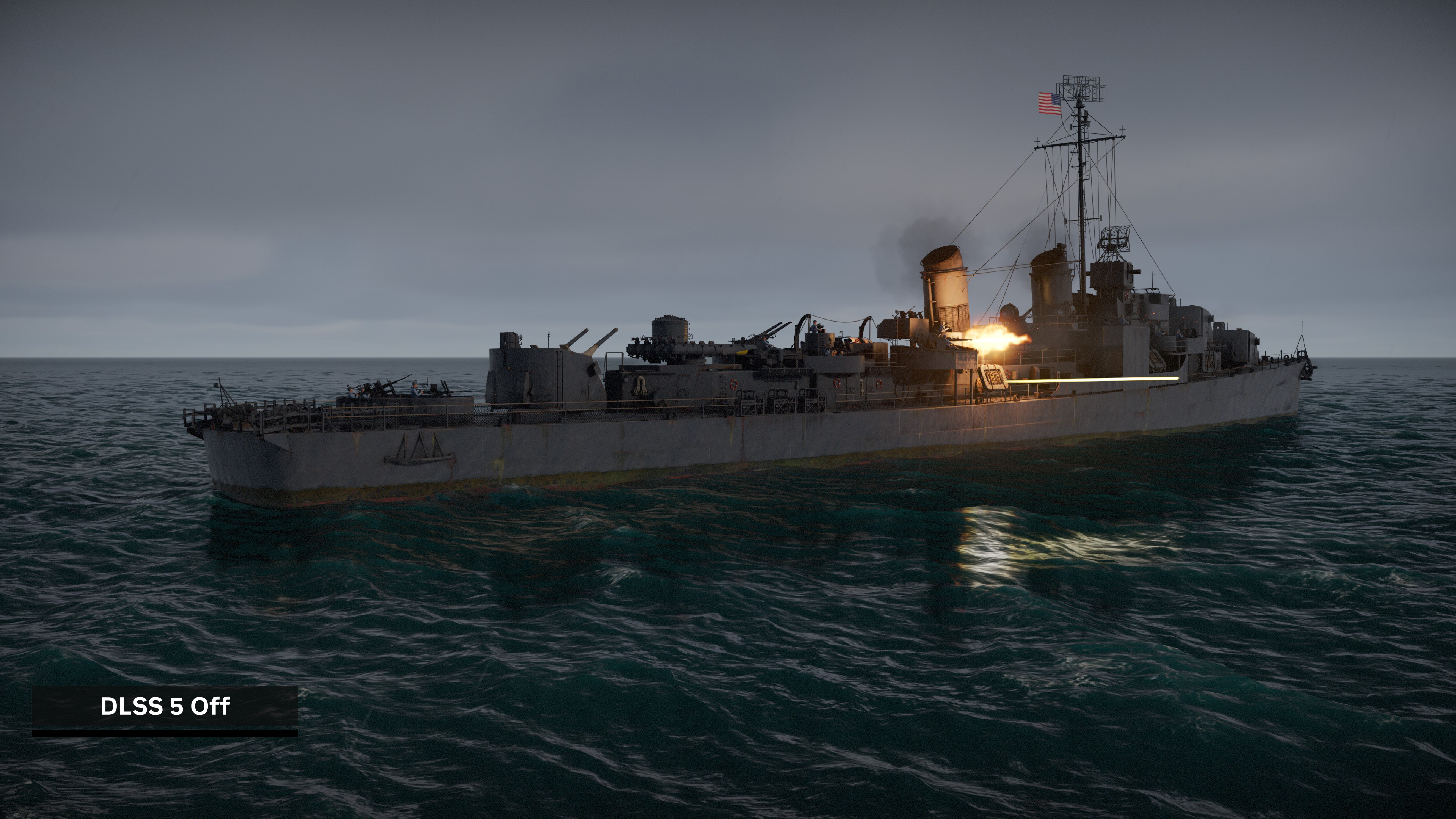
Click here to load a fullscreen 4K comparison
Gamers can play War Thunder with DLSS 3D-Guided Neural Rendering at high frame rates thanks to Ray Reconstruction and up to 6X Multi Frame Generation, even when using the Ultra preset, which includes path-traced global illumination lighting and several ray-traced effects.
At 4K, War Thunder with DLSS 5 runs at up to 400 frames per second in our ground battle benchmark:
At 2560x1440, GeForce RTX Series gamers can experience Ultra preset, path-traced, DLSS 5-enhanced War Thunder gameplay at up to 550 frames per second:
And at 1920x1080, GeForce RTX 50 Series gamers can experience War Thunder with path tracing and DLSS 5 with 3D-Guided Neural Rendering at fast frame rates:
On GeForce RTX 5090 Laptop GPUs, DLSS Ray Reconstruction, 6X Multi Frame Generation, and other RTX enhancements enable on-the-go, DLSS 5-enhanced, High preset, path-traced, 2560x1440 War Thunder gameplay at up to 300 frames per second:
And at 1920x1080, GeForce RTX 50 Series Laptop GPUs can run War Thunder with DLSS 5 3D-Guided Neural Rendering at up to 490 frames per second:
DLSS 5 Coming To Where Winds Meet On November 23rd
Where Winds Meet is a Wuxia open-world action-adventure RPG developed by Everstone Studio, offering a stunning open world, engaging action-adventure gameplay, deep RPG progression, and long-term free live-service updates for players. It has more than 100 million players worldwide and has reached a peak of over 250,000 concurrent players on Steam, currently holding a Steam rating of Very Positive (with over 116,000 reviews and still climbing).
Where Winds Meet includes support for DLSS Multi Frame Generation and Super Resolution, and on November 23rd support for DLSS 5 with 3D-Guided Neural Rendering will be introduced, further enhancing its world and characters.


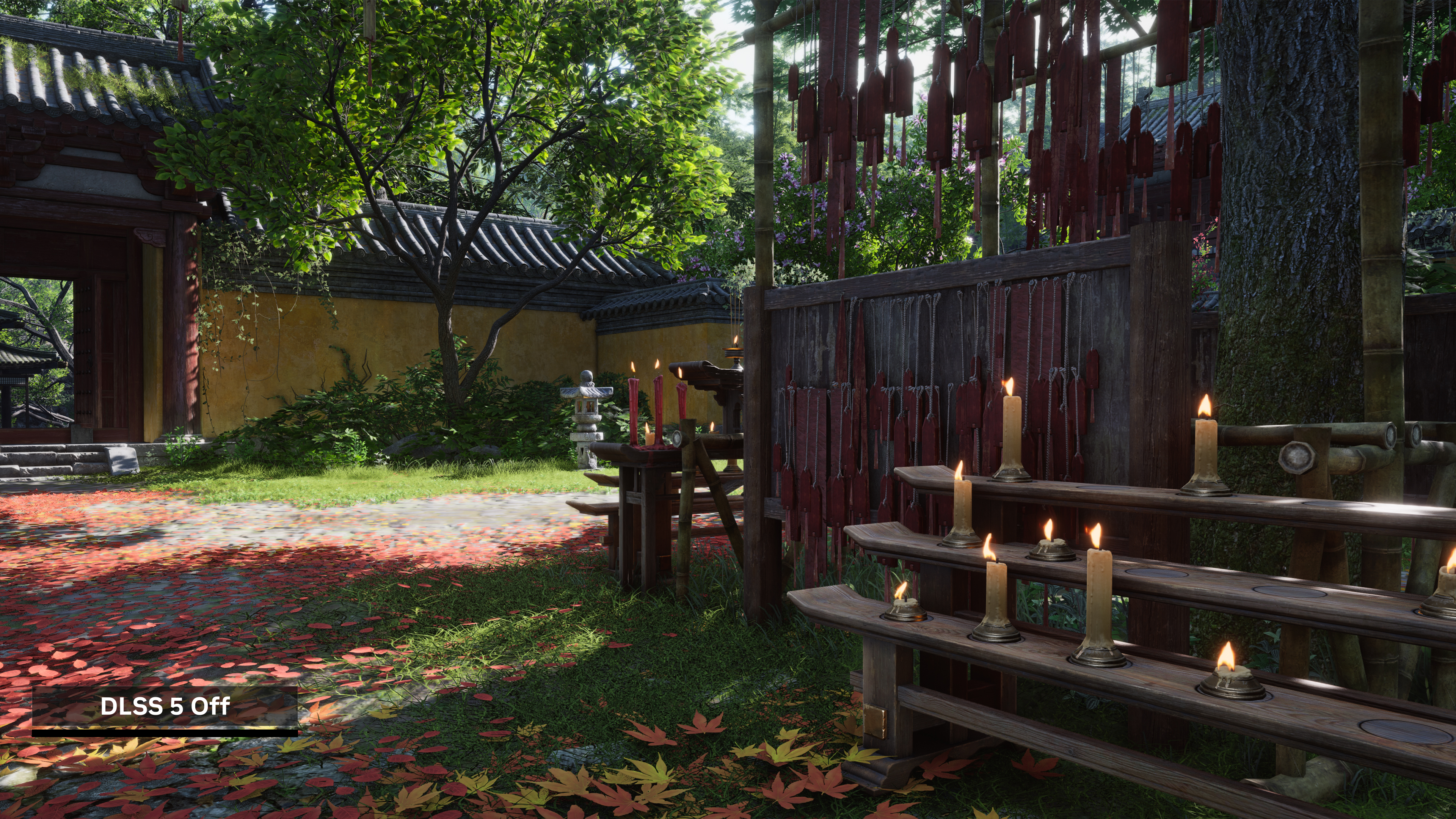
Click here to load a fullscreen 4K comparison
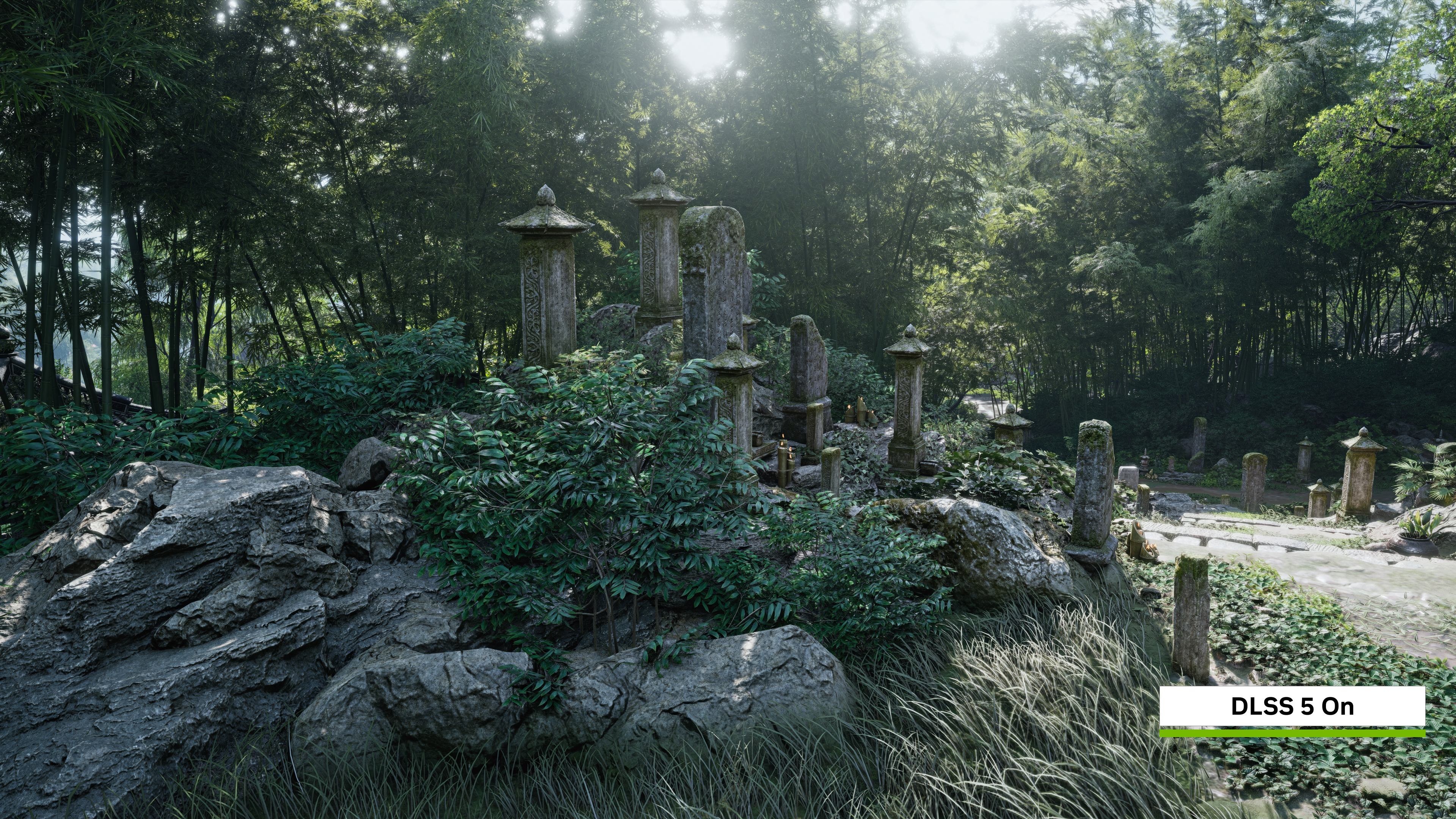
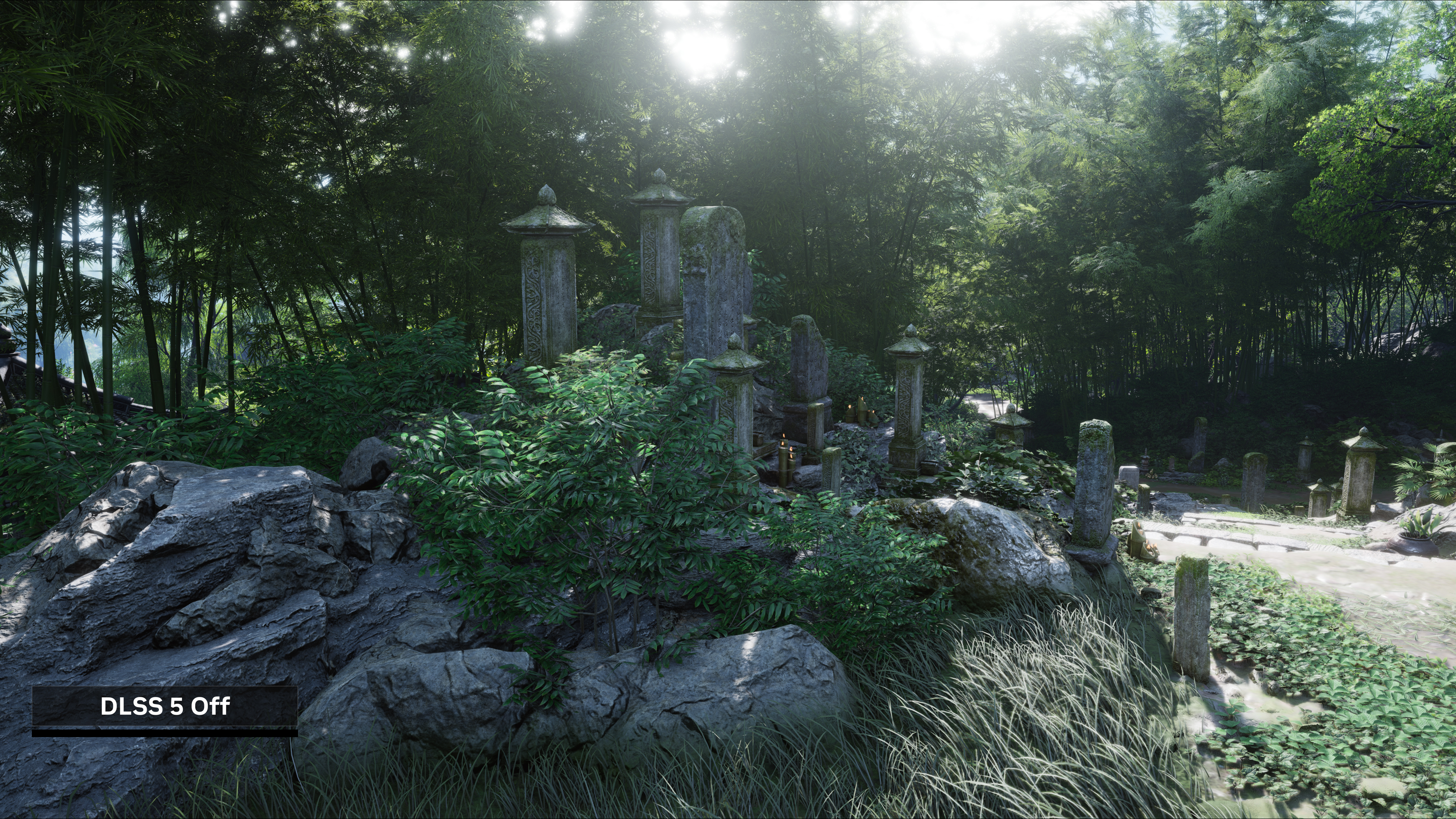
Click here to load a fullscreen 4K comparison
DLSS 5 Evolution Continues
Since the initial announcement of DLSS 5 in March, our progress has been rapid: from running on dual GeForce RTX 5090s to now a single graphics card, we’ve achieved a 10X performance gain in just seven months, making DLSS 5 available for all GeForce RTX 50 Series GPUs, RTX Spark devices, and streaming for GeForce NOW Ultimate members. This milestone stems from a combination of systematic pipeline optimizations, and neural model refinements that yield both faster execution and better image quality.
Hogwarts Legacy, War Thunder and Where Winds Meet will all launch with our October 2026 Neural Rendering model, which shrank DLSS 5’s footprint by 24% to roughly 118 million parameters, while reducing 4K VRAM usage by 20%, increasing performance by 2X compared to the previous version, giving you an even better experience.
To experience DLSS 5 in Hogwarts Legacy, War Thunder and Where Winds Meet on GeForce and RTX Spark, get the games and download our upcoming Game Ready Driver, launching November 4th in the NVIDIA app, or play on GeForce NOW. And stay tuned to GeForce.com for upcoming announcements as more titles integrate DLSS 5 in the coming weeks and months.
Call of Duty®: Modern Warfare 4® 4 Season 1 Launches November 6th
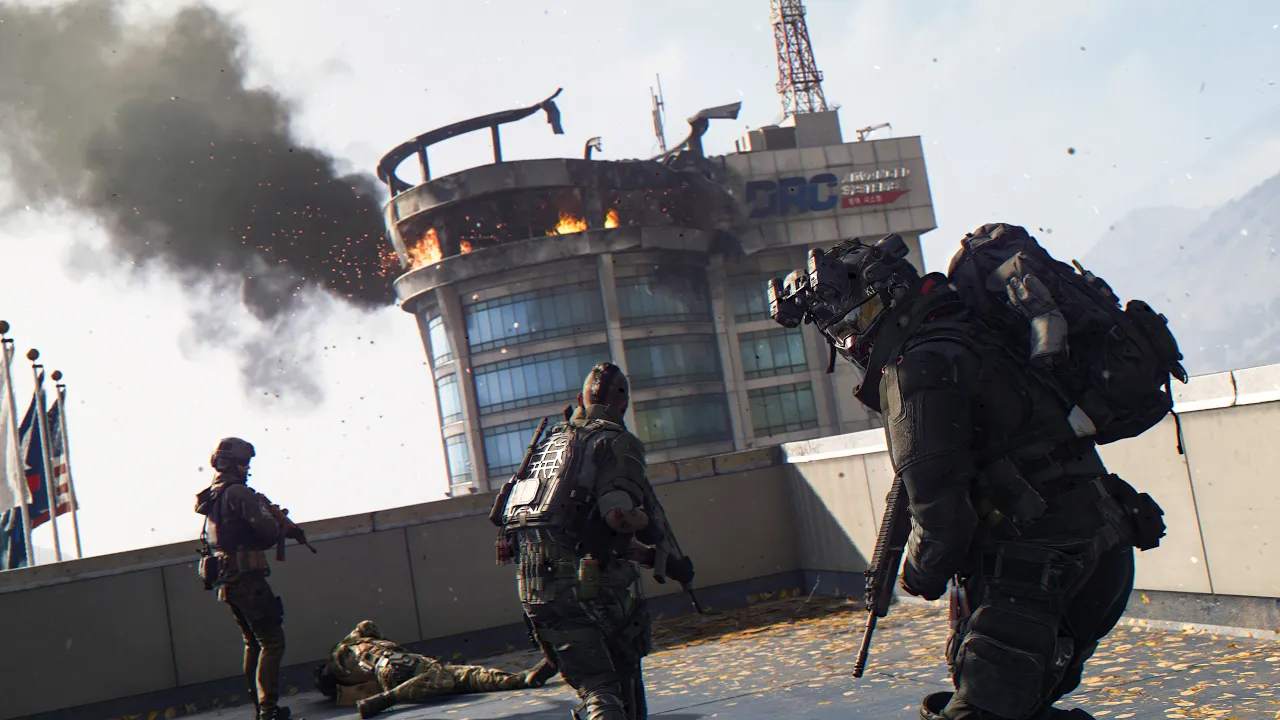
Get ready for Call of Duty®: Modern Warfare 4® Season 1, launching November 6th. Highlights include new maps and modes in Multiplayer, while in DMZ, the X01 Black Site opens up along with new enemies, orders, and more. Two new Call of Duty®: Warzone™ maps — Hajin and Zodiac — plus integration with Modern Warfare® 4 round out the colossal season of content.

- Video 1
- Video 2
In all modes, DLSS Super Resolution will accelerate gameplay and enhance image quality. On GeForce RTX 40 Series systems, DLSS Frame Generation will further boost frame rates. And on GeForce RTX 50 Series systems, players can activate DLSS Dynamic Multi Frame Generation, with up to 6X multiplication, offering an ideal balance between image quality and performance, perfect for maximizing frame rates.
Additionally, NVIDIA Reflex can be enabled on all GeForce RTX systems, further reducing PC latency, making gameplay even more responsive.
GRAVHOUNDS Available Now With DLSS 4.5
Octopus Panic’s GRAVHOUNDS is a 1-4 player co-op action builder featuring a cast of bio-engineered canine characters, including Dozer the bulldog. Drop into hostile planets as a pack, build and defend your base in physics-driven mayhem, and extract with everything you can carry before you become alien chow! The longer you stay, the greater the danger, and the rewards.
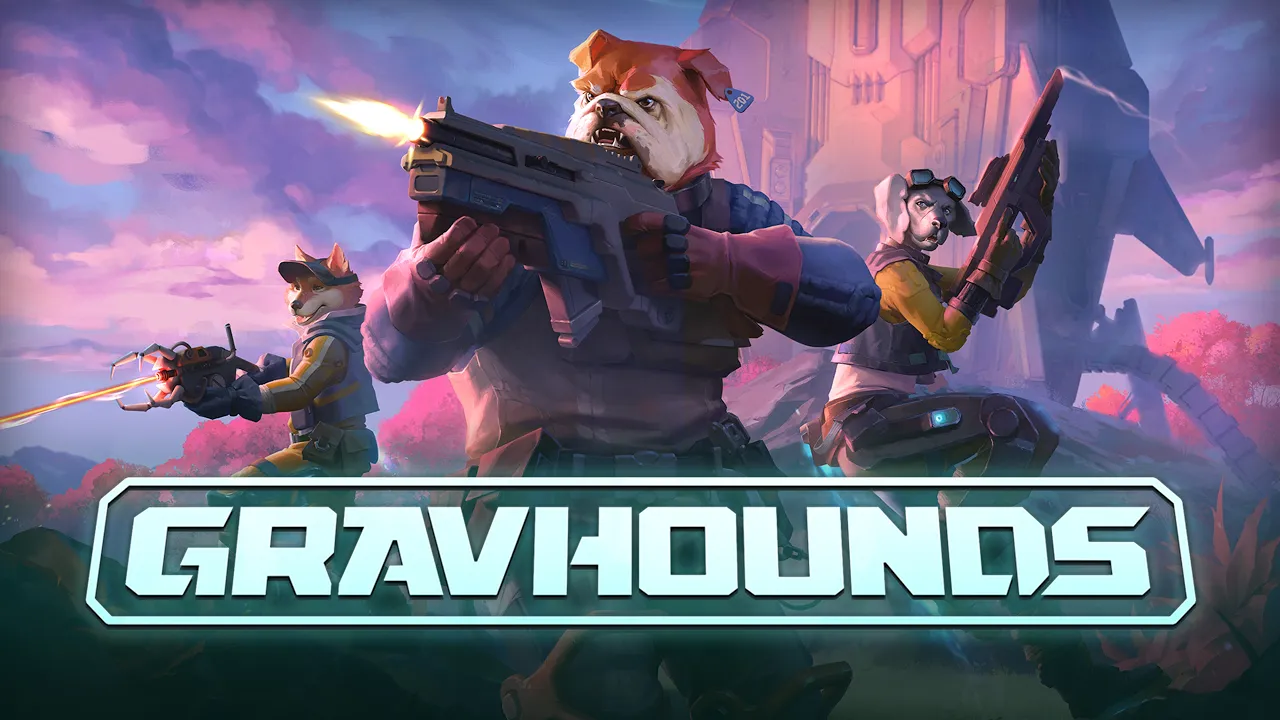
GRAVHOUNDS entered into Early Access yesterday for GeForce RTX and RTX Spark systems, featuring a suite of DLSS 4.5 technologies, including Super Resolution, Dynamic Multi Frame Generation, DLAA, Reflex, and a native in-game integration of RTX Dynamic Vibrance, an AI-powered filter debuted in the NVIDIA app that enhances color saturation, contrast and clarity.
Activate this suite of technology to accelerate performance, enhance image quality, reduce PC latency, and to increase the vibrancy of the action-packed game’s visuals.
Hunting Simulator 3 Available Now With DLSS 4.5 & Ray Tracing
Nacon’s Hunting Simulator 3 offers players an authentic hunting experience, exploring vibrant nature across Colorado and Texas to hunt over 35 digital recreations of native animal species. This new entry in the series, which has over 2 million players worldwide, retains the core features appreciated by the community while offering new gameplay features and improvements, all developed on Unreal Engine 5, revealing the full richness and beauty of the game’s environments.

Hunting Simulator 3 launched last week with the complete suite of DLSS 4.5 technologies, including Ray Reconstruction, Super Resolution, Dynamic Multi Frame Generation, DLAA, and Reflex, accelerating and enhancing its hardware-accelerated, ray-traced Lumen lighting, and reducing PC latency to further increase responsiveness.
DLSS 4.5 Unreal Engine Plugin
The updated NVIDIA DLSS 4.5 plugin for Unreal Engine gives developers powerful tools for delivering sharper images and smoother gameplay. Its second-generation transformer model for Super Resolution improves image stability, anti-aliasing, and visual clarity, while Ray Reconstruction enhances ray-traced image quality.
On supported GeForce RTX 50 Series and RTX PRO Blackwell GPUs, Dynamic Multi Frame Generation adapts the frame-generation multiplier as workloads change, with 6X Multi Frame Generation producing up to five additional frames per rendered frame. Download now.
Head Back Soon For Even More RTX Games
There are even more DLSS integrations arriving soon for a whole host of games. Return regularly for a rundown of the next DLSS and RTX titles to GeForce RTX and RTX Spark systems, and head here to see the full list of over 1,000 RTX-enhanced games and apps, along with a list of all games and apps with verified support for NVIDIA app’s DLSS overrides.