NVIDIA DLSS 5 Available Now: 3D-Guided Neural Rendering Debuts In NBA 2K27 For All GeForce RTX 50 Series GPUs, And On GeForce NOW
NVIDIA has continuously redefined the boundaries of PC gaming. From introducing real-time ray tracing to pioneering AI-powered graphics with DLSS Super Resolution, Frame Generation and Ray Reconstruction, our RTX technologies have transformed how games are rendered and experienced.
Now, we’re releasing DLSS 5, which introduces 3D-Guided Neural Rendering, a major step forward in using AI to bring real-time graphics closer than ever to Hollywood-grade photorealism.
Watch how DLSS 3D-Guided Neural Rendering and its artistic controls work from Edward Liu, NVIDIA’s Director of Applied Deep Learning Research, and Gabriele Leone, Director of Content Technology
DLSS 5 is available starting now in NBA 2K27, from developer Visual Concepts and publisher 2K, for all GeForce RTX 50 Series GPUs and laptops, and GeForce NOW. It marks the debut of how the technology can be used by game artists to elevate visual fidelity in alignment with their creative vision.
“What’s great is the level of control that it gives us. We can set the overall tone and style to match our existing art direction and then really get precise where it matters most, using a per pixel uplift control mask to fine tune detail on characters. Given that we want to respect their likeness with the utmost care.” - Peter Kavic, Senior Producer - Visual Concepts
2x NBA All-Star and Olympic gold medalist Tyrese Haliburton recently joined NVIDIA GeForce Evangelist Jacob Freeman to get a first look at DLSS 5 in NBA 2K27. Check out what he had to say about his lifelike game appearance in the clip below:

Bridging The Cinematic Gap
Since the dawn of GeForce, NVIDIA has strived to deliver the graphics horsepower required for game developers to create incredible, realistic worlds where lighting, reflections and shadows obey the laws of nature.
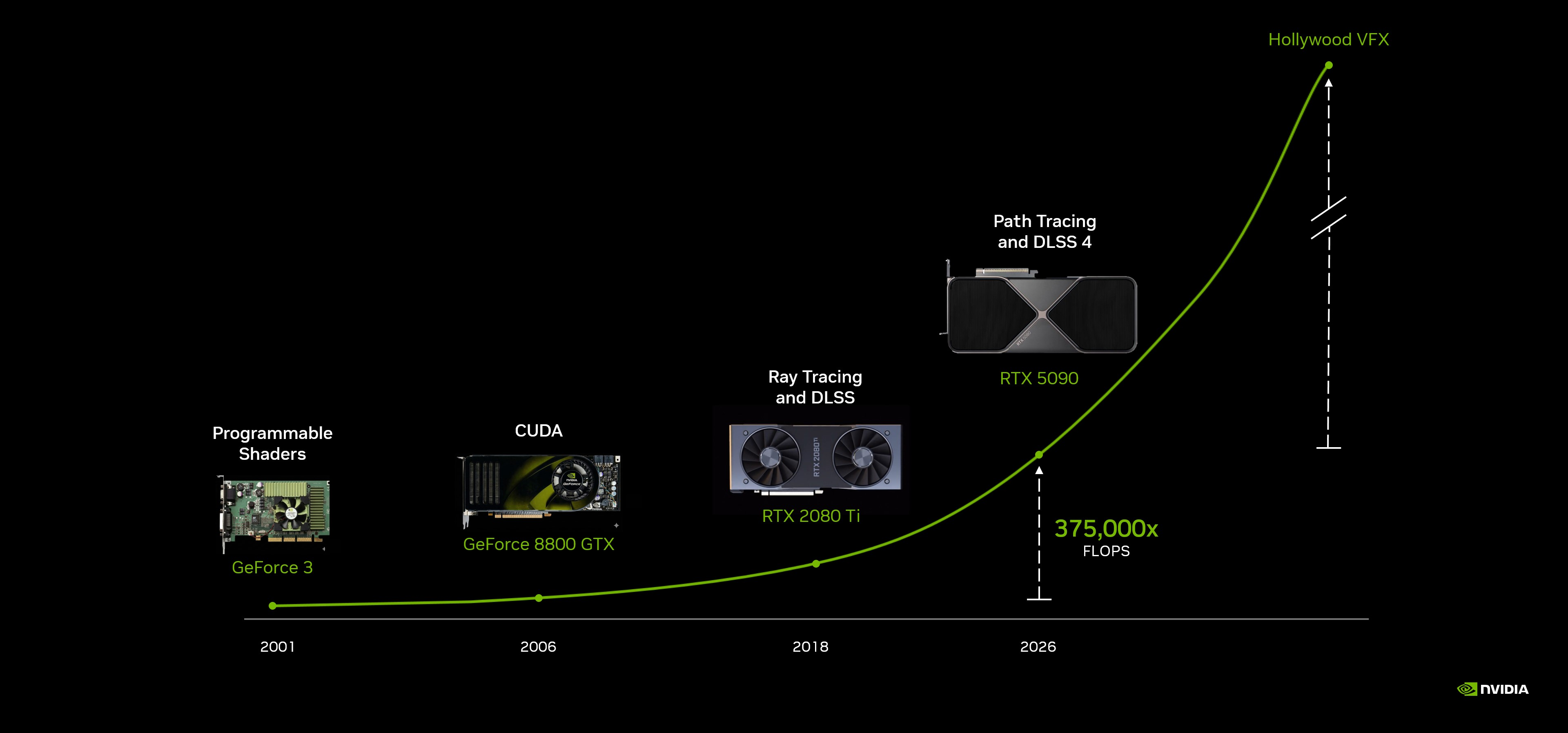
From programmable shaders with GeForce 3 in 2001, to CUDA with GeForce 8800 GTX in 2006, real-time ray tracing with GeForce RTX 2080 Ti in 2018, and path tracing and neural shaders with GeForce RTX 5090 in 2025, we have delivered major architectural innovations and a massive 375,000X increase in compute.
But Hollywood-level realism remains out of reach. A photoreal Hollywood VFX frame can take hours or even days to render a single frame, whereas game developers need to deliver 60-plus frames every second for a smooth experience. As a result, game developers have traditionally had to scale back their artistic vision to achieve real-time performance. Even if the developer could shoot an infinite number of rays, the rendered frame still wouldn’t be photorealistic because the scene content itself must be cut back. For example, individual hair strands are replaced by simplified geometry, and complex, multi-layered materials like skin lose their natural depth.
Rather than brute force rendering each frame or adding more details to the scene, an alternative approach to photorealism emerged: generative AI.
By learning complex lighting patterns from the physical world, generative models can produce photoreal lighting effects that traditional rendering struggles with, such as how hair glows when backlit, or how light naturally scatters through complex, multi-layered materials like human skin.
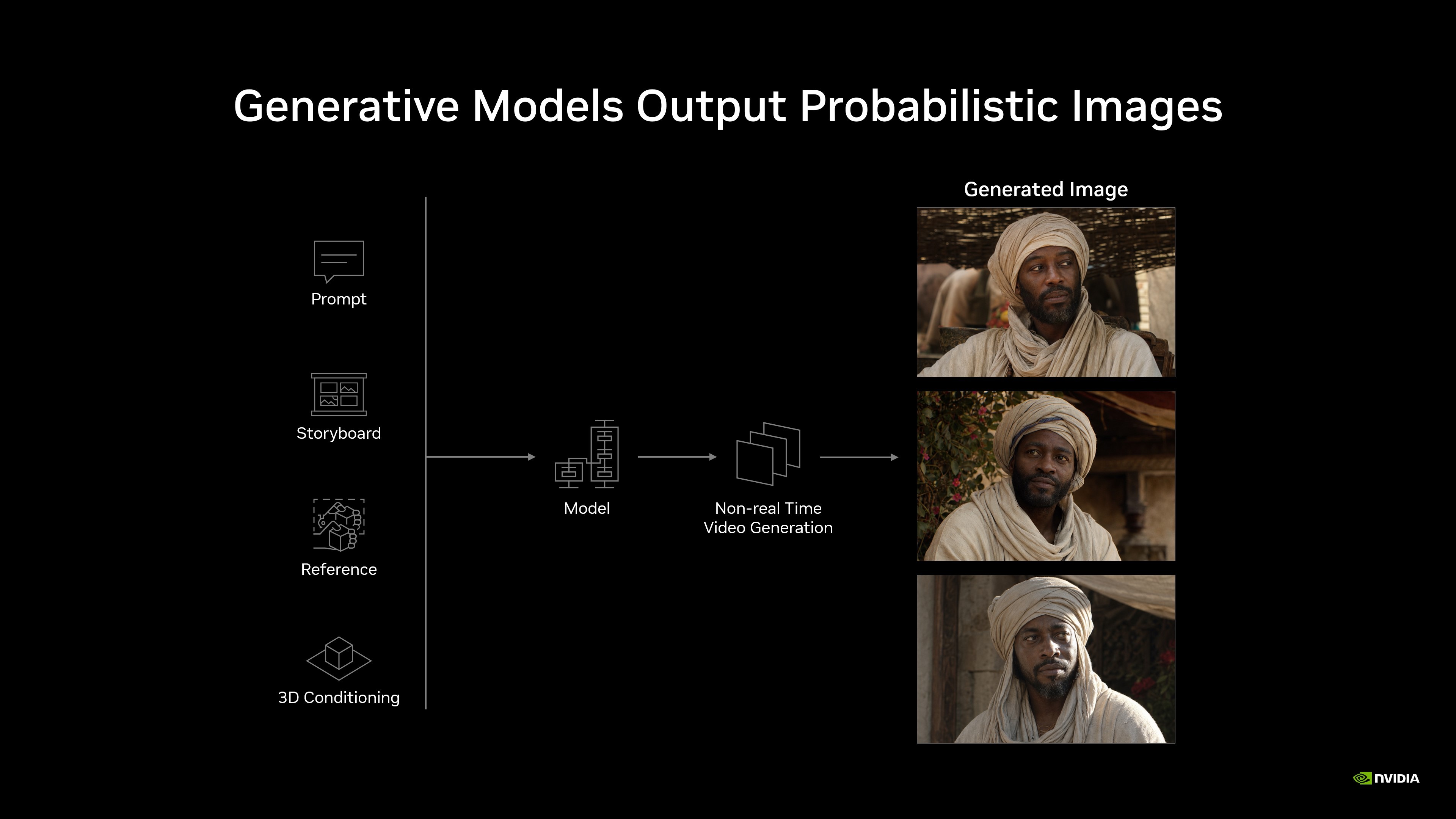
But traditional generative models are large, slow, and inherently probabilistic: when given a text prompt ten times, a standard diffusion model outputs ten completely different results. That unpredictability works for offline image creation where an artist can select their favorite result, but interactive games demand absolute pixel consistency, locked character identity, and frame-to-frame stability dependent on player input. This unpredictability is not viable for gaming, where a character’s face, or environment cannot randomly morph from one millisecond to the next.
DLSS 5 Introduces 3D-Guided Neural Rendering
First released in 2018, NVIDIA DLSS became the industry standard in using AI to boost performance, initially with Super Resolution, followed by Frame Generation and Multi-Frame Generation. Combined, today’s suite of DLSS 4.5 technologies can use AI to draw 23 out of every 24 pixels seen on the screen.
Now, DLSS is evolving beyond performance to transform visual fidelity as well. While previous DLSS technologies focused on reconstructing existing scene data to deliver higher-resolution images, additional frames, or cleaner ray-traced lighting, DLSS 5 with 3D-Guided Neural Rendering takes the next step by using AI to generate the rich lighting and material details that real-time performance constraints once forced developers to strip away, allowing them to realize their original artistic vision.
And instead of generating frames from text prompts, 3D-Guided Neural Rendering uses the game engine’s rendered frame, complete with its artist-designed geometry, textures, and lighting buffers, as an unyielding foundation. DLSS 5 becomes the final rendering stage of the graphics pipeline, infusing scenes with lifelike lighting and materials while ensuring the engine frame defines what must remain, and the artist directs what may change.
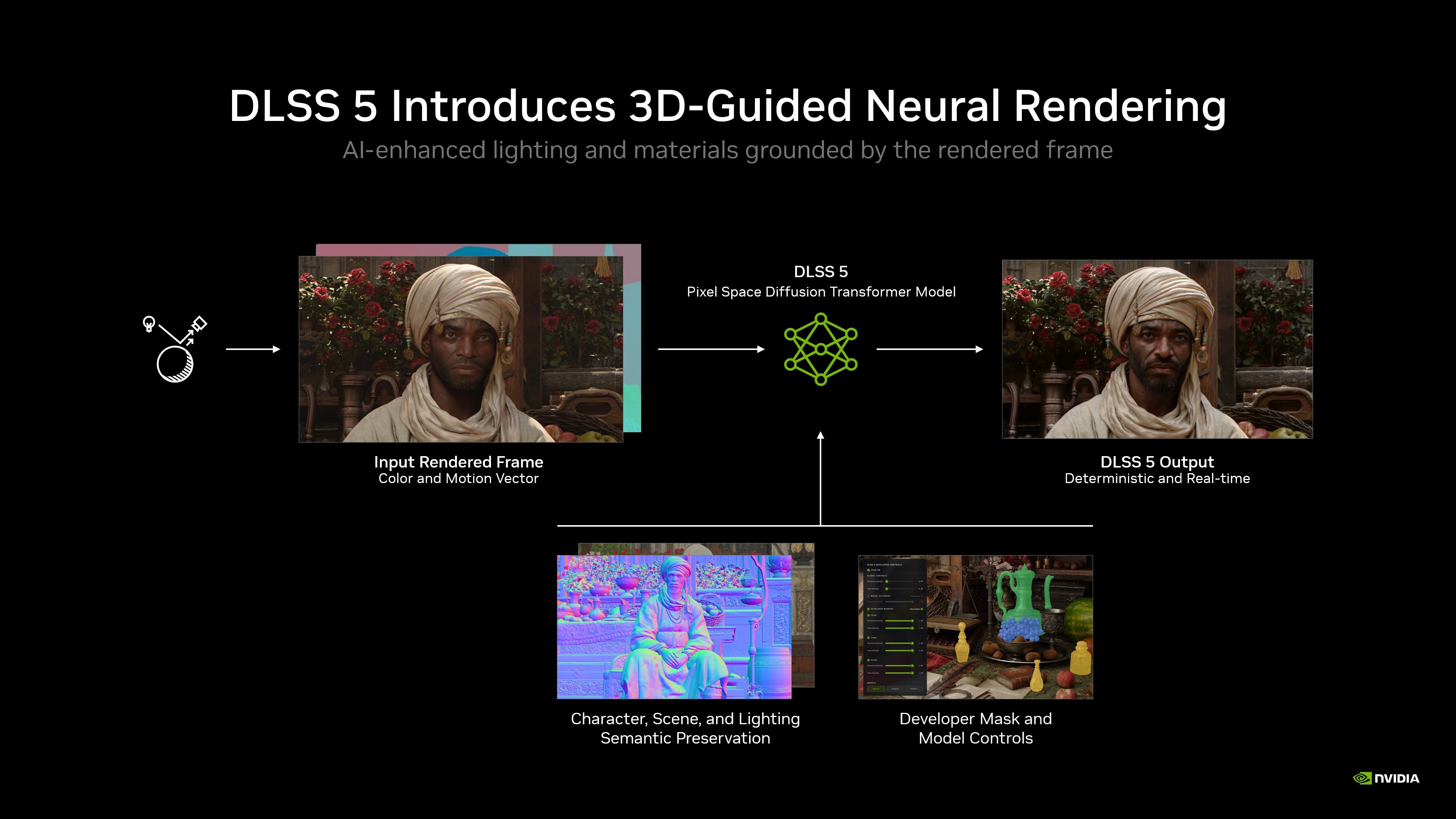
DLSS 5 takes a frame’s color and motion vectors as input to deliver lifelike lighting and materials that are deterministic, temporally stable and anchored to the game’s content
To deliver DLSS 5, we had to invent a new real-time AI model, which addressed three fundamental engineering challenges: preserving artistic intent, guaranteeing temporal stability, and achieving execution speeds in the milliseconds.
First, DLSS 5 is designed to operate deterministically, delivering consistent outputs when processing identical input frames. Grounded in the original frame crafted by artists and the game engine, the model analyzes on-screen objects, materials, spatial relationships, and light sources. It anchors directly to the rendered frame, by training to recognize engine data such as color, surface albedo, detailed lighting, and surface normals.
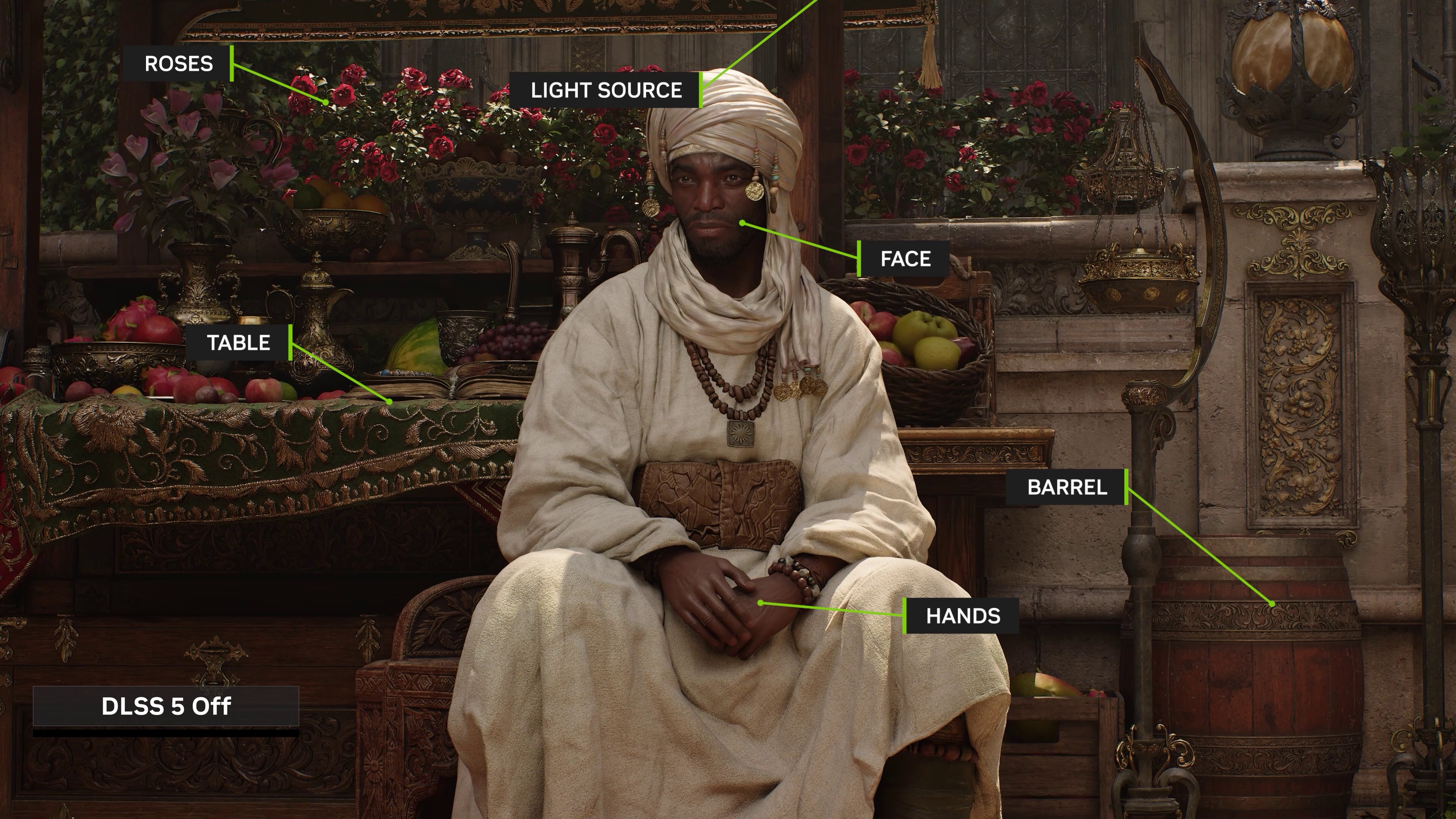
DLSS 5 recognizes object-level scene semantics like objects, materials, and light sources
As a result, DLSS 5 enriches the scene with lifelike material interactions, introducing natural skin subsurface scattering, realistic light transmission through hair and foliage, and deeper contact shadows alongside global illumination.
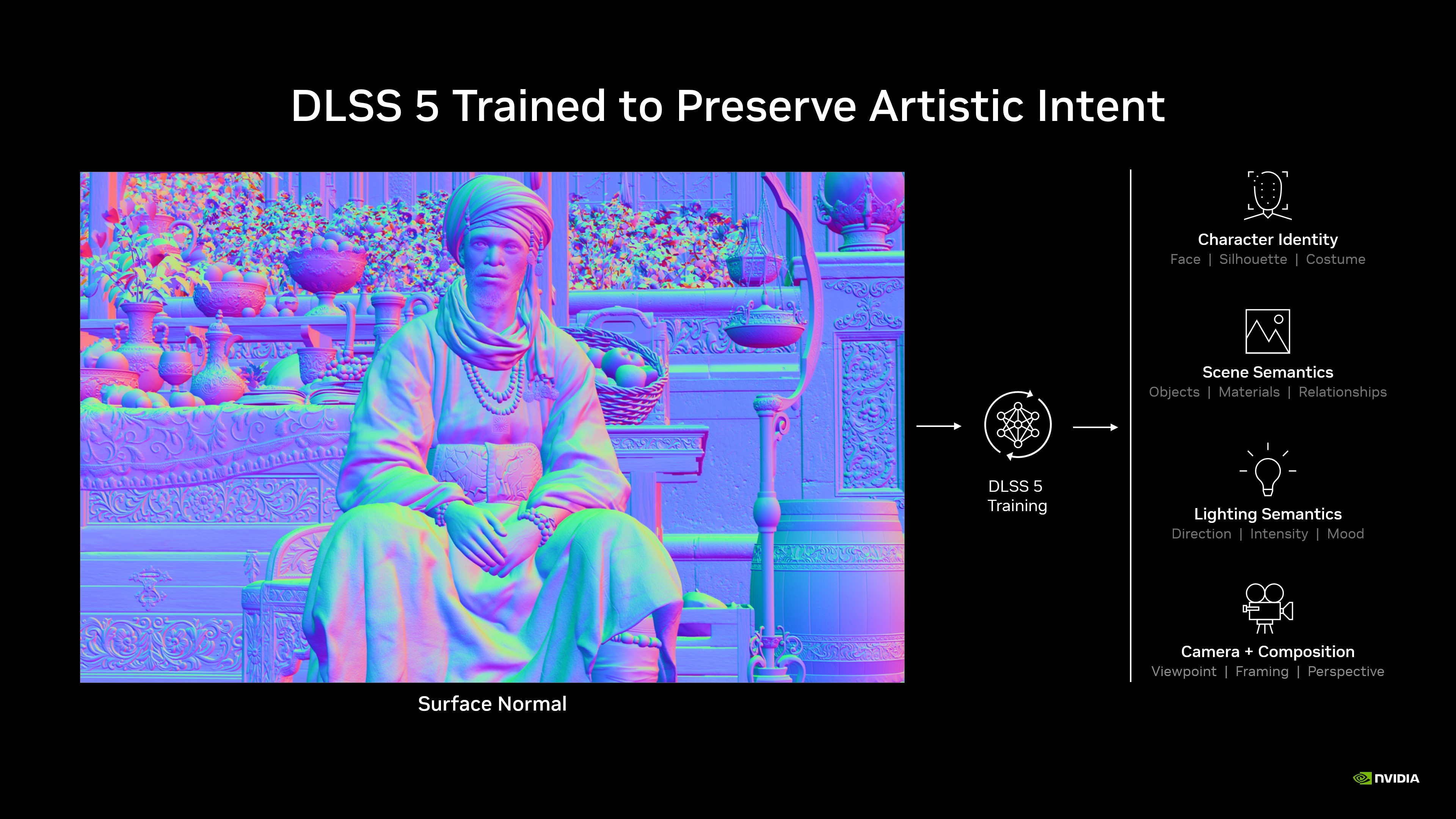
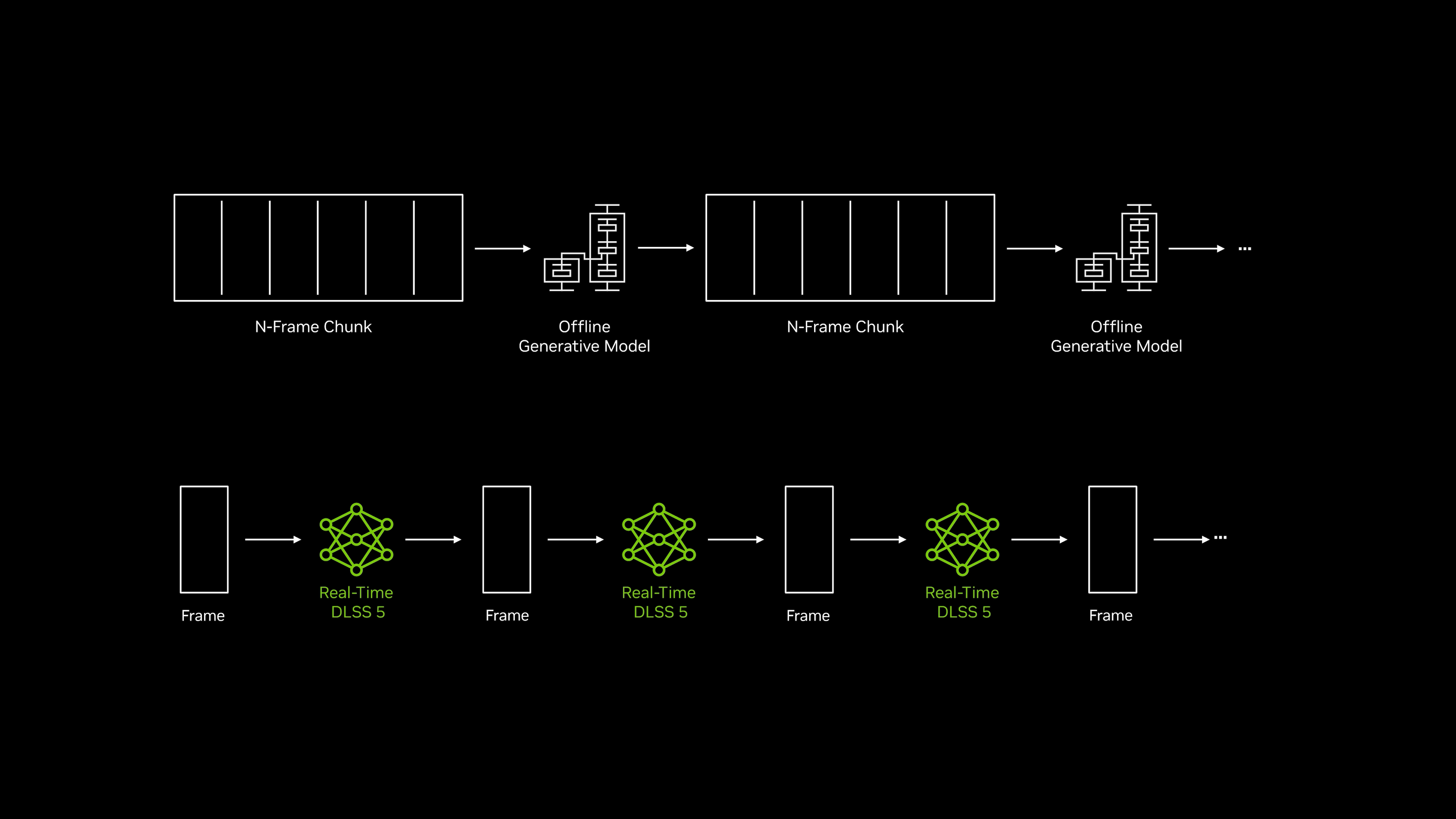
Second, DLSS 5 delivers real-time frame-by-frame temporal stability. Unlike video generation models that operate on batch frame sequences, DLSS 5 operates on a strict one-frame-in, one-frame-out model. By leveraging motion vectors directly from the game engine, DLSS 5 ensures every generated frame is stable, eliminating visual shimmering, swimming, or temporal drift even as players move.
Third, we invented a fast, specialized AI model designed explicitly for real-time 3D rendering pipelines. This compact network interprets engine data directly from the rendered frame and leverages the powerful Tensor Cores of GeForce RTX 50 Series GPUs to render complex lighting and materials in real-time. Running locally on a single GPU, it maintains smooth frame rates at up to 4K resolution.
Integration for developers is straightforward, leveraging the same NVIDIA Streamline framework already utilized across the DLSS technology suite, as well as Unreal Engine 5 plugin for Unreal Engine games. DLSS 5 operates as an optional and independent feature, giving studios flexibility to enable it alongside Super Resolution, Multi Frame Generation and Ray Reconstruction as they see fit.
By working in tandem with traditional rasterization, ray tracing, and path tracing, DLSS 5 represents the beginning of a new era where traditional game rendering and real-time neural graphics unite to bridge the cinematic gap.
DLSS 5’s Artistic Controls For Game Developers
Making an image more realistic is ultimately a creative decision, which is why DLSS 5 puts art-direction tools directly into the hands of developers. DLSS 5 empowers teams to add photoreal detail that their compute and VRAM budgets would never let them model and render explicitly. It also adds different models and controls to let them art-direct how and where it is applied. For gamers, it is a simple on or off toggle.

Let’s first look at how DLSS 5 preserves artistic intent. In this example with the ramen chef, the underlying facial proportions and geometry remain exactly as the artists designed them. When enabled, DLSS 5 enhances light responses and material detail. Ambient occlusion adds defined depth around his headband, while light transmits naturally through his ears via enhanced subsurface scattering. These subtle additions elevate the character and scene without altering his core identity.


Click here to load a fullscreen 4K comparison
Through the DLSS 5 SDK, developers have several models to choose from, with different parameter weights that produce different outputs, allowing them to pick the model that works best for their game.
This model choice can be applied to the entire game, or they can mix-and-match the models in different scenes. For example, artists can select one model for dense outdoor foliage, and another model for dramatic indoor scenes. They can also mix-and-match different models for gameplay and cutscenes, whichever fits their artistic vision.
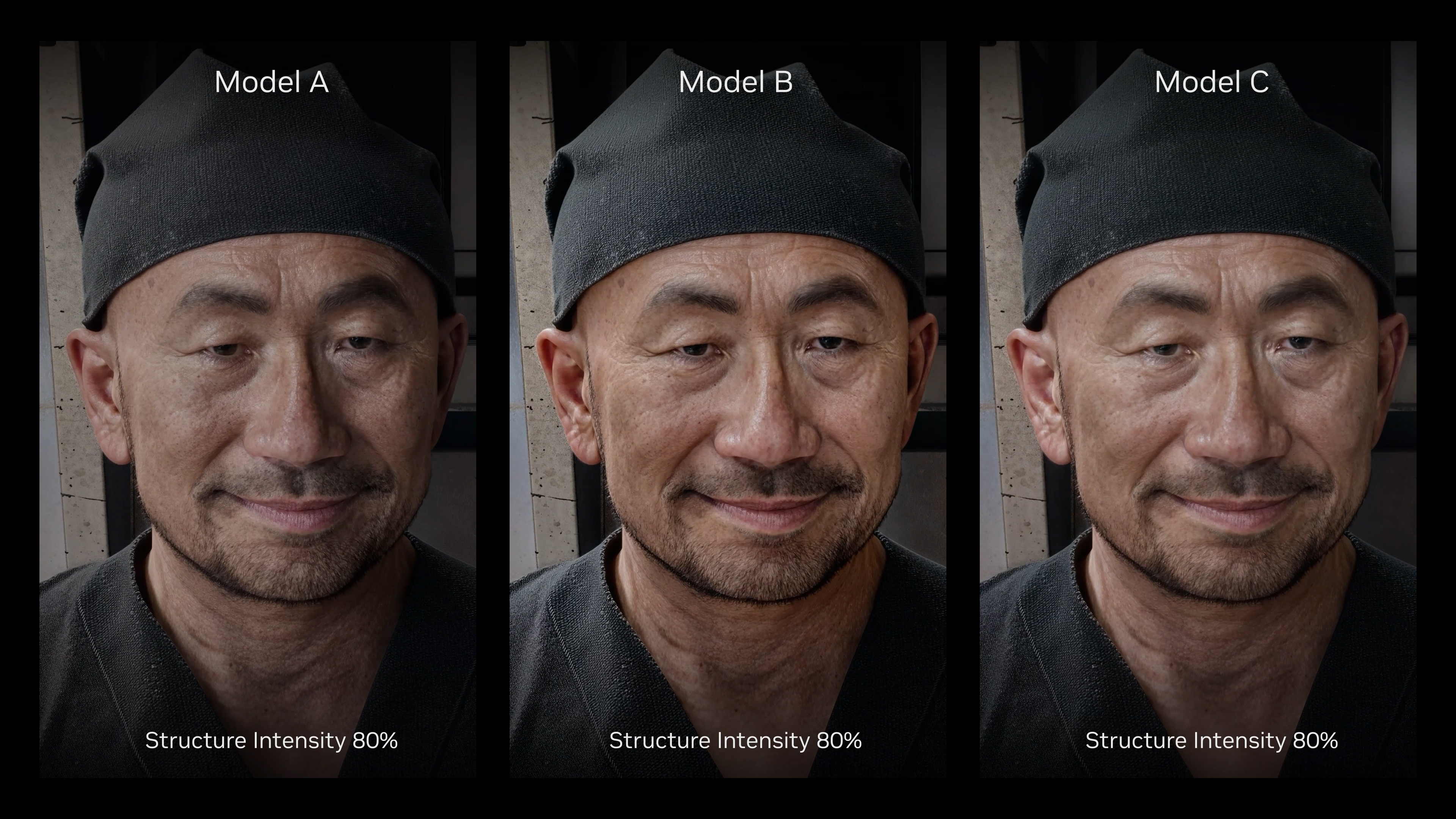
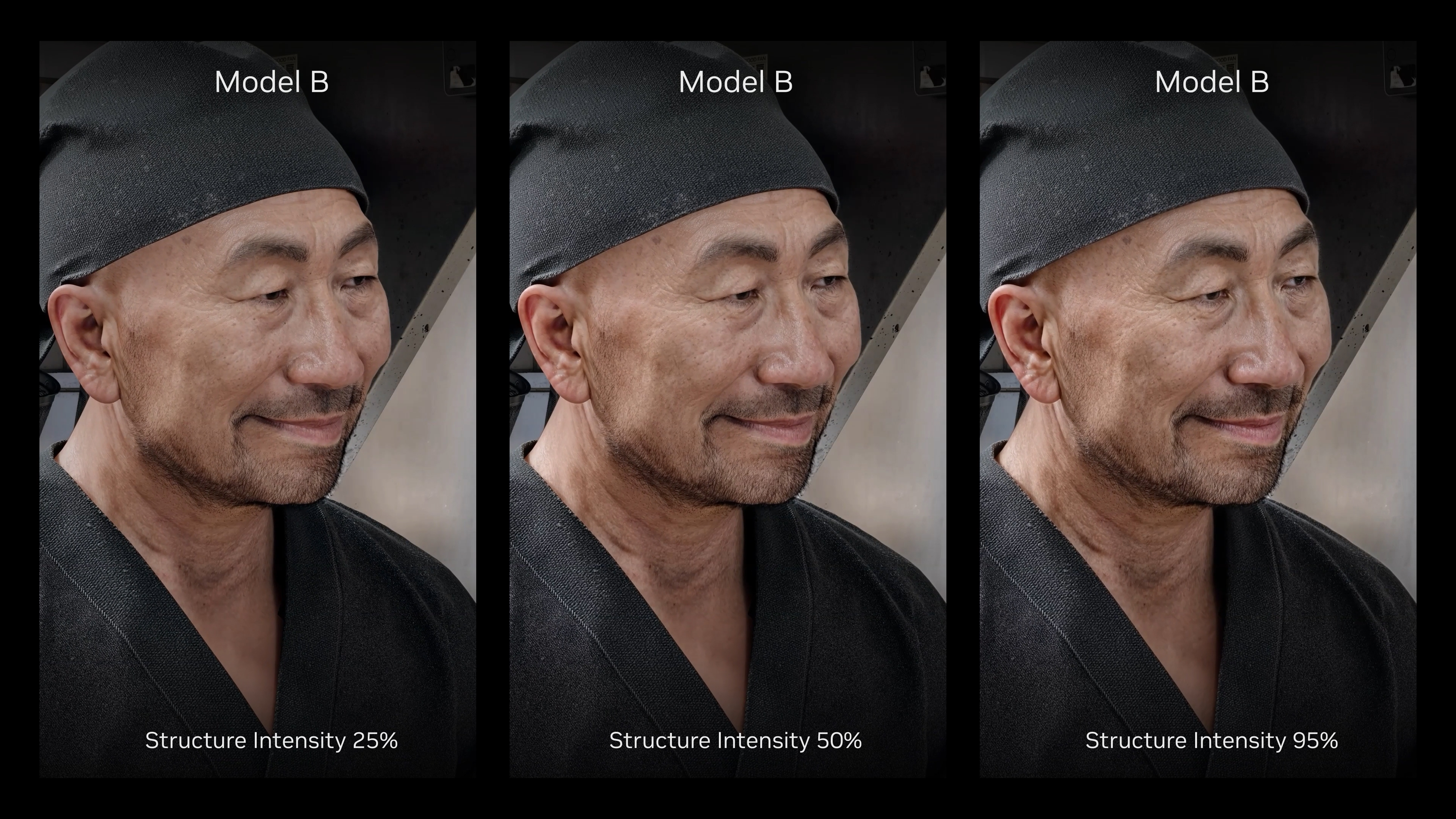
DLSS 5 also offers Structure Intensity and Tone Intensity adjustments. Structure Intensity controls high-frequency details such as ambient occlusion, reflections, and subsurface scattering. This control enables developers to have a big lever to increase realism in their games.
With Tone Intensity, developers can control the low-frequency details such as broader lighting and color response. This allows the developer to decide to show the exact colors from the rendered frame by setting this value to zero, or increase the setting to make tonal adjustments based on the scene. Together, they let the artists decide how much enhancement is applied to the output.


Click here to load a fullscreen 4K comparison
To ensure enhancements are applied only where intended, DLSS 5 features semantic AI masking that recognizes scene objects automatically, allowing developers to boost the environmental uplift while holding back on characters, or vice versa.
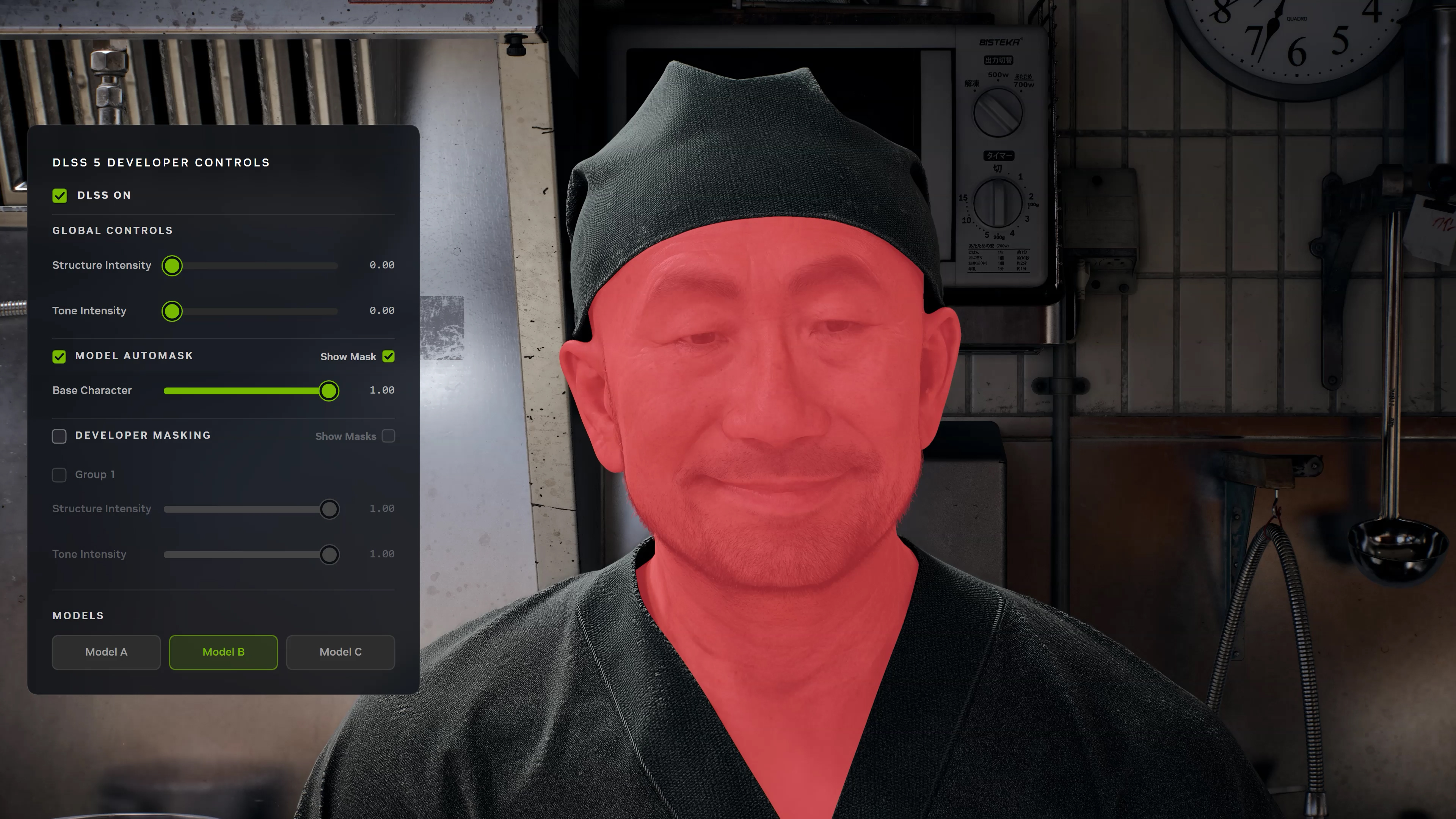
Furthermore, engine-level masking allows artists to isolate specific props or asset groups, such as glassware, water droplets, or foliage, and apply custom neural lighting tweaks to specific elements of a game without altering surrounding elements.

The neural rendering result remains firmly grounded in the engine's base frame, meaning the quality of the final output scales with the fidelity of the input.

DLSS 5 noticeably elevates traditional rasterized graphics, but giving the model richer source data, like ray-traced or path-traced lighting, yields dramatically more-accurate results. In other words, the higher the quality of the foundational information provided by the game, the better the final output.


Click here to load a fullscreen 4K comparison
As we work in close partnership with studios, developer feedback continues to directly shape how we refine the technology and expand our suite of models and controls.
NBA 2K27 Available Now With DLSS 5
For over 25 years, Visual Concepts has delivered NBA 2K as the most authentic sports experience in gaming. Their focus is to make the in-game experience feel as close as possible to watching a real NBA or WNBA broadcast.
Through a close partnership with Visual Concepts and 2K, we’ve brought DLSS 5 3D-Guided Neural Rendering to NBA 2K27, achieving a new level of authenticity for the player experience.
It’s available now for GeForce RTX 50 Series PCs and laptops, and GeForce NOW Ultimate members streaming from NVIDIA-operated GeForce RTX 5080-powered gaming rigs in the cloud.
Visual Concepts uses DLSS 5 to enhance and tune NBA 2K27 to make it even more realistic. With DLSS 5, you can see how light naturally passes through player ears, the natural lighting of skin, and how light catches hair, all while preserving the facial geometry scanned from real-world athletes.
“DLSS 3D-guided neural rendering helped boost the visual quality of our materials and lighting, bringing a real jump to photorealism across the game,” said Peter Kavic, Senior Producer at Visual Concepts.
Enabling DLSS 5 delivers a noticeable upgrade for All-Star guard Cade Cunningham, with improved skin subsurface scattering providing lifelike warmth under the arena lighting, and tighter contact shadows bringing out finer detail along his neck and jersey collar, while natural light transmission elevates his hair definition, enhancing overall realism.


Click here to load a fullscreen 4K comparison of Cade Cunningham with DLSS 3D-Guided Neural Rendering
DLSS 5 also elevates the visual fidelity of All-NBA point guard Tyrese Haliburton. Subsurface scattering gives his face realistic warmth under the arena lights, casting precise contact shadows beneath his nose and chin. And refined ambient occlusion adds crisp shadow definition across the folds of his compression arm sleeve.


Click here to load a fullscreen 4K comparison of Tyrese Haliburton with DLSS 3D-Guided Neural Rendering
Courtside spectators and staff also gain richer lighting and material responses, with natural subsurface skin scattering and defined contact shadows that elevate the image quality of their models.
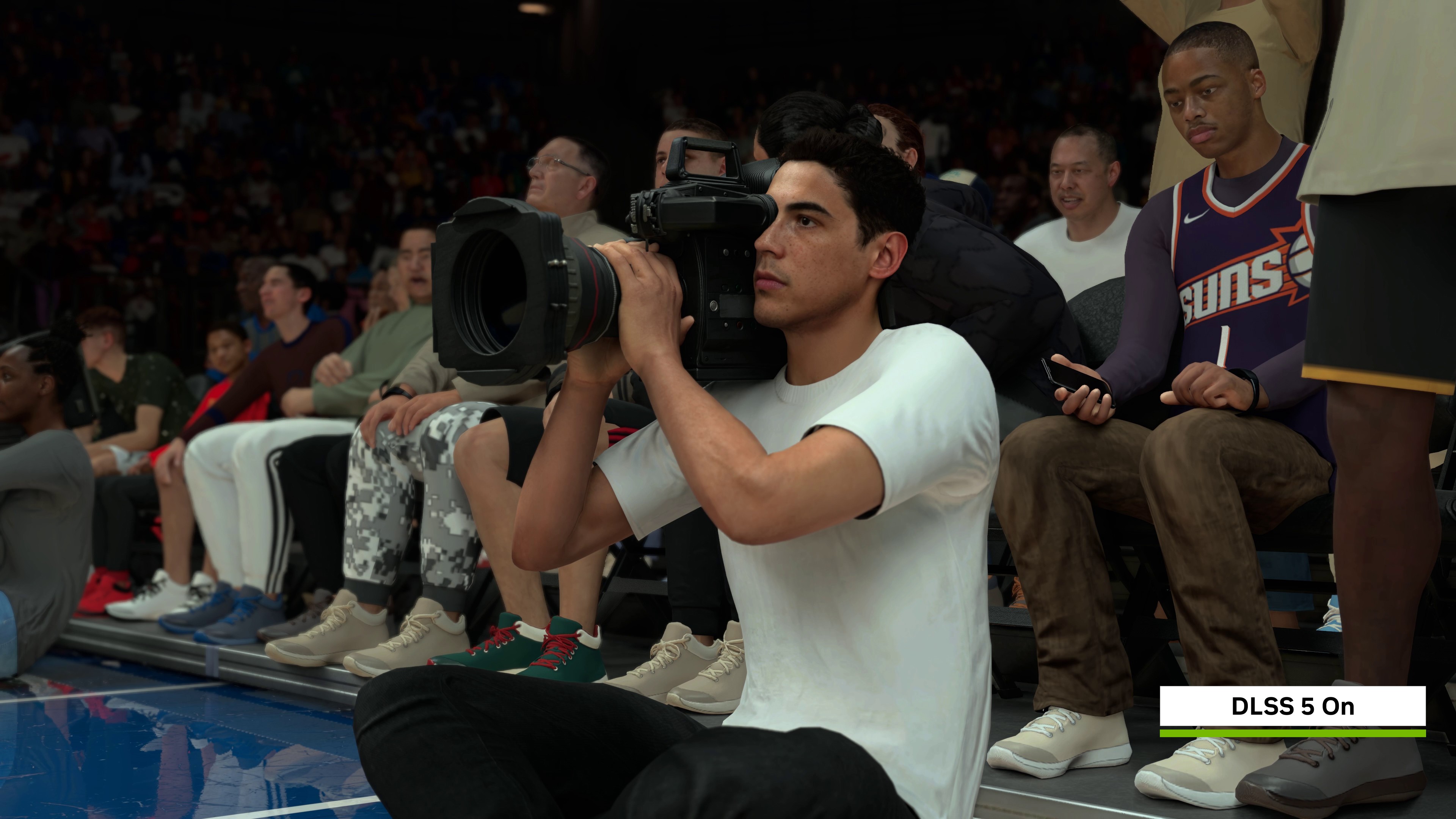

Click here to load a fullscreen 4K comparison
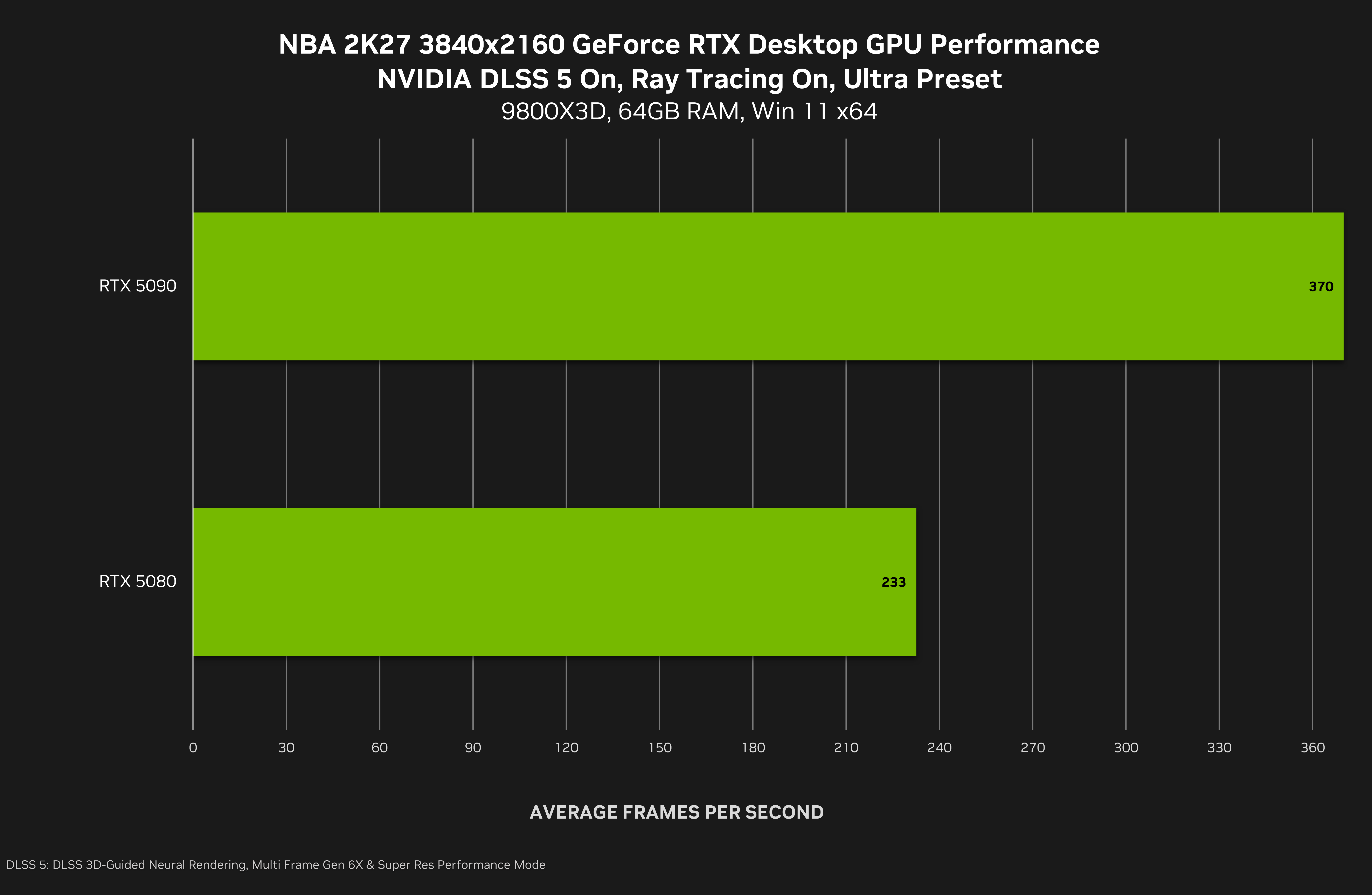
Using the full suite of DLSS technologies in NBA 2K27, at 4K with the Ultra Preset and ray tracing, GeForce RTX 5090 owners can play at up to 370 frames per second with DLSS 5, for the definitive experience.
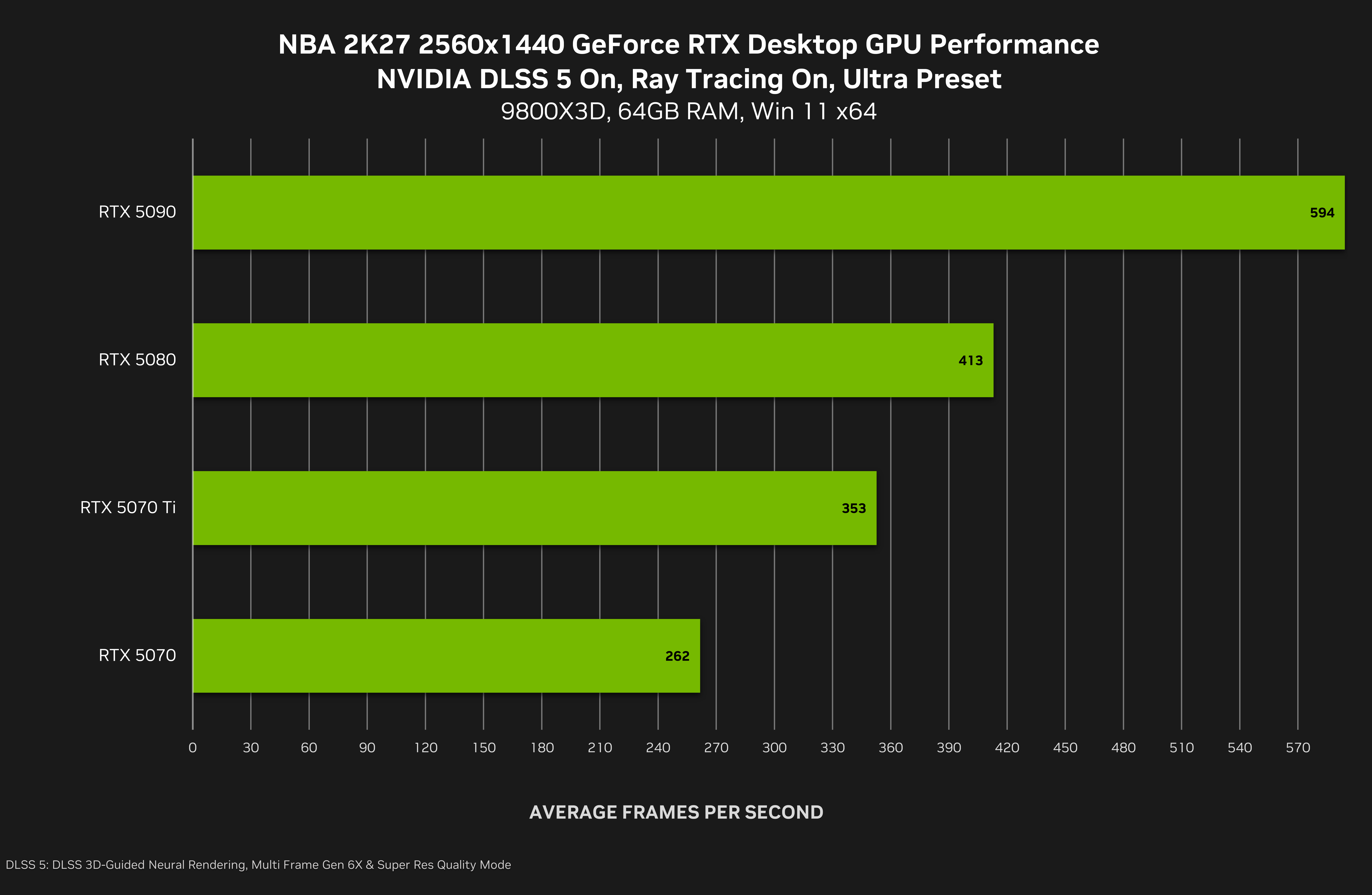
At 2560x1440, GeForce RTX Series gamers can experience Ultra Preset, ray-traced, DLSS 5-enhanced NBA 2K27 at up to a super fast 590 frames per second on the GeForce RTX 5090, at up to 410 frames per second on the GeForce RTX 5080, up to 350 frames per second on the GeForce RTX 5070 Ti, and up to 260 frames per second on the GeForce RTX 5070.
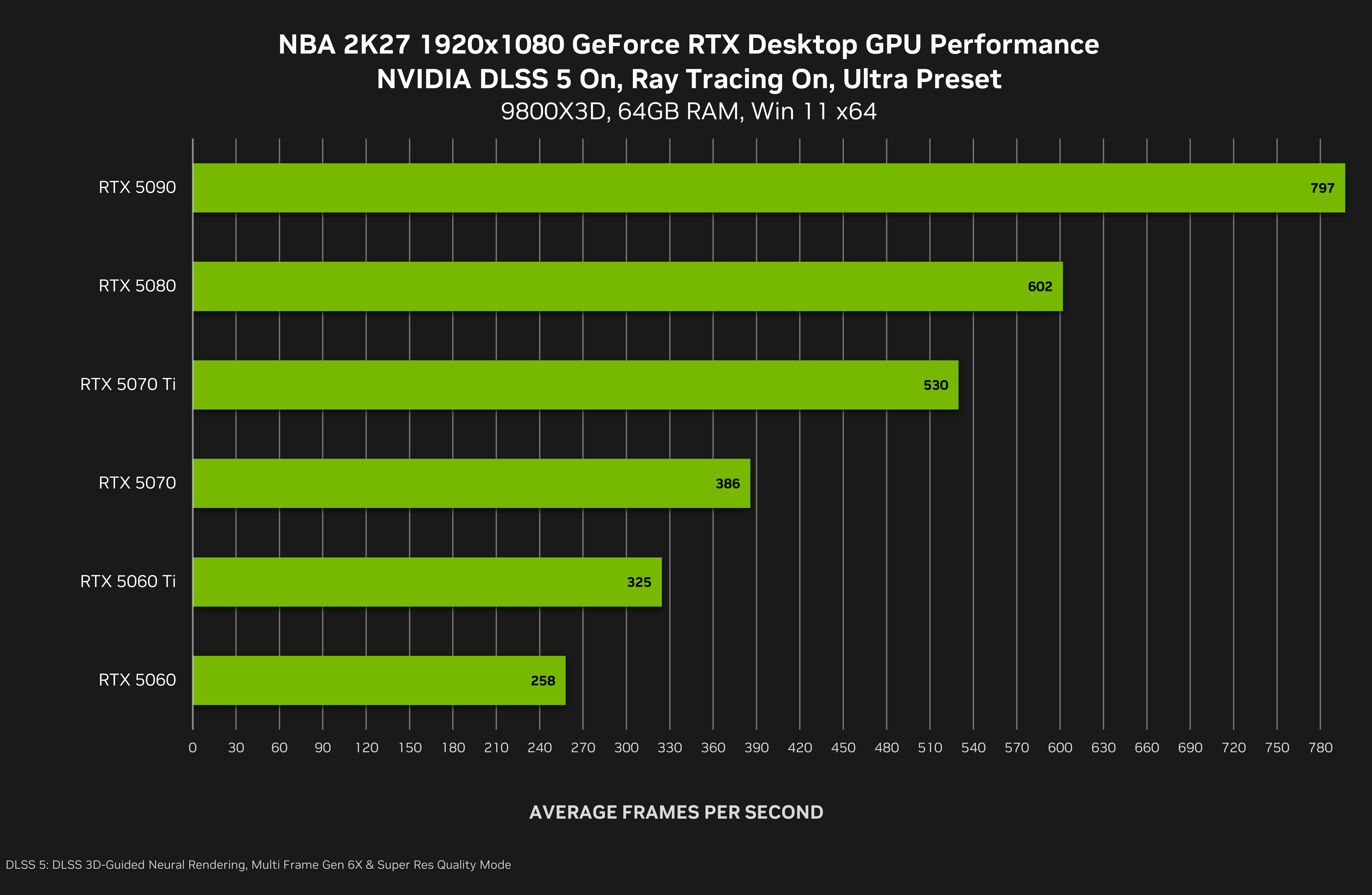
At 1920x1080, virtually all GeForce RTX 50 Series gamers can experience NBA 2K27 with ray tracing, using the Ultra Preset in conjunction with DLSS 5.
Combined, DLSS 5 with 3D-Guided Neural Rendering, Super Resolution, and Multi Frame Generation deliver higher frame rates and dramatically improved image quality. DLSS 5 enhances Jayson Tatum with natural skin subsurface scattering, refined facial hair lighting, and deeper contact shadows across his jersey and the basketball.
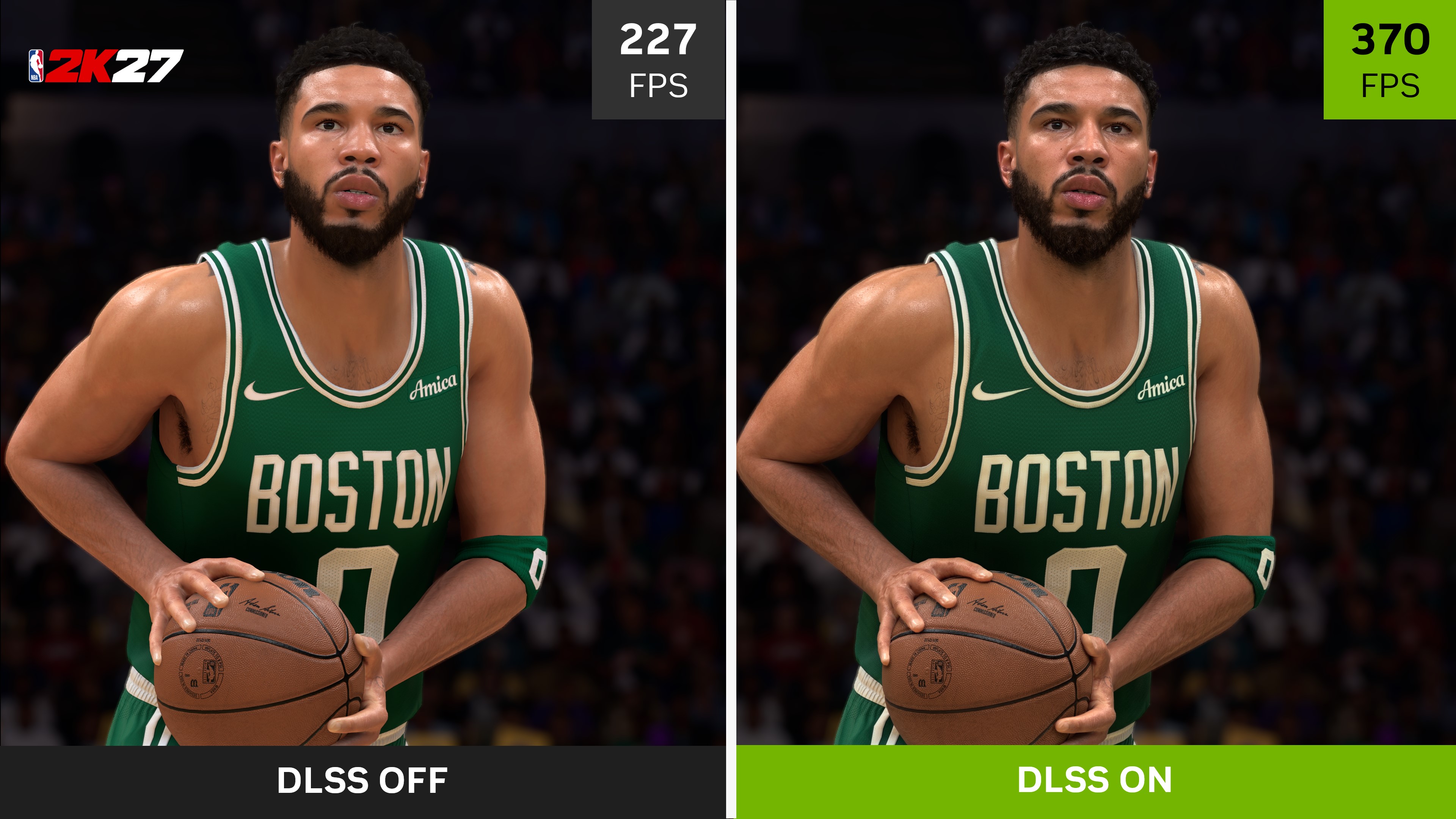
With DLSS ON, framerates are boosted to 370 FPS at 4K at Ultra Settings, with ray tracing, on a GeForce RTX 5090
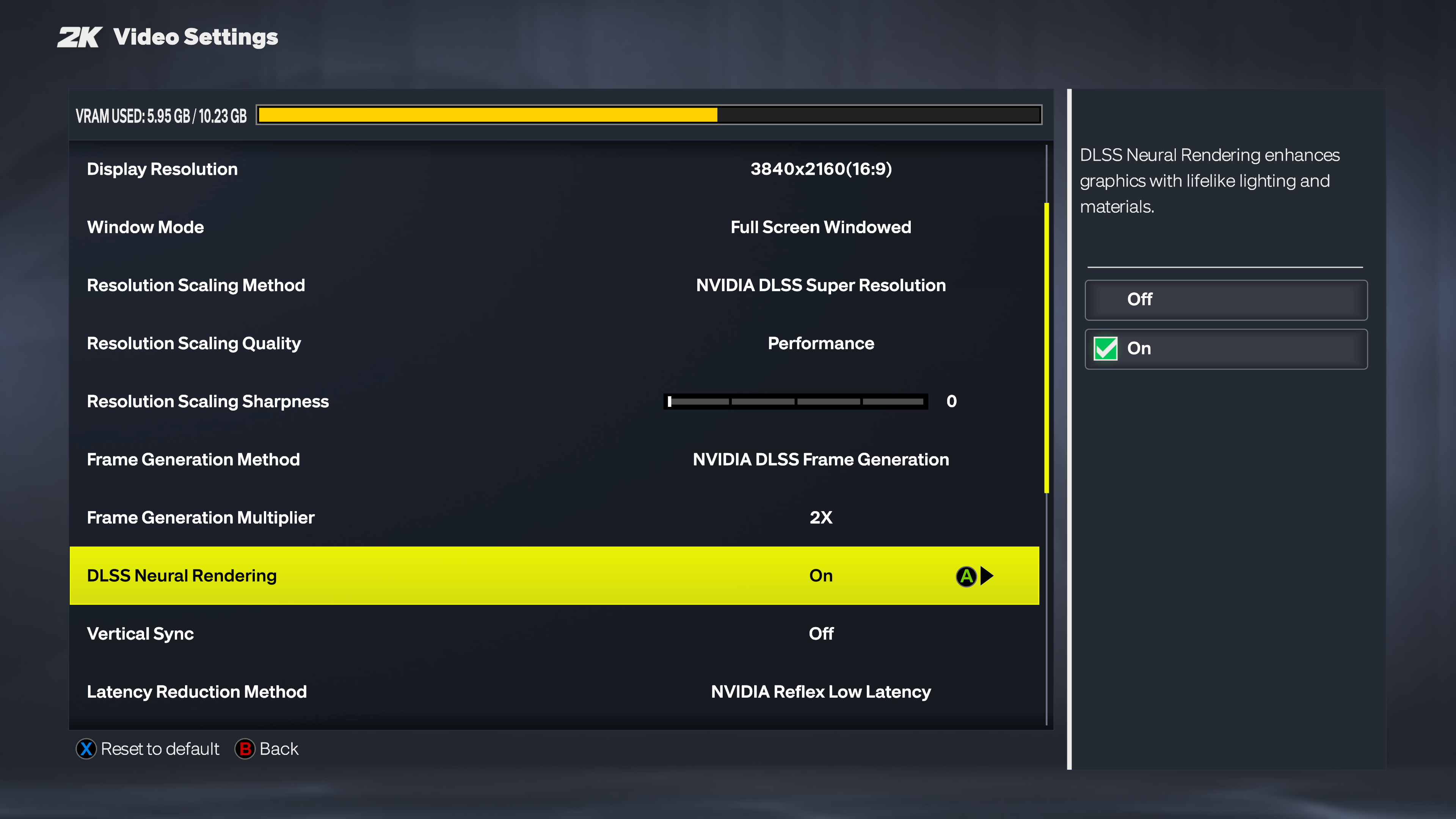
To enable DLSS 5 in NBA 2K27, players need to download and install our newest GeForce Game Ready Driver, 616.64 WHQL, revealing the option for DLSS Neural Rendering in-game:
- Download and install the newest GeForce Game Ready driver from our website or the NVIDIA app
- In-game, select “Video Settings,” and turn On “DLSS Neural Rendering”
- Configure other DLSS Super Resolution, Frame Generation, and NVIDIA Reflex options to your liking
- Toggle DLSS Neural Rendering during gameplay and replays via F9 on your keyboard
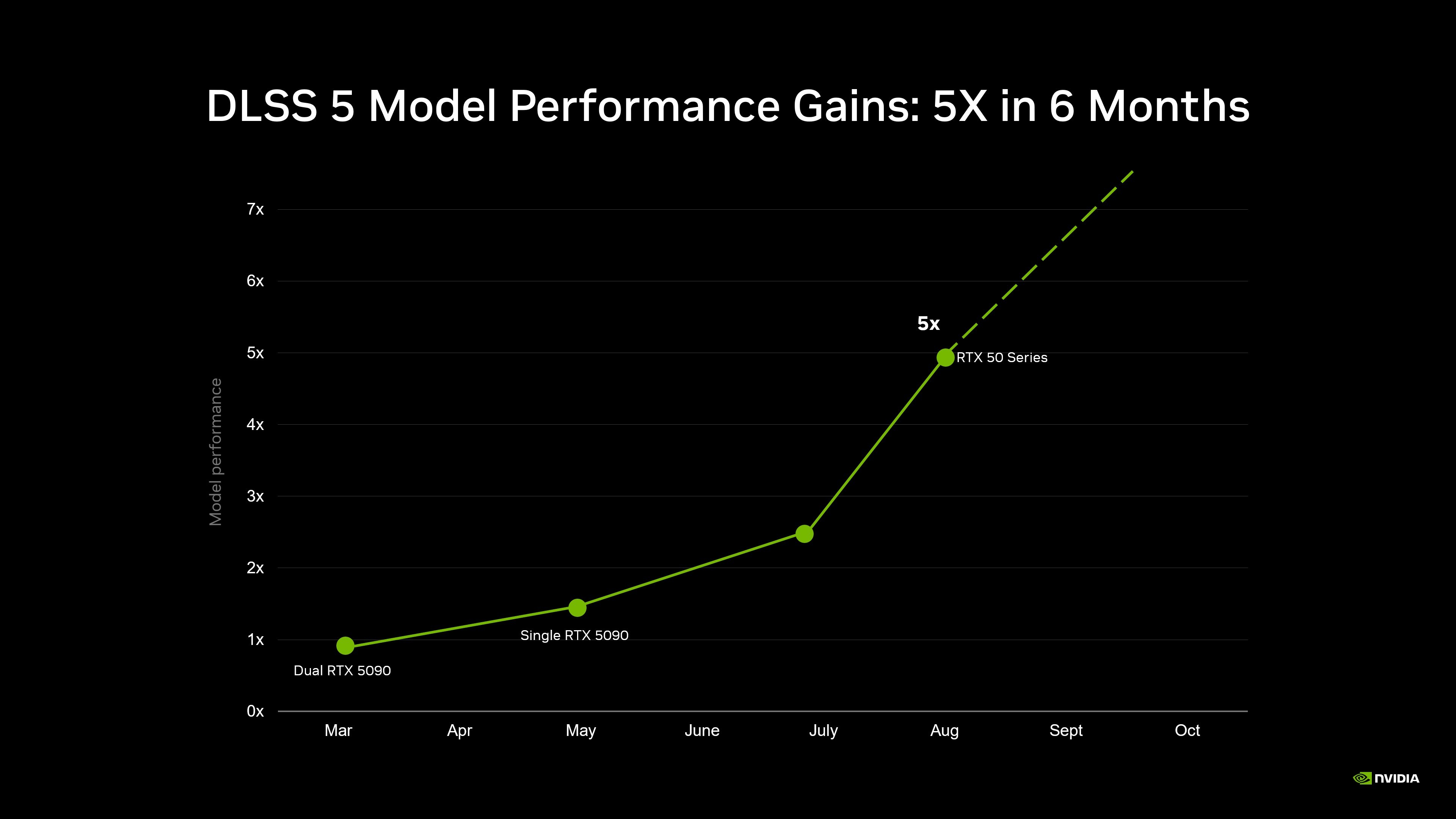
Rapid Progress & Continuous Evolution
Since the initial announcement of DLSS 5 in March, our progress has been rapid: from running on dual GeForce RTX 5090s to now a single graphics card, we’ve achieved a 5X performance gain in just six months, making DLSS 5 available for all GeForce RTX 50 Series GPUs and Laptop GPUs. This milestone stems from a combination of systematic pipeline optimizations, and neural model refinements that yield both faster execution and better image quality.
Our optimization curve isn’t flattening out, and we have further optimizations in active development. We expect upcoming model updates coming in the Fall to boost performance beyond today’s baseline. Backed by over a decade of DLSS expertise, we remain committed to continuously pushing the boundaries of performance and image quality, and this is only the beginning.
DLSS 5: A New Era Of Real-Time Graphics
DLSS 5 is a breakthrough in both AI and graphics; a new level of realism for games:
- 3D-Guided & 4K Real-Time: Fully deterministic, temporally consistent neural rendering running at up to 4K on a single GeForce RTX 50 Series GPU
- Frame Is The Foundation: Trained to maintain the structural and geometric integrity of the rendered frame
- Intelligent Model: Intelligently analyzes scene objects and semantics to deliver lifelike lighting, subsurface scattering, and realistic material responses
- Granular Developer Controls: Creative controls calibrate the neural model via structure, tone, and semantic masking to rigorously maintain artist intent
- Streamlined Integration: Offers fast, easy integration for game developers via NVIDIA Streamline or Unreal Engine 5 plugin
DLSS 5 extends the rendering pipeline, rather than replacing it. It works seamlessly across the entire graphics stack by building upon our DLSS technologies (Super Resolution, Multi Frame Generation, and Ray Reconstruction), while enhancing traditional rendering methods like rasterization, ray tracing, and path tracing. Together, these innovations mark the beginning of a transformative era which blends hand-crafted rendering with neural graphics to deliver a dramatic leap in visual realism while preserving the control artists need for creative expression.
To experience DLSS 5 in NBA 2K27, get the game and download our latest GeForce Game Ready Driver from the NVIDIA app, or play on GeForce NOW. And stay tuned to GeForce.com for upcoming announcements as more titles integrate DLSS 5 in the coming weeks and months.