
Media and Entertainment
Streamlining Brand-Consistent Content Production Across Global Teams
Grip, Moët Hennessy
Objective
INDG is a global company with over 25 years of experience in digital content automation, supporting more than 200 major brands across industries including consumer products, retail, automotive, and healthcare. Many brands struggle with slow, costly, and inconsistent manual processes for localizing content—making adaptation challenging or even out of reach, impacting brand accuracy and audience engagement. Grip, INDG’s SaaS platform developed on NVIDIA Omniverse™ and OpenUSD, addresses these challenges by centralizing OpenUSD asset libraries and creating digital twins for each product. This unified approach gives teams instant access to photorealistic, brand-accurate assets through an intuitive interface powered by advanced 3D and AI workflows. As a result, teams can quickly assemble, adapt, and deploy campaign-ready content in minutes instead of weeks. Customers like Moët Hennessy, Coca-Cola, and Beiersdorf have increased content production speed to deliver tailored visuals to a variety of markets.
Customer
Moët Hennessy
The Coca-Cola Company
Beiersdorf
Partner
Grip
Use Case
Content Creation / Rendering
Products
NVIDIA Omniverse Enterprise
NVIDIA RTX Workstation
NVIDIA AI Enterprise
Key Takeaways
- Grip enabled Moët Hennessy to double their content production speed and deliver over 3 million high-quality visuals.
- Grip's rule-based AI engine and 3D rendering, developed on NVIDIA Omniverse, support brands like Coca-Cola in creating personalized content at scale while maintaining brand standards.
- By centralizing OpenUSD asset libraries and providing API-driven, self-service workflows, Grip helps brands like Beiersdorf manage operational costs, maximize the value of their content assets, and empower teams worldwide to quickly respond to market trends.
Grip Enables Scalable Content Production at Double Speed
The Grip platform addresses the challenge of producing high-quality, hyper-localized marketing visuals at scale for global brands by automating and streamlining each step of the content supply chain.
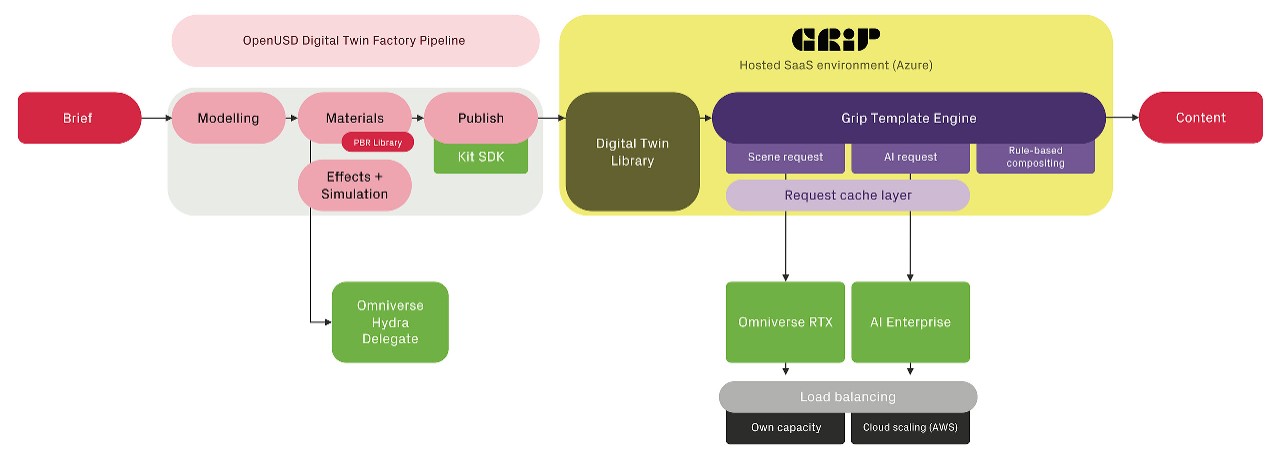
Grip’s architecture is anchored by its Digital Twin Factory, which uses NVIDIA Omniverse and OpenUSD to coordinate the content pipeline. High-fidelity digital twins of products are authored in OpenUSD, enriched with variant sets, style layers, and a universal material library based on physically based rendering (PBR) standards. This ensures interoperability for asset creation in the Grip application with 3D content creation tools like Autodesk 3ds Max, Maya, Blender, and Houdini.
Real-time 3D rendering, compositing, and high-volume image generation are accelerated by NVIDIA RTX™ GPUs, both on premises and in the cloud. An Omniverse hydra delegate allows artists to build high-fidelity digital twins, and Omniverse RTX integrated into Grip’s rule-based compositing engine allows marketers to preview and approve content for photorealistic, physically accurate outputs on demand.

Grip, Moët Hennessy
This GPU-accelerated foundation powers the Grip platform’s compositing engine—a system that combines 3D product models, backgrounds, AI, and branding elements into a single, photorealistic visual. The engine dynamically composes campaign-ready assets using a node-graph system, enabling teams to instantly swap products, backgrounds, props, talent, and branding elements. The result is on-demand content generation at scale, with seamless integration into enterprise digital asset management (DAM) systems for centralized asset distribution.
This approach has enabled Grip to help Moët Hennessy double their content production speed and deliver high-quality, market-specific visuals globally, helping both global and local teams meet the demands of modern digital commerce.
“Now we can create and deploy content much faster to be also more culturally relevant and it allows us to meet the E-retail landscape demands and try new digital trends, which is super exciting.”
Chloé Fournier,
Global Digital Content Manager Moët Hennessy
Grip, Moët Hennessy
Rule-Based AI Ensures Every Asset Meets Brand Guidelines
Grip ensures brand consistency and high-quality visuals across diverse markets by uniting rule-based AI controls with advanced 3D visualization.
The platform’s AI engine acts as a virtual art director—codifying and enforcing brand guidelines for every asset. This approach delivers the automated visual control and robust brand governance– similar to the NVIDIA Omniverse Blueprint for precise visual generative AI. As scenes are constructed in OpenUSD, AI controllers—running on NVIDIA RTX GPUs—dynamically adjust composition, lighting, perspective, and product-specific details, such as label placement, droplet size, and material finish. These controls use advanced mechanisms like depth guidance, segmentation, pose control, and upscaling to ensure every asset is photorealistic and on brand.
The Digital Twin Factory pipeline guarantees that all digital twins are built with variant sets and style layers, enabling even the smallest regional or product differences to be managed centrally and consistently. Omniverse RTX’s physically based rendering, powered by NVIDIA RTX hardware, supports our high-quality standards. OpenUSD streamlines asset interchange and collaboration across creative, technical, and marketing teams, making workflows seamless. This rule-driven architecture reduces manual errors and ensures that every visual—from product swaps to campaign adaptations—meets global brand standards.At the same time, local teams retain the creative flexibility to tailor content for their specific market.
As a result, The Coca-Cola Company achieved brand consistency and high visual quality in more than 200 markets, giving local teams creative flexibility for adaptation—without compromising standards.

Grip, The Coca-Cola Company
Automated Workflows Enable Rapid, On-Brand Adaptation
Traditional workflows increase costs and limit the agility of local teams to respond to fast-moving trends.
Grip’s platform provides both self-service and API-driven automation, built on a robust OpenUSD-based architecture. Local and global teams can access the centralized digital twin library and instantly adapt visuals for their region—swapping products, backgrounds, props, or talent as needed, with every change governed by automated rule checks. OpenUSD ensures that assets remain interoperable and ready for diverse use cases—from ecommerce to digital marketing to internal sales tools.
For enterprise deployments at global scale, Grip leverages NVIDIA AI Enterprise software and cloud GPU infrastructure to deliver high-throughput, on-demand content generation. The Digital Twin Factory pipeline bundles and publishes assets into ready-to-stream OpenUSD formats, making them instantly available for distribution and reuse. Integration with enterprise DAM systems ensures that every new asset is automatically distributed across the business, maximizing content value and minimizing manual effort.
This approach has led to cost savings, extended the lifetime value of content assets, and empowered local teams to respond rapidly to market needs—helping Beiersdorf trial new formats and maximize asset value at global scale.

Grip, Beiersdorf
Looking Forward
Grip’s platform, built on NVIDIA Omniverse and the open, extensible Universal Scene Description (USD) framework, is designed to adapt as new enterprise needs emerge. After helping customers like Moët Hennessy, Coca-Cola, and Beiersdorf digitize their product portfolios for e-commerce and marketing, Grip is now exploring broader digital twin applications, including areas such as store planning, planogram compliance, and operational insights.
“By combining AI-driven content configurators with digital twins of our complete product portfolio, we’ve unlocked unprecedented scalability in content creation.”
Jasmin Quellmann
Head of Marketing Technology & AI at Beiersdorf
Start developing interoperable 3D workflows and OpenUSD applications.