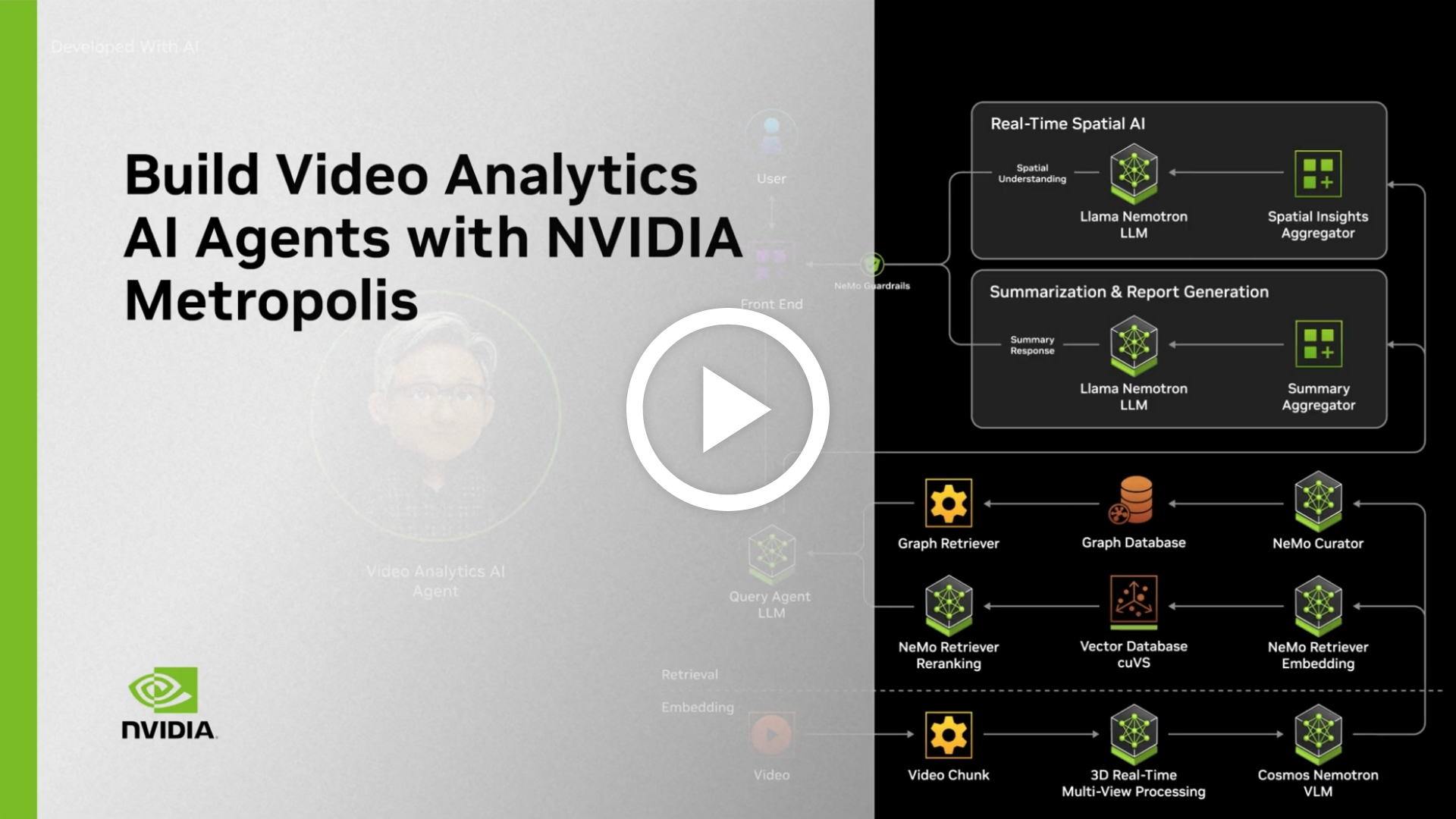
Video Analytics AI Agents
Turn live video into real-time operational intelligence with visual AI agents that can see, reason, and act.
Workloads
Computer Vision / Video Analytics
Generative AI / LLMs
Edge Computing
Industries
Manufacturing
Smart Cities/Spaces
Retail/ Consumer Packaged Goods
Media and Entertainment
Healthcare and Life Sciences
Business Goal
Return on Investment
Innovation
Overview
How Do AI Agents Improve on Traditional Video Analytics?
Cameras capture the world’s operations, yet more than 99% of that footage goes unwatched—leaving safety risks, inefficiencies, and opportunities unseen. Powered by vision language models (VLMs), video analytics agents go beyond detecting predefined objects and events to understand what’s happening, reason, and then act. Building these agents from scratch requires integrating video processing, model training, validation, and deployment—a complex development effort. NVIDIA simplifies work across the entire development lifecycle with open models such as NVIDIA Cosmos™, accelerated libraries, and skills. These building blocks help developers customize and deploy agents faster while helping teams investigate incidents faster, identify safety risks, and improve operations.
What Is a Video Analytics AI Agent?
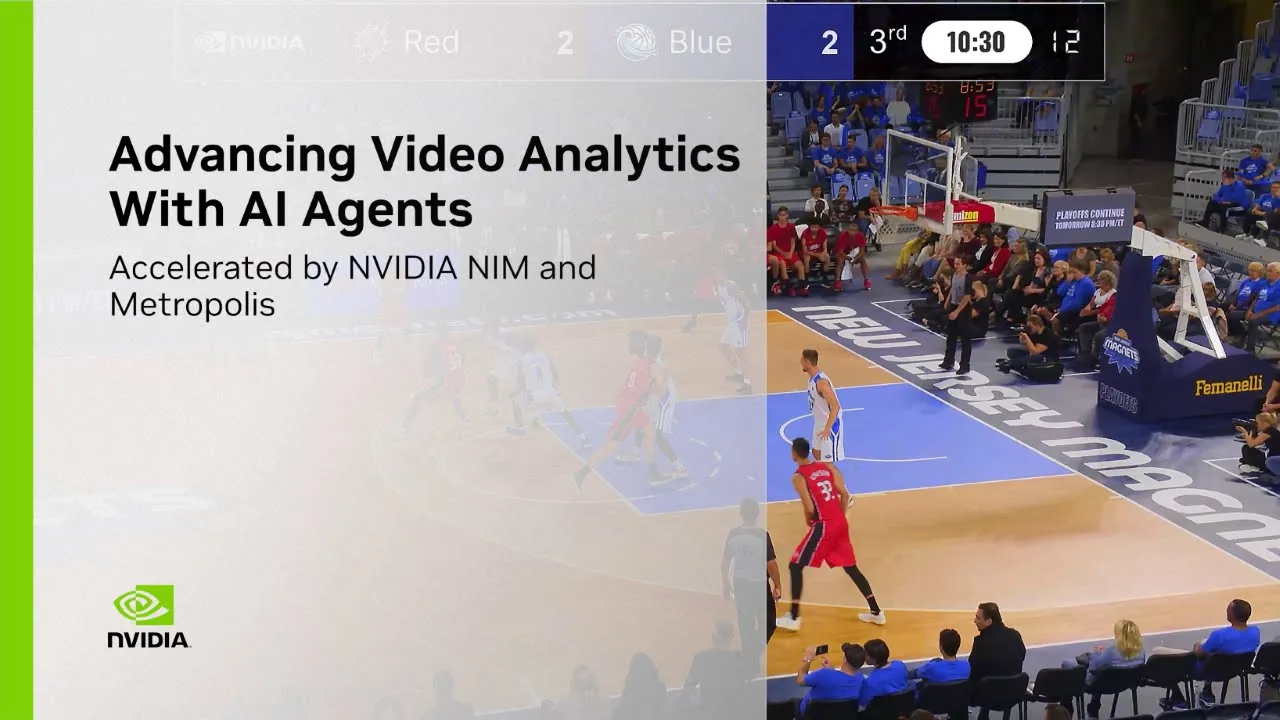
A video analytics AI agent can see, reason, and act by combining vision and language modalities to understand a broad range of natural language questions or prompts applied to a recorded or live video stream. This deeper understanding of video content enables more accurate and meaningful interpretations, improving the functionality of video analytics applications and analysis of real-world scenarios. These agents promise to unlock entirely new insights and possibilities for automation.

Where Are Video Analytics AI Agents Deployed?
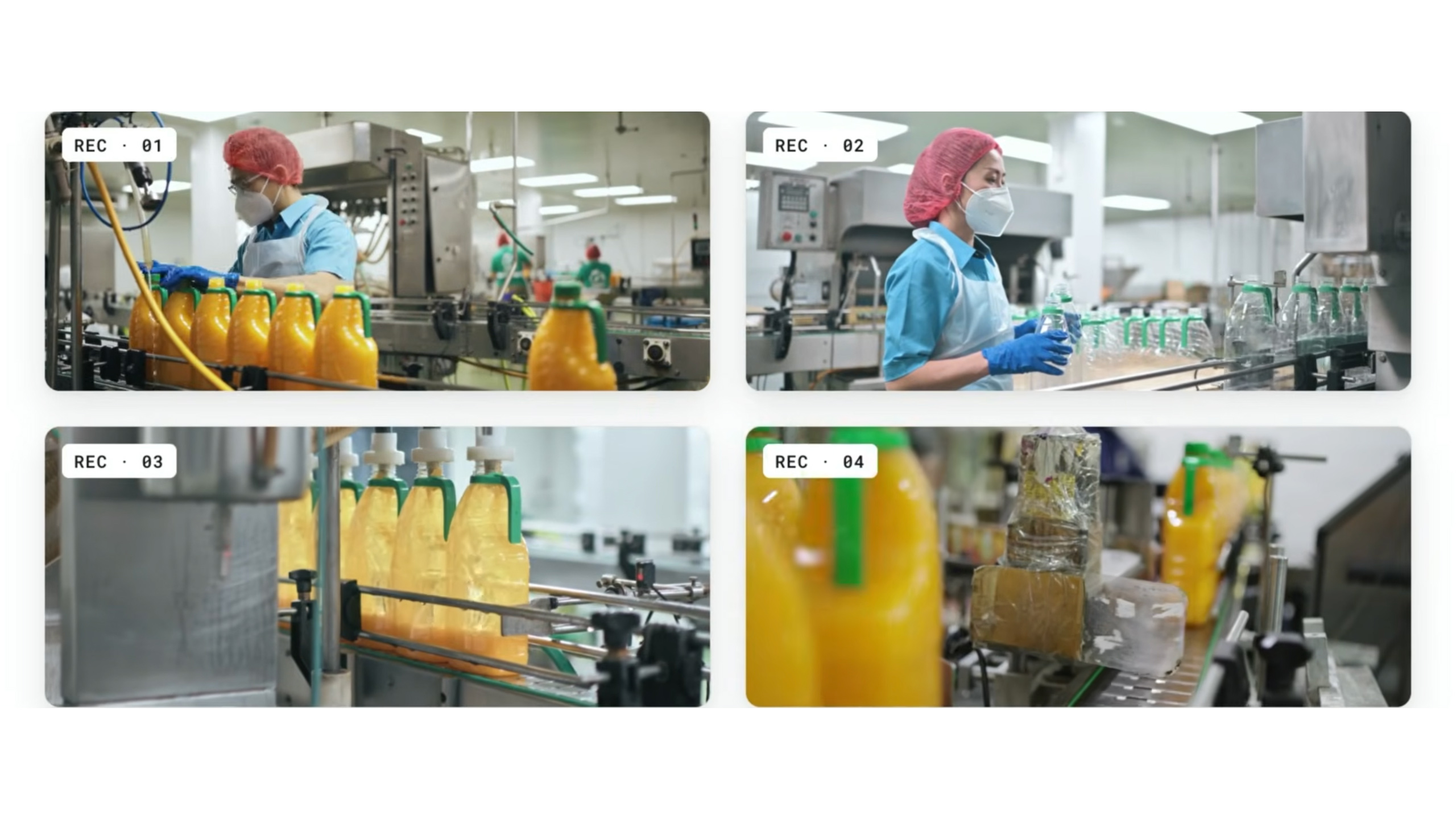
Highly perceptive, accurate, and interactive video analytics AI agents will be deployed throughout factories, warehouses, retail stores, airports, traffic intersections, and more. These agents will support visual inspection to detect product defects and assembly issues, safety and security to identify hazards and unauthorized access, operational intelligence to uncover bottlenecks and improve workflows, and preventive maintenance to spot visible signs of equipment wear or damage before failures occur. Managers and operations teams will communicate with these agents in natural language to gain richer insights, create safer spaces, and make better decisions—all powered by generative AI and VLMs at their core.

Quick Links
Technical Implementation
Understand the World With NVIDIA Cosmos

The brain inside every video analytics AI agent is a VLM that can see and reason. Two common VLMs are NVIDIA Cosmos 3 and Cosmos Embed. Both can be used to augment current computer vision applications with rich metadata and content summaries.
NVIDIA NIM™ is a set of accelerated inference microservices that are optimized for NVIDIA GPUs and include industry standard APIs, domain-specific code, optimized inference engines, and enterprise runtime.
Quick Links
Build AI Agents Fast With NVIDIA Metropolis VSS Blueprint and Skills
Building custom video analytics AI agents can consume over 10,000 engineering hours a year as teams integrate models, video processing, search, and reasoning into working applications. The NVIDIA Metropolis Blueprint for video search and summarization (VSS) simplifies this development. Developers can use VSS agent skills to build a custom, agent-ready vision stack in 30 minutes, using natural language prompts and a coding agent.
VSS combines generative AI, vision language models, large language models, retrieval-augmented generation, and NVIDIA NIM to help agents analyze vast amounts of video and turn natural language requests into actionable insights. Its modular components, accelerated microservices, agentic fusion search across diverse embeddings, and comprehensive reporting help teams customize applications that optimize processes, improve safety, and reduce costs. VSS agent skills simplify deployment and operation through coding agents.
VSS brings multimodal understanding and zero-shot reasoning to existing computer vision pipelines, enhancing inspection, search, and analytics. It supports deployment from edge to cloud on NVIDIA RTX™ 4500, RTX PRO™ 6000, DGX Spark™, Jetson Thor™, Jetson Orin™, Orin NX, and GB300.
Quick Links
Improve Accuracy With Model Fine-Tuning and Synthetic Data Generation Agentic Blueprints
Traditional approaches to customizing models for video analytics AI agents were linear and slow—collect video, label frames, train, evaluate, repeat—with a human in the loop at every step and months to reach acceptable accuracy. Modern approaches break this cycle by enabling coding agents to iteratively improve VLM and vision foundation model performance based on target goals.
Fine-tune vision language models with the NVIDIA Cosmos framework.
The NVIDIA Cosmos framework is a suite of agent skills and tools for pretraining, post-training, or fine-tuning world models, including Cosmos 3, with natural language prompts.
Solve training data challenges with agent skills for curation, labeling, synthetic data generation, and evaluation.
With Cosmos Data Factory, developers can curate raw data into training-ready datasets and quickly generate synthetic defect data for visual inspection or augment videos for different scenarios such as weather, lighting, and more when data is limited.
Quick Links

FAQs
Yes, you can now build video analytics AI agents faster from simple natural language prompts using VSS skills with coding agents like Codex and Claude. Explore a suite of VSS skills in github.
A NIM is a set of easy-to-use microservices designed for secure, reliable deployment of high-performance AI model inferencing across the cloud, data center, and workstations. It supports a wide range of AI models, including open source community and NVIDIA AI foundation models to ensure seamless, scalable AI inferencing — on premises or in the cloud — using industry-standard APIs. All NIM microservices and associated preview APIs can be found at build.nvidia.com.
Visit build.nvidia.com to start exploring the NVIDIA Metropolis VSS Blueprint and available NIM microservices such as Cosmos 3 Reasoner NIM.
All users can get started for free with the preview APIs on build.nvidia.com. Each new account can receive up to 5,000 credits to try out the APIs. To continue development after credits run out, you can deploy the downloadable NIM microservices locally to your hardware or to a cloud instance. Developers can also access NIM via the NVIDIA Developer Program. See details in this FAQ.
NVIDIA NIM is free for developers to try out. To go to production, downloadable NIM microservices require an NVIDIA AI Enterprise License. To learn more, visit this page.
The NIM developer forum is the best place to ask questions and engage with our developer community. You can access the forums here.
Get Started
Build Video Analytics AI Agents
Explore the reference workflow, powered by multiple visual language models, to easily build your video analytics AI agent.
Developer Guides: Build a Video Analytics AI Agent
-
Blogs
-
Videos
-
GTC On-Demand Videos


Deploy AI Agents From Edge to Cloud
Tap into the power of the VSS blueprint to deploy AI agents seamlessly from edge to cloud, with scalable performance across a diverse range of GPUs.


Related Success Stories