
AI-Powered Multi-Camera Tracking
Track and identify objects anonymously across cameras for smart city, warehouse, factory, and retail operations use cases.
Workloads
Computer Vision / Video Analytics
Industries
Smart Cities / Spaces
Retail/Consumer packaged goods
Manufacturing
Healthcare and Life Science
Business Goal
Return on Investment
Risk Mitigation
Products
NVIDIA DeepStream
NVIDIA Metropolis
NVIDIA Omniverse
NVIDIA AI Enterprise
Overview
What Is Multi-Camera Tracking?
Imagine a world where factories run automatically with safety and efficiency, retail spaces are optimized for the shopper experience, and public spaces like hospitals, airports, and campuses are safer and more streamlined. These spaces are too large for a single camera to cover, so they’re typically monitored by hundreds of overlapping cameras. Following objects and measuring activity accurately across cameras and space is called multi-camera tracking, letting you more effectively monitor and manage your spaces.
How Can You Use Multi-Camera Tracking?
Manufacturing and warehouse automation: Improve your shop floor operations by optimizing routes for autonomous robots, equipment, and workers. AI-powered analytics help identify congestion, bottlenecks, and risks, allowing for data-driven decisions that enhance productivity and worker safety.
Retail store layout optimization: By analyzing customer navigation throughout your store, you can reconfigure aisles and product placement to maximize sales and revenue. Multi-camera tracking helps identify bottlenecks, track customer behavior, and simulate layout scenarios to predict impact on sales and customer experiences. .
In-hospital patient care: Access continuous monitoring of patients in hospitals for an added layer of safety and security. The solution enables real-time alerts and notifications, ensuring prompt attention and care when it’s needed.
Quick Links
Technical Implementation
Launch Multi-Camera Tracking in Less Than Five Minutes With DeepStream
Historically, multi-camera tracking has been difficult because it involves matching objects across different camera views, requiring precise camera calibration and synchronization. Challenges include varying camera angles, lighting, and video quality. Handling non-overlapping views and fusing information for accurate and consistent IDs across cameras adds even more complexity.
The NVIDIA DeepStream SDK multi-camera tracking (MCT) plug-in provides consistent 3D object tracking across multiple overlapping, calibrated cameras. And setup can be completed in less than five minutes, including global IDs, real-time fusion, and scalable deployment for retail, warehouses, and beyond.
End-to-End Workflow for Multi-Camera Tracking
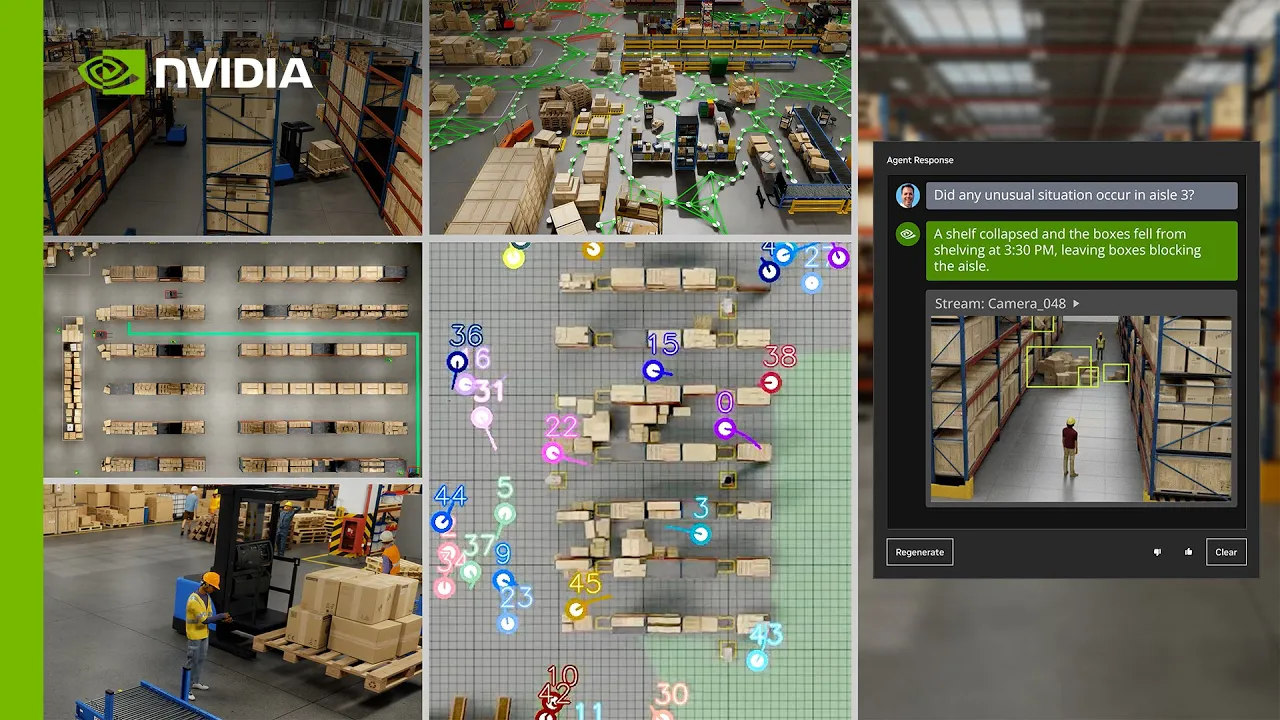
In this demo, a digital twin of a warehouse–built using NVIDIA Omniverse™ libraries–operates as a simulation environment for dozens of digital workers and multiple autonomous robots. Integrated into the NVIDIA Mega virtual factory workflow, the multi-camera tracking workflow enabled the creation of a centralized map of the entire warehouse with 100 simulated cameras, providing real-time awareness of the physical space.
NVIDIA provides the software tools for the entire development pipeline—from data generation to model training to application development—to help developers build complex vision AI applications for large spaces, fast.
- NVIDIA Omniverse libraries for creating 3D digital twins of real-world environments.
Use NVIDIA Omniverse—a collection of libraries and microservices—to construct 3D digital twins of real-world spaces, position virtual cameras to capture diverse synthetic data, generate ground-truth annotations for training perception models, and validate end-to-end applications prior to real-world deployment.
- NVIDIA Isaac Sim™ for synthetic data generation to optimize training..
- NVIDIA TAO toolkit for streamlined model development with real and synthetic data.
- DeepStream for Multi-Camera Tracking (MCT) across a range of cameras.
- Cloud-native design for scalable deployment from edge to cloud.
Jumpstart development of multi-camera vision AI applications with the NVIDIA accelerated end-to-end workflow—from Omniverse libraries for synthetic data generation to TAO for streamlined model development to Metropolis for modular, cloud-native application building blocks.
Quick Links
Accelerate the development of your multi-camera tracking AI application.