
Synthetic Data Generation for Agentic AI
Accelerate the development of agentic workflows with high-quality, domain-specific synthetic data.
Workloads
Generative AI / LLMs
Conversational AI / NLP
Industries
All Industries
Business Goal
Innovation
Products
Overview
Why Create Synthetic Data?
Training specialized agentic systems requires extensive, high-quality datasets that are often scarce, siloed, or sensitive. Synthetic data eliminates this bottleneck by creating diverse datasets at scale for any domain to accelerate AI agent development.
Synthetic data can help solve challenges such as:
- Data scarcity: Domain-specific datasets are typically limited or unavailable.
- Security concerns: Internal data is often too sensitive to share externally.
- Cost and time: Manual data collection and labeling are expensive, slow, and prone to bias.
- Complex requirements: Reasoning large language models (LLMs), multi-agent systems, and multimodal AI assistants require ample training data to be useful and autonomous.
Synthetic Data Usage
“By 2026, 75% of businesses will use GenAI to create synthetic customer data, up from less than 5% in 2023.”
Gartner®, Over 100 Data, Analytics and AI Predictions Through 2030 by Sarah James, Alan D. Duncan, 2 May 2025
GARTNER is a registered trademark and service mark of Gartner, Inc. and/or its affiliates in the U.S. and internationally and is used herein with permission. All rights reserved.
Quick Links
Using Synthetic Data for LLM and Agentic System Development
Agentic AI models enable autonomous systems to reason, plan, and take goal-driven actions across digital and real-world environments. Text-based synthetic data is critical for training and evaluating these models safely, efficiently, and at scale.
Conversational AI
Generative AI can be used to create data for high-quality conversations, capturing domain-specific language, intent variations, and rare edge cases, overcoming the limitations of scarce real-world transcripts. By enriching training data with tailored dialogues, it improves conversational AI accuracy, adaptability, and the ability to handle nuanced, multi-turn interactions.
Evaluation and Benchmarks
Targeted evaluation and benchmark datasets, such as domain-specific question-answer pairs, can be used to measure and enhance retrieval-augmented generation (RAG) system performance. Side-by-side comparison of multiple models on the same use case ensures consistent, fair evaluation and informed model selection.
Low-Resource Adaptation
Low-resource domains like proprietary coding languages or underrepresented languages benefit greatly from realistic, complex synthetic text data—enhancing AI models’ reasoning, accuracy, and overall performance.
Private & Compliant Data
NeMo Safe Synthesizer creates privacy-safe versions of sensitive data with default configurations designed to meet data privacy regulations such as HIPAA and GDPR, providing seamless access to synthetic medical data without regulatory or privacy constraints—enabling vast knowledge sharing both internally and externally.
Synthetic Documents
Design high-fidelity synthetic document datasets for large-scale AI model training in tax form validation, legal documents, mortgage approvals, and other structured data applications.
Technical Implementation
Generating Synthetic Data
Design Custom Synthetic Datasets from Scratch or Example Data
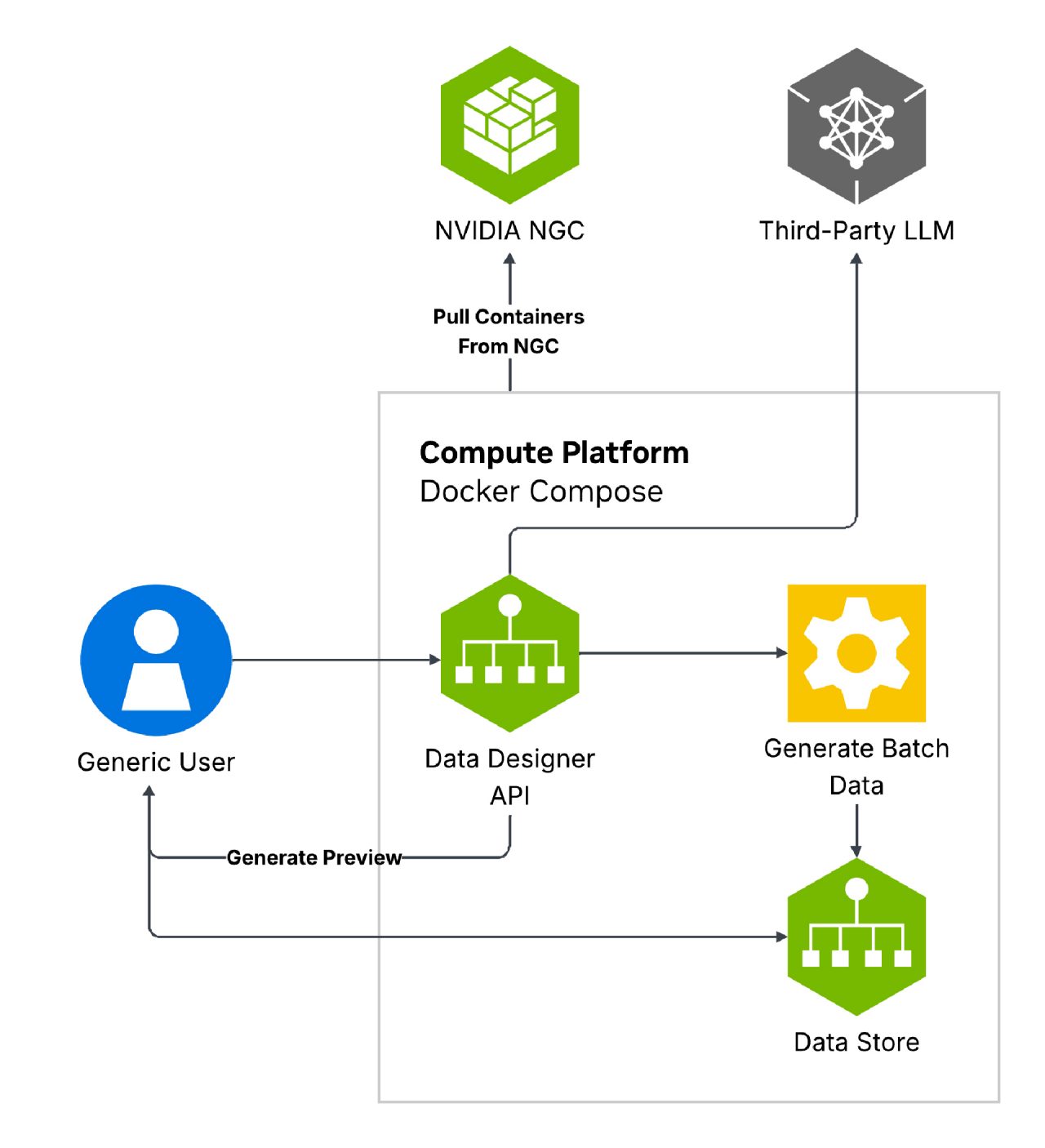
Configure the models you want to use for Synthetic Data Generation (SDG): Connect and customize the models that power your synthetic datasets in NeMo Data Designer. You can use model aliases for easy reference, and fine-tune inference parameters to get the right output quality and style you need.
Configure the seed datasets you want to use to diversify your dataset: The most effective way to generate synthetic data that matches your specific domain is to seed the SDG process with your existing (real-world) datasets. By providing real data as a foundation, you can steer the generation process to ensure the synthetic data maintains the patterns, distributions, and characteristics of your actual data.
Configure the columns you want to use to diversify your dataset: Design the structure and content of your synthetic datasets by defining columns that work together to produce realistic, high-quality data. Columns are the fundamental building blocks that determine what data you’ll generate and how it will be structured.
Configure your LLM-generated columns with prompts and structured outputs: Design the structure and content of your synthetic datasets by defining columns that work together to produce realistic data. Columns are the fundamental building blocks that determine what data you’ll generate and how it will be structured. Data Designer provides powerful capabilities for generating structured data with user-defined schemas.
Preview your dataset and iterate on your configuration: Generate a small sample for validation. Refine your design based on preview results.
Generate data at scale. Once your design meets your requirements, you can scale up to create a full dataset.
Evaluate the quality of your data: Ensure high-quality synthetic data generation with comprehensive validation and evaluation tools in NeMo Data Designer. Validate generated code for correctness and assess overall data quality using automated metrics and LLM-based judges.
Quick Links
Get Started
Build your own SDG pipeline for conversational AI, evaluation and benchmarks, and other agentic AI use cases.