What Is Physical AI?
Physical AI enables autonomous machines, such as robots in factories and robotaxis, to perceive, understand, and perform complex actions in the physical world.
How Does Physical AI Work?
Physical AI combines AI models, real-world data, simulation, and accelerated computing to help autonomous machines interpret their surroundings and take action.
Unlike AI systems that primarily work with digital information, physical AI must account for spatial relationships, changing conditions, and the rules that govern the physical world. It can use multimodal inputs, including images, video, language, speech, and sensor data, to inform an autonomous machine’s decisions and actions.
Developers can use open models, datasets, and software to inspect, test, customize, and post-train systems for their domain. They use physically based simulation and synthetic data to train and validate models across diverse, rare, and safety-critical scenarios before deploying them in robots, vehicles, and industrial environments.
How Does the Three-Computer Framework Support Physical AI?
The three-computer framework describes three connected stages: training AI models, simulating and validating autonomous systems, and running trained models on real-world machines. Together, these stages help teams develop physical AI for robotaxis and autonomous vehicles, robotics, and industrial AI.
Train and Fine-Tune Models
Training systems process large real-world and synthetic datasets to develop and post-train models for perception, reasoning, planning, and action. Open models can give developers greater ability to inspect, test, customize, and govern models for their specific environments and tasks.
Simulate and Validate Systems
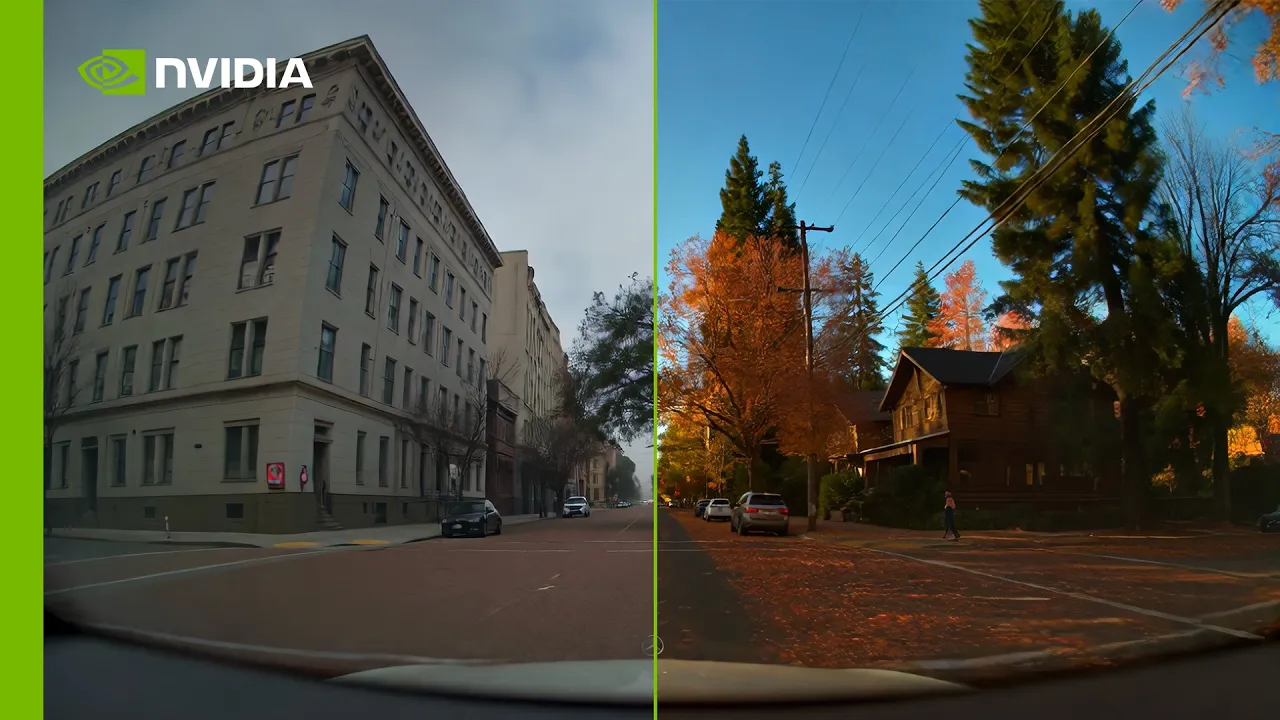
Simulation systems create physically based virtual environments where teams can train, test, and evaluate physical AI before deployment. Because diverse real-world data can be slow, costly, or unsafe to collect, world models and simulation can help create varied scenarios and synthetic data. For robotaxis and autonomous vehicles, teams can evaluate rare and safety-critical road situations.
Digital twins represent real machines and spaces, helping teams test how robots, sensors, and AI agents interact across a facility, including fleet movements, layouts, and workflows. Simulation can also support reinforcement learning and imitation learning for robots. Synthetic data, evaluation results, and operational data can inform further training and validation.
Run AI on Autonomous Machines
Runtime systems enable robots, vehicles, and industrial machines to process sensor data and make decisions in real time. They connect perception, reasoning, planning, and action so machines can operate in dynamic physical environments.
Safety spans all three stages, with validation, monitoring, and evidence integrated throughout development and deployment.

Quick Links
Applications and Use Cases of Physical AI
Physical AI applications span robotics, autonomous vehicles and robotaxis, and industrial AI and manufacturing.
Robotics
Physical AI elevates robots from rigid automation to autonomy that can generalize to new environments and tasks.
- Autonomous mobile robots in warehouses can navigate complex environments and avoid obstacles and workers, using direct feedback from onboard sensors.
- Manipulators, or robot arms, can adjust their grasping strength and position based on the pose of objects on a conveyor belt.
- Surgical robots can learn intricate tasks such as threading needles and performing stitches.
- Humanoid robots need both gross and fine motor skills, plus the ability to move, perceive, understand, reason, and interact with the physical world.
Robotaxis and Autonomous Vehicles
Physical AI helps robotaxis and other autonomous vehicles process sensor data to perceive and understand changing road conditions. Reasoning vision-language-action models can connect perception, planning, and action to support decisions in complex driving situations. Training and validating AVs in physically based simulation helps teams evaluate rare and safety-critical scenarios that are difficult or dangerous to reproduce on public roads.
Industrial AI and Manufacturing
Physical AI helps improve the safety and efficiency of factories and warehouses, where people, vehicles, and robots share dynamic environments. Fixed cameras and computer vision can support operational awareness and route planning by tracking multiple entities and activities. Video analytics AI agents can help detect anomalies and provide real-time alerts. These insights can inform industrial facility digital twins, helping teams simulate workflows, evaluate layouts, and optimize routes before implementing changes in the physical facility.
What Are the Benefits of Physical AI?
Safer Human-Machine Collaboration
Perception and real-time decision-making help machines operate more safely around people and changing conditions.
Greater Adaptability
Physical AI helps machines adjust to changing environments, tasks, and unforeseen challenges.
Higher Precision and Efficiency
Real-time perception and reasoning can improve task accuracy, operational awareness, and responsiveness.
Reduced Data Collection Burden
Simulation and synthetic data reduce the cost, risk, and time required to collect diverse training data.
Challenges and Solutions
Physical AI development presents data and deployment challenges. Simulation, synthetic data, and validation offer practical ways to address them.
Training Data Coverage and Quality
Real-world data may miss rare conditions, while generated data must reflect the environments machines will encounter.
Solutions
- Generate task-relevant variations with physically based simulation.
- Compare synthetic data with real-world examples, then curate and annotate it for training.
- Evaluate models on both synthetic and real-world data to identify coverage gaps.
Safe Deployment and Validation
Robotaxis, other autonomous vehicles, and robots must operate reliably around people and in changing real-world conditions. Performance in simulation may not fully predict behavior after deployment.
Solutions
- Test rare and safety-critical scenarios in simulation and controlled physical settings.
- Compare simulated results with real-world tests and address gaps before deployment.
- Build safety considerations, monitoring, validation, and evidence into the development lifecycle.
Quick Links
FAQs
Generative AI creates content such as text, images, and code, while physical AI helps autonomous machines perceive, reason about, and act in the real world.
Open models give developers greater trust, control, and customization. They can inspect, test, govern, customize, and post-train models for specific environments, tasks, and data, and combine them with other models as needed.
Teams train physical AI systems with real and synthetic data, simulation, and learning methods such as reinforcement learning. They then evaluate system behavior across diverse and safety-critical scenarios before deployment.
Next Steps
Explore Robotaxis and Autonomous Vehicles
Explore how NVIDIA DRIVE brings together open models, simulation, validation, and in-vehicle computing for reasoning-based robotaxis and AVs.
Explore Open Models for Physical AI
Discover NVIDIA open model families for physical AI, robotics, and autonomous vehicles, including Cosmos, Isaac GR00T, and Alpamayo
Engineer Safety for Physical AI
Learn how NVIDIA Halos supports safety across compute, software, evaluation, validation, and deployment for autonomous vehicles and robots.