
Manufacturing
Robot Retasking in High-Mix Manufacturing with Workr
Objective
Workr is a manufacturing AI company focused on integrating artificial intelligence with industrial robotics. Its mission is to make robotic automation adaptable, trainable, and simple, particularly for high-mix, low-volume (HMLV) manufacturing environments where traditional automation has struggled due to frequent part changes and the need for precise, reliable 6DOF pose estimation.
Using NVIDIA Omniverse, Isaac Sim, and accelerated computing, Workr is enabling on-site operators to retask industrial robots in under five minutes, eliminating weeks of traditional programming and bringing flexible automation to 90% of manufacturing that remains unautomated.
Partner
Workr
Customer
Yuasa International
Haas Alfex
Use Case
Robotics
Products
Overcoming the High-Mix Manufacturing Automation Gap
Industrial robots have existed since the 1960s, yet adoption outside high-volume production lines remains limited. Despite decades of technological advancement, almost 90% of manufacturing still remains unautomated in 2025. The challenge isn't the capability of robots themselves—it's the prohibitive time and expertise required to deploy them.
Each new part or cell layout requires expert programming, calibration, and fixture design—work that can take weeks or even months. When production runs change frequently in high-mix environments, that upfront effort outweighs the benefit, forcing most factories to rely on manual labor instead. Traditional automation simply cannot keep pace with the dynamic nature of modern manufacturing, where product variety and customization demands continue to grow.
While interest in AI for manufacturing has intensified, research in embodied AI has focused on "open-world" benchmarks—attempting to solve generalized problems with thousands of scenes and endless novelty. Manufacturing floors present the opposite challenge: robots operate in constrained, predictable environments with limited part variety. What manufacturers need isn't a robot that can navigate any possible scenario, but one that can quickly adapt to the specific tasks within their facilities with the accuracy, robustness, and reliability that manufacturing demands.
Workr robots make automation and machine tending easy, quick and mistake free. It simplifies what has always been a complicated and intimidating process for some.
Didier Bartholome
Senior Applications Engineer, Haas Alfex
Deploying Edge-Based AI for Rapid Robot Configuration
Workr developed a software solution that fundamentally reimagines robot deployment by leveraging NVIDIA GPU-accelerated AI at the edge. The system allows operators to retask robots in under five minutes using nothing more than a tablet, transforming what was once a multi-week engineering project into a simple five-step process.
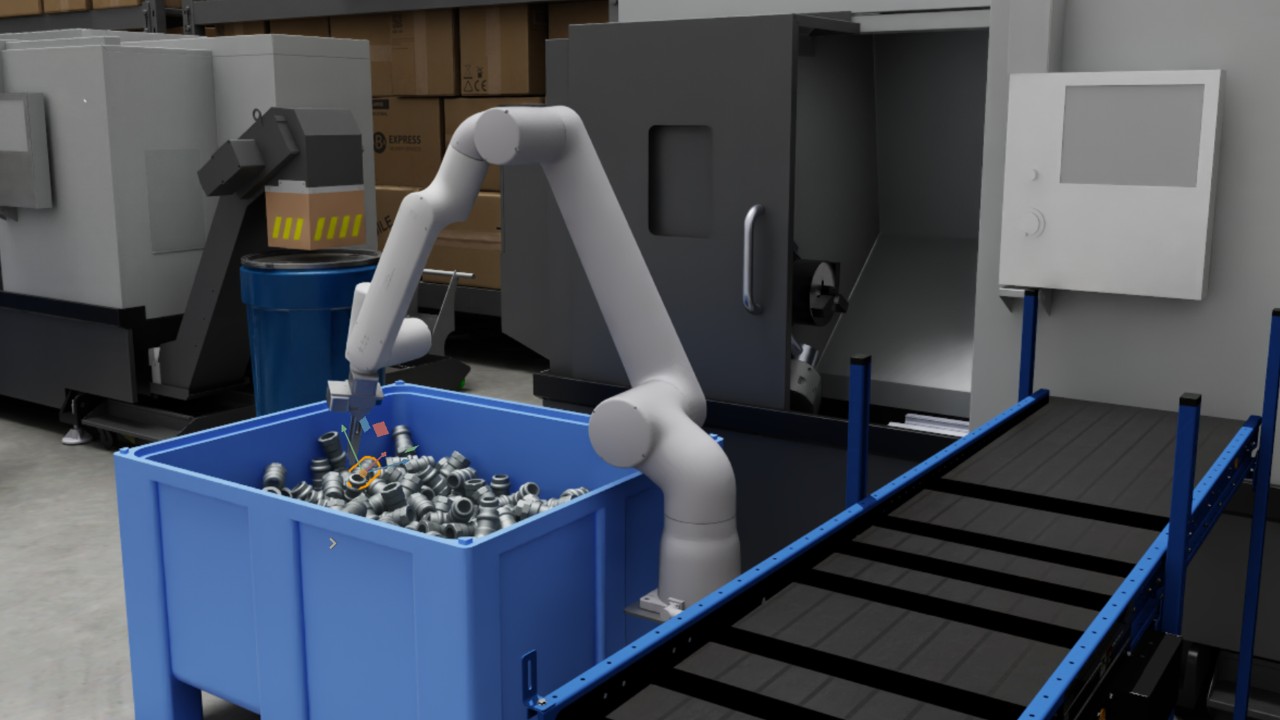
The workflow for configuring a bin pick-and-place operation requires operators to place the component to pick in the “Learn Part Zone” so the robot can scan it with its sensors to make a mesh file for the part, move the robot to the infeed bin area, move it to the outfeed placement area, place an example part in the desired position and orientation, and hit "Learn." At that point, the Workr software takes over, creating the models necessary to start operations in under five minutes. The entire software stack runs on the edge using 2x NVIDIA RTX PRO 6000 Blackwell Max-Q’s attached to any robot cell, eliminating networking requirements and data privacy concerns critical to manufacturing environments.
Under the hood, Workr makes aggressive use of NVIDIA GPU compute to undertake complex tasks: accurately determining the location and orientation of parts in the infeed bin, determining optimal grasp points, and creating safe motion plans that avoid obstacles. The system doesn't require expensive hardware or sensors—multiple industrial RGB+D cameras provides sufficient input when paired with powerful GPU processing.
Workr leverages multiple AI models in its pipeline, including a customized variant of RAFT-Stereo for accurate depth map creation with minimal noise even under adverse conditions, Detectron2 with per-instance finetuned R-CNN models for accurate segmentation of industrial parts, NVIDIA Isaac FoundationPose for robust 6-DOF pose estimation optimized with TensorRT, and NVIDIA Isaa
Workr leverages multiple AI models in its pipeline, including a customized variant of RAFT-Stereo for accurate depth map creation with minimal noise even under adverse conditions, Detectron2 with per-instance finetuned R-CNN models for accurate segmentation of industrial parts, NVIDIA Isaac FoundationPose for robust 6-DOF pose estimation optimized with TensorRT, and NVIDIA Isaac cuMotion for CUDA-accelerated motion planning and collision-free path generation.
Accurate 6DOF pose estimation is a cornerstone for most meaningful physical interactions between robots and their environment. High-mix, low-volume manufacturing presents unique challenges for traditional automation due to frequent part changes. The ‘pre-trained’ nature of models such as NVIDIA’s FoundationPose significantly accelerates the development and deployment of advanced perception capabilities by reducing the need for extensive per-object data collection and training.
Lawrence Spracklen
Chief Technology Officer, Workr
Training AI Models at the Edge With Synthetic Data
Traditional AI model training requires thousands to hundreds of thousands of images. Workr discovered a more efficient approach using NVIDIA Isaac Sim, the open reference robotic simulation framework built on NVIDIA Omniverse. By creating a detailed digital twin of each robot cell, Workr generates physically accurate, labeled synthetic data that closely resembles the real-world environment.
Rather than randomly generating generic images, Workr intelligently integrates objects into the virtual world based on a detailed understanding of when segmentation models struggle and knowledge of cell and bin packing dynamics. This targeted approach means just a handful of images are sufficient to create robust models. RAFT-Stereo and the FoundationPose model require no per-cell fine-tuning, while the Detectron2 segmentation model is quickly customized using the synthetic training data generated through Isaac Sim.
During the cell commissioning phase, Workr performs a trial pick-and-place run and leverages a simple tablet UI interface for human-in-the-loop refinement. Operators select any parts the system may have missed in the bin using Segment Anything 2 model to interpret clicks on the tablet, and perform quick checks on potentially borderline segmentations. This feedback is immediately added to the training set, and an improved model is produced within minutes. This onsite calibration eliminates the need to anticipate every possible variation beforehand, avoiding the common bloat in remotely trained models.
Bringing AI-Driven Flexibility to Manufacturing Operations
Workr's approach leverages the NVIDIA Isaac platform for edge-based training to provide a transformative framework for deploying AI-driven robotics in high-mix manufacturing environments. By running the entire AI training and inference pipeline on NVIDIA GPUs at the edge, new parts can be introduced and robot tasks deployed in under five minutes, dramatically reducing downtime and engineering costs that have historically prevented automation adoption.
The intuitive tablet interface abstracts away the underlying complexity of AI and robotics, empowering on-site operators without specialized programming expertise to confidently configure and manage new automation tasks. With all computation performed locally, the system eliminates cloud dependencies and data privacy concerns while ensuring the reliable, low-latency performance essential for mission-critical manufacturing operations.
In contrast to the complexity and unpredictability of open-world AI benchmarks, Workr focuses on the precision and reliability demanded by manufacturing. By tailoring per-cell, per-part models to fixed workspaces, the AI only needs to master a narrow slice of reality—enabling consistent achievement of strict manufacturing tolerances. The optimized pipeline delivers unmatched speed, accuracy, and robustness purpose-built for the factory floor, finally bringing flexible automation to the 90% of manufacturing that has remained beyond the reach of traditional robotics.
Workr is doing for vision-guided robotics what the PC did for computing — democratizing access, simplifying setup, and empowering manufacturers to deploy automation without writing a single line of code.
Sam Thomason
National Sales Manager, Yuasa International
Ready to jump start your AI robot development? Visit NVIDIA Isaac Sim™