What Is OpenUSD?
Universal Scene Description is an open and extensible framework for describing, composing, simulating, and collaborating in 3D worlds.
Why OpenUSD for Physical AI?
Invented by Pixar Animation Studios, Universal Scene Description (OpenUSD) is an open source framework for describing, composing, simulating, and collaborating on 3D content. OpenUSD is more than just a file format—it’s a framework that serves as a standard for digital twins, physical AI development, and simulation-ready workflows across industries. Through the Alliance for OpenUSD (AOUSD)—founded by Adobe, Apple, Autodesk, Pixar, and NVIDIA—leaders across industries are collaborating to advance OpenUSD standardization and 3D content interoperability.
OpenUSD is a driving force behind the scalability of physical AI providing a common, scene-description language that lets teams bring 3D data, simulation assets, and real-world telemetry into a shared, physically accurate view of the world.
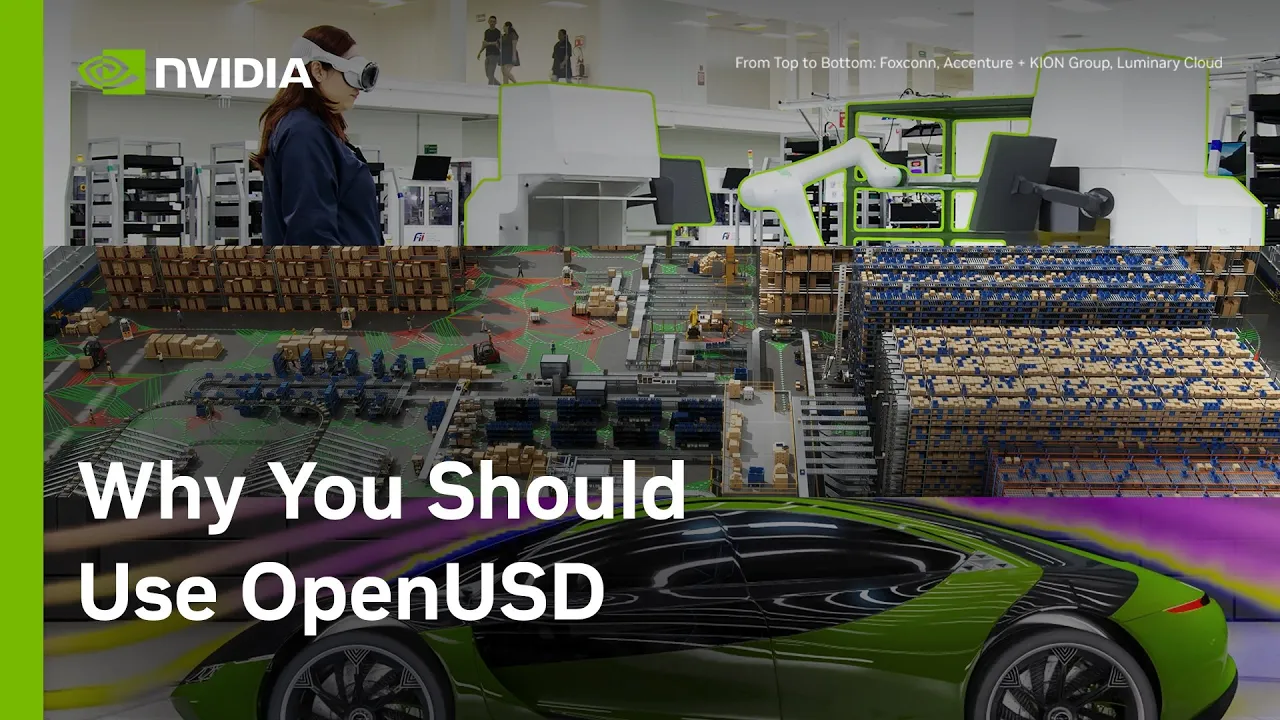
The shared framework is what makes it possible to build, simulate, and validate autonomous systems across the full development pipeline:
- Digital twins: OpenUSD provides the common data layer that assembles sensor streams, CAD geometry, materials, and simulation physics into a unified scene that can be queried and updated in real time.
- Robotics simulation: URDF, MJCF, and CAD assemblies convert to USD with kinematics, colliders, and materials preserved, enabling robots to be validated in physically accurate environments before deployment.
- Synthetic data generation: OpenUSD’s nondestructive layer model lets teams rapidly vary materials, lighting, semantics, and geometry to generate training data for AI models without duplicating assets.
- SimReady asset validation: SimReady specifications define the requirements, capabilities, features, and profiles that OpenUSD assets must meet for supported physical AI simulation workflows.
How OpenUSD Works

OpenUSD unifies multiple data layers into a single view, or “stage,” for seamless collaboration across 3D tools and workflows.
OpenUSD unifies 3D data into a single composed view, or “stage,” where every element is built from layered scene descriptions and composition arcs.
- OpenUSD Stage: All 3D elements come together in a hierarchy of “prims” (primitives, i.e., objects or elements) that include data layers.
- Data Layer Stack: Each data layer has a scene description, including attributes and relationships (such as physics, lightning, shading, and geometry).
- Composition Arcs: To assemble and layer multiple data layer stacks, 3D elements must scale in units of measurement. Key composition arcs include references and variant sets, which store multiple variations of a component without duplicating data.
OpenUSD scales from individual assets to large-scale industrial environments through effective asset structuring and SimReady (simulation-ready) standards:
- Asset Structuring: Well-designed assets (structured container of one or more resources) break 3D content into smaller, manageable components that can be referenced and reused, improving both reusability and performance.
- SimReady Standards: SimReady ensures 3D scenes and assets carry the physical properties, behaviors, and data bindings required for industrial simulations and physical AI training. SimReady specifications define requirements, capabilities, features, and profiles and validation paths for confirming whether assets are ready for physical AI simulations.
What OpenUSD Enables
OpenUSD is the open 3D interchange format that industries are embedding natively into their products. Assets created in film VFX pipelines, CAD tools, game engines, and robotics platforms can coexist in the same simulation environment without file conversion.
OpenUSD natively supports:
- Physics in the scene: Mass, friction, joints, and colliders live directly in USD and can be read by GPU-accelerated engines without a separate renderer or GUI.
- Sensor and metadata integration: Time-series data, semantic labels, and annotations attach directly to 3D geometry.
- Robot and CAD ingestion: URDF, MJCF, and CAD assemblies convert to USD, preserving all kinematics, colliders, and materials.
- Accurate Materials: MDL converts proprietary CAD finishes into physically based materials that render correctly under ray tracing, regardless of source tool.
Because OpenUSD is extensible and nondestructive, it serves as the foundational data layer for physical AI development and agentic AI systems.

Quick Links
What Are the Benefits of OpenUSD?
Extensible
Compose, edit, query, render, and simulate 3D worlds using an open framework built to extend across workflows and tools.
Nondestructive
Create scenes and aggregate assets nondestructively so teams can iterate in parallel without overwriting each other’s work.
Collaborative
Connect scene data across tools using layers, references, schemas, and nondestructive workflows that help teams contribute in parallel.
Standardized
Build against AOUSD-driven standards, including the Core Specification and working groups for materials, geometry, physics, and interoperable 3D workflows.
Challenges and Solutions
Streamlining 3D Development Pipelines
OpenUSD's broad extensibility requires investment and learning to maximize efficiency for asset structuring and 3D pipeline development.
Solutions
- The Learn OpenUSD learning path is a fully open source, customizable curriculum for 3D developers.
Standardization Across Domains
New extensions and domain-specific standards are required as more industries continue to adopt OpenUSD.
Solutions
- The Alliance for OpenUSD (AOUSD) enables open governance and community-driven standardization, with active working groups for materials, geometry, physics, and interest groups in other domains.
Data Compatibility Across 3D Assets
3D assets require OpenUSD compatibility to deliver enhanced data quality and new functionality to 3D assets, like conceptual mapping and ETL (Extract-Transform-Load).
Solutions
- The OpenUSD Exchange SDK accelerates the development of data exchange solutions and empowers developers to create high-quality OpenUSD data.
- USD tools provide OpenUSD converters and validators for common languages (FBX, OBJ, MJCF, URDF, Gaussian Splats) to accelerate time to simulation.
Templated Process for Complex Physical AI Workflows
Physical AI workflows are complex and need specifications to define requirements, capabilities, features, and profiles to validate whether 3D assets meet the physical properties, semantics, and structure required for physically-accurate simulation workflows.
Solutions
- The USD Core Specification defines OpenUSD's standard data types, file formats, and composition behaviors, giving developers a predictable, interoperable foundation for building USD pipelines.
- The SimReady Foundation validates OpenUSD assets against requirements and profiles for supported physical AI simulation and agentic workflows.
NVIDIA’s Contributions to OpenUSD
As a founding member of AOUSD, alongside Adobe, Apple, Autodesk, and Pixar, NVIDIA helps advance OpenUSD for large-scale, physically accurate digital twins and physical AI workflows.
Use Cases for OpenUSD


Next Steps
Start Developing With OpenUSD
Develop with OpenUSD to compose physically accurate 3D scenes and assets used for physical AI simulation.
Learn OpenUSD
Accelerate your OpenUSD workflows with this free, open source curriculum for developers and 3D practitioners.
Contribute to OpenUSD
Shape the standards and evolution of OpenUSD through the Alliance for OpenUSD (AOUSD).
