
Agentic Commerce
Enable AI agents to discover products, negotiate promotions, and complete secure checkouts—all under merchant control.
Workloads
Generative AI / LLMs
Recommenders / Personalization
Industries
Retail/ Consumer Packaged Goods
Business Goal
Return on Investment
Innovation
Products
Why Agentic Commerce Matters for Retailers
Scale Product Discovery Where AI Agents Shop
Agentic commerce represents a fundamental shift in how online shopping works—moving from human-driven browser sessions to AI agents that autonomously discover products, negotiate promotions, complete secure checkouts, and deliver personalized post-purchase experiences on a customer’s behalf.
As AI platforms like ChatGPT and Gemini become primary interfaces for product discovery and purchasing, retailers face a critical integration challenge. Today’s ecommerce infrastructure was built for human-driven browser sessions, not autonomous agent workflows. Without standardized protocols, each agent platform requires custom, fragile integrations that don’t scale—while merchants risk losing control of pricing, inventory, and compliance when delegating decisions to third-party agents.
Agentic commerce solves this by establishing a protocol layer that keeps the merchant in control while enabling AI agents to transact on behalf of customers. This delivers several key advantages:
- New Revenue Channels: Sell directly through AI assistant platforms where shoppers already discover products, serving multiple agent ecosystems from a single deployment.
- Merchant-of-Record Control: Retain full authority over pricing, payments, promotions, and regulatory compliance, even when agents handle the transaction.
- Multi-Agent Orchestration: Deploy specialized agents for dynamic promotions, personalized recommendations, semantic product search, and multilingual post-purchase messaging.
- Reduced Integration Complexity: One open source reference implementation supports both major agentic commerce protocols out of the box.
- Better Shopper Experiences: Customers discover, compare, and purchase through natural-language conversations without leaving their preferred AI assistant.
From Discovery to Checkout—Under Merchant Control

Agentic commerce architectural diagram
For retailers, agentic commerce creates a new commerce layer where AI agents act as intelligent intermediaries—connecting shoppers to products, promotions, and checkout flows through natural-language interactions rather than traditional browsing. The system coordinates multiple specialized agents under a unified protocol framework that standardizes communication between agents and merchants.
This coordination operates through three key pillars:
| Pillar | What It Does |
|---|---|
| Protocol Interoperability | Implements both the Agentic Commerce Protocol (ACP) and the Universal Commerce Protocol (UCP)—one codebase serves both OpenAI and Google agent ecosystems for discovery, checkout, delegated payments, and order lifecycle events. |
| Multi-Agent Orchestration | Four specialized agents operate under merchant authority: promotion pricing (dynamic, real-time offers), ARAG recommendations (contextual cross-sell grounded in inventory), semantic search (intent-aware product discovery), and multilingual messaging (localized post-purchase follow-up). |
| Merchant-Controlled Transaction Security | A delegated payment system keeps every agent action—from price negotiation to checkout—within the merchant's business logic, preserving control over pricing, inventory, and compliance. |
Technical Implementation of the Commerce Protocol
Build Agent-Ready Commerce With Open Standards
The NVIDIA Blueprint for retail agentic commerce provides a complete, open source reference implementation that enables AI agents to conduct end-to-end shopping transactions under merchant authority. Built on the NVIDIA NeMo™ Agent Toolkit and powered by NVIDIA Nemotron™ open models, the system implements dual-protocol support for both the Agentic Commerce Protocol (ACP) and the Universal Commerce Protocol (UCP)—serving both major agentic commerce standards from a single deployment.
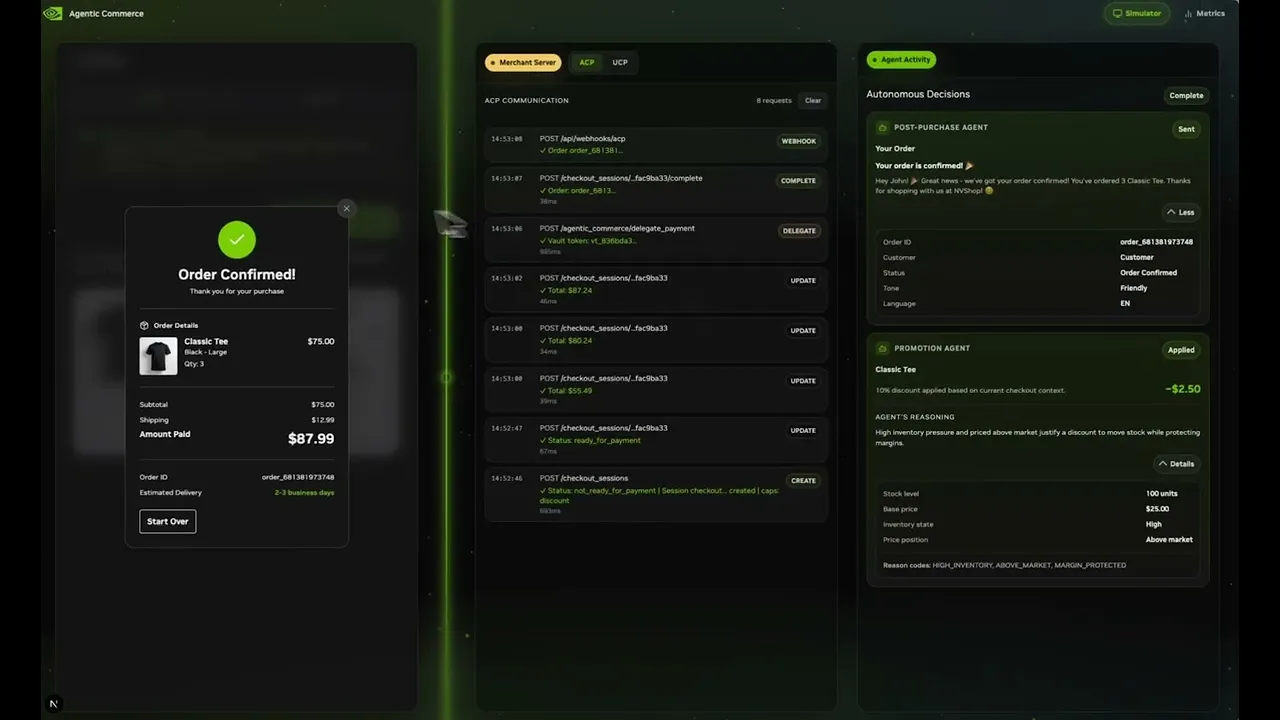
The architecture coordinates four specialized agents through a merchant-controlled protocol layer. The typical workflow includes:
- Agent Discovery and Protocol Negotiation
AI agents—whether from ChatGPT, Gemini, or a merchant’s own application—discover merchant capabilities through standardized protocol endpoints. ACP uses REST-based communication for OpenAI’s Apps SDK ecosystem, while UCP implements A2A JSON-RPC for Google’s agent framework. The protocol layer handles authentication, capability advertisement, and session management so merchants control which agent actions are permitted. - Semantic Product Search and Discovery
The semantic search agent uses NV-EmbedQA-E5 embeddings with Milvus vector search to power intent-aware product discovery. Rather than relying on keyword matching, the agent understands natural-language shopping queries—enabling customers to describe what they need conversationally and receive relevant product results grounded in the merchant’s actual catalog. - Intelligent Promotion and Pricing
The promotion agent leverages NVIDIA Nemotron-3-Nano-30B to generate dynamic, real-time offers based on competitive signals, inventory pressure, and customer context. This replaces static discount rules with AI-driven pricing strategies that optimize both conversion and margin under merchant-defined constraints. - ARAG-Powered Personalized Recommendations
A multi-agent agentic retrieval-augmented generation (ARAG) pipeline orchestrates four specialized recommendation sub-agents to deliver contextual cross-sell suggestions. Each recommendation is grounded in available merchant inventory and informed by the shopper’s browsing and purchase context, producing relevant suggestions rather than generic upsells. - Secure Delegated Checkout and Payment
The delegated payment system processes transactions through merchant-controlled payment service providers, ensuring that pricing, tax calculations, and compliance remain under the merchant’s authority. The protocol layer coordinates cart assembly, payment authorization, and order confirmation across both ACP and UCP flows. - Multilingual Post-Purchase Messaging
After checkout, the post-purchase messaging agent uses Nemotron LLM to generate automated shipping updates, order confirmations, and customer follow-up communications. Content is localized into configurable languages and adapted to the merchant’s brand tone, maintaining a consistent post-purchase experience across channels.
This modular architecture allows retailers to extend or replace individual agents, add new protocol support, or integrate with existing ecommerce platforms and payment service providers. The Apps SDK MCP server provides a ready-made bridge for embedding merchant-owned shopping widgets directly inside ChatGPT, enabling a complete in-agent purchase experience.
Open Source, Ready to Deploy
For teams ready to implement, the NVIDIA Agentic Commerce Blueprint provides the full stack on GitHub with Docker Compose deployment, sample merchant catalog, and protocol activity visualization panels—everything needed to start serving AI agent traffic alongside existing ecommerce channels.
Quick Links
Partner Ecosystem
Get Started With Our Partners
Looking for someone to help you build your own solution? Our solutions are enabled by a network of trusted partners who customize and deploy NVIDIA platforms for every industry and every use case.
Contact NVIDIA to help you identify the most suitable partner for your needs.


Get Started With Agentic Commerce Frameworks
Build This Use Case
Build next-gen shopping experiences for seamless, agent-led commerce from discovery to checkout.
FAQs About Agentic Commerce
Agentic commerce is a paradigm shift where AI agents autonomously perform end-to-end shopping tasks—including product discovery, negotiation, and secure checkout—on a customer’s behalf, moving beyond traditional human-driven browser sessions.
- Learn how agentic commerce enables new revenue channels and merchant-of-record control for transactions handled by AI.
- Explore the fundamental shift from traditional browsing to AI agents acting as intelligent intermediaries in the ecommerce transaction.
The challenge is that traditional ecommerce infrastructure is built for human-driven sessions, leading to custom and fragile integrations for each autonomous AI agent platform; agentic commerce solves this by providing a standardized protocol layer that allows one deployment to serve multiple agent ecosystems while retaining merchant control.
- Read the official announcement and technical overview of the NVIDIA Agentic Commerce Blueprint that addresses this integration complexity.
The blueprint provides new revenue channels by selling directly through AI assistant platforms, retains full merchant-of-record control over pricing and compliance, and simplifies multi-agent orchestration through a single, open source reference implementation.
- Understand how the blueprint helps retailers retain full authority over pricing, payments, and compliance during agent-led transactions.
ACP (Agentic Commerce Protocol) and UCP (Universal Commerce Protocol) are the two major agentic commerce standards; the NVIDIA Blueprint implements both from a single codebase, allowing retailers to serve both the OpenAI (ACP) and Google (UCP) agent ecosystems for discovery and checkout.
- Review the technical implementation of dual-protocol support for agent discovery and negotiation within the blueprint.
When AI agents handle discovery, promotions, and checkout on behalf of customers, retailers need every transaction to still operate within their business rules. Without that control, retailers risk losing authority over pricing, inventory, compliance, and brand experience. Agentic commerce solves this by establishing a protocol layer with delegated payment systems that keep every agent action—from price negotiation to final checkout—within the merchant’s defined business logic.
- Discover how the delegated payment system preserves control over pricing, inventory, and compliance by keeping agent actions within merchant business logic.
The NVIDIA NeMo Agent Toolkit is the foundation upon which the specialized agents in the blueprint are built, providing the core framework for creating, evaluating, and deploying autonomous AI agents.
- Access the technical documentation and resources for the NVIDIA NeMo Agent Toolkit for building custom agents.
Nemotron is a family of open foundation models from NVIDIA, and its open models, like Nemotron-3-Nano-30B, are leveraged by the promotion agent to generate dynamic, real-time offers and by the messaging agent for localized communications.
- Learn about the NVIDIA Nemotron foundation models for AI and data science.
The semantic search agent uses NV-EmbedQA-E5 embeddings with Milvus vector search to understand natural-language shopping queries, allowing customers to conversationally describe their needs and receive relevant product results grounded in the merchant’s catalog.
- Discover how to use Milvus vector search with NV-EmbedQA-E5 embeddings for intent-aware product discovery.
NVIDIA provides open source, production-ready resources to accelerate adoption. The NVIDIA Agentic Commerce Blueprint includes the full stack on GitHub with Docker Compose deployment, a sample merchant catalog, and protocol visualization panels—giving engineering teams a working reference implementation to evaluate against their own commerce environment.
Yes, the architecture is modular by design, allowing retailers the flexibility to extend, modify, or completely replace individual agents or to add new protocol support as their ecommerce needs evolve.
- The modular architecture allows retailers to integrate with existing ecommerce platforms and payment service providers and customize agent functionality.