
Cross Industries
Israel's Meteorological Service Predicts the Weather Using NVIDIA Earth-2
Objective
The Israel Meteorological Service (IMS) is Israel's national weather forecasting agency. They're responsible for providing critical meteorological services to protect lives and support economic activities across the country. IMS is the authoritative source for weather predictions that impact agriculture, aviation, emergency response, and public safety. To streamline accurate forecasting, IMS integrated an AI weather model into their weather forecasting system, powered by NVIDIA Earth-2 and GPUs.
Customer
The Israel Meteorological Service (IMS)
Topic
Simulation / Modeling / Design
Products
Key Takeaways
Massive Compute Acceleration
- Achieved 90 percent computational savings compared with running a classic numerical weather prediction model without AI on a CPU cluster.
Best-in-Class Precipitation Accuracy
- Enabled hyperlocal 2.5-kilometer resolution forecasts with Earth-2
Cost Savings for Municipalities
- Saved 20–30 percent of the Tel Aviv-Yafo Municipality's preparedness budget
Sporadic Weather Changes Mapped With AI Models
IMS is located in a Mediterranean climate zone with diverse weather patterns, from intense flooding to fire seasons. As the climate continues to change, predicting the weather will become increasingly difficult. Now more than ever, reliable tools are essential to saving time, money, and human lives.
Traditional weather models typically take hours to run using large supercomputing clusters. AI weather models, on the other hand, can be run efficiently on a handful of GPUs, lowering the barrier to creating sovereign forecast capabilities, which can be deployed on premises, in the cloud, or at national data centers.
Weather Predictions With NVIDIA Earth-2
IMS adopted NVIDIA Earth-2 to develop a high-resolution weather forecasting system specifically designed for precipitation prediction, known as F3. It has 90 percent lower computational costs compared to non-AI systems while delivering answers in minutes instead of hours.

Comparison of rainfall observations and forecasts over Israel on February 4, 2024. The top row shows radar observations (left), low-resolution (ECMWF IFS, center), and high-resolution (ICON, right), physics-based forecasts. The bottom row shows high-resolution Earth-2 forecasts: ensemble mean (left), 80th percentile (center), and 90th percentile (right).
With Earth 2’s open source software and open science models, IMS built a full stack across hardware and software, which they run as a sovereign capability. They’re now able to issue hyperlocal 2.5-kilometer resolution forecasts, allowing decision- makers to respond more effectively to extreme weather.
IMS was first introduced to NVIDIA Earth-2 via their director general, Amir Givati, when he attended the Climate Conference in Baku, Azerbaijan. Givati realized that AI combined with GPU capabilities could revolutionize weather forecasting.
F3’s Earth-2-powered weather predictions have saved 20–30 percent of the Tel Aviv-Yafo Municipality's preparedness budget allocated for things like urban flood safety.
"If you talk about planning, this is a problem because you have to have a huge amount of compute time to generate these predictions, and AI solved this. Short term, the advantage is a life saving, and long term, it's billions of dollars saved in infrastructure."
Amir Givati
Director General
IMS
Achieving Higher Resolution Forecasts With CorrDiff
IMS specifically utilized NVIDIA Earth-2 Corrector Diffusion (CorrDiff), a neural network model that improves the resolution of weather forecasts without sacrificing accuracy. The team trained CorrDiff to emulate their regional high-resolution ICON model with low-resolution input from the European Centre for Medium-Range Weather Forecasts' Integrated Forecasting System (ECMWF IFS). This allows them to issue a high-resolution forecast four times a day.
IMS achieved comparable-to-better forecast accuracy than traditional non-AI models with dramatically faster processing. The Earth-2 platform can produce multiple possible weather fields, enabling a probabilistic analysis of the forecast. These probabilistic forecasts are generated within minutes with far less energy consumption than traditional methods.
Numerous partners of IMS have begun to adopt these weather forecasts into their own systems and planning operations, including:
- The Israeli Police
- The National Fire and Rescue Authority
- The Ministry of Transportation
- The National Road Company
IMS is seeing the impacts of this model in real time. F3 isn't only enabling fast and accurate weather forecasting-it's saving lives.
A recent early January storm produced 150 millimeters of rain within a six-hour period, causing severe flooding and unsafe conditions for pedestrians and drivers. IMS quickly delivered a high-resolution map showing where flooding would occur, giving government agencies the ability to shut down roads and avoid casualties.
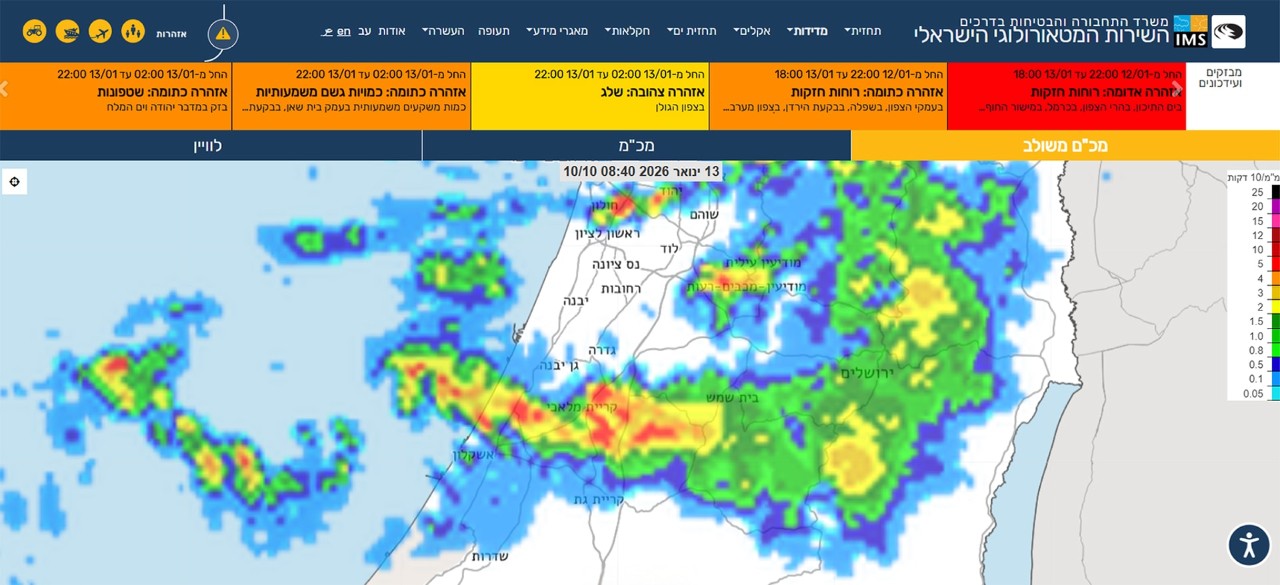
IMS’s forecasting image of six hours of accumulated precipitation, generated by the F3 model.
The next step for IMS is to utilize Earth-2 for long-term climate analysis and international weather forecasting collaboration. IMS will work with the Japan Meteorological Agency to produce the first global, high-resolution AI climate model.
IMS will also be integrating Earth-2 Nowcasting models into their existing systems to continue increasing the resolution of climate simulations, while saving on computational energy.
“We ran six hours of simulations prior to the storm. Of the IMS radar accumulated precipitation versus all our other models, F3 was by far the best."
Amir Givati
Director General
IMS
Explore the world through the NVIDIA Earth-2 model.