
Manufacturing
Humanoid Robot ‘Digit’ Powered by Whole-Body Control Foundation Model
Agility Robotics
Objective
Agility Robotics is a developer of general-purpose humanoid robots that can work in various environments. Digit, the company’s humanoid robot, is designed to work seamlessly in human-built environments without costly facility modification. Digit’s initial use cases focus on addressing critical labor shortages in manufacturing, warehouses, and distribution centers. Ultimately, Agility Robotics intends to deploy Digit across use cases from industrial settings to homes and hotels. To overcome the inherent complexity of achieving reliable whole-body control for humanoid robots operating safely alongside human workers, Agility Robotics leveraged NVIDIA Isaac Sim™ and Isaac™ Lab, reference robotics simulation and learning frameworks built on NVIDIA Omniverse™, to create a breakthrough training methodology.
Partner
Agility Robotics
Customer
GXO Logistics
Schaeffler
Use Case
Robotics
Products
NVIDIA Omniverse
NVIDIA Isaac
Key Benefits
- Improved Step-Recovery Performance: Trained across billions of simulation steps to enhance stability management for Digit when encountering physical disturbances like sudden forces or unexpected terrain.
- Accelerated Development Timeline: Iteration cycles for developing and testing new controllers are reduced from weeks to days through multi-GPU physics-based simulation before real-world deployment.
- Enhanced Real-World Deployment Success: Successfully deployed trained whole-body control foundation models from simulation to real warehouse and manufacturing operations with improved reliability and task performance.
Engineering Complex Whole-Body Control, at Scale
U.S. warehouses face persistent labor gaps on material-handling lines, yet remodeling facilities for fixed automation is costly and slow. Humanoid robots offer a drop-in alternative, but only if they can move with human-level agility in spaces never designed for machines.
The Solution
Agility Robotics takes a “simulation-first” approach to teaching its Digit robot how to stay on its feet in new environments.
Engineers begin by modeling the robot’s chassis in Isaac Sim, using OpenUSD to preserve every joint, mass, and contact surface. Customer CAD and BIM data drop into the same scene graph, and the team scripts thousands of stress-test scenarios—varying aisle widths, floor friction, lighting, and shove forces—to probe every balance-breaking edge case.
Digital twin simulations flow into Isaac Lab, where millions of parallel reinforcement-learning episodes refine Digit’s whole-body controller—the robot’s software “motor cortex.” Perception data stays in the loop, letting Digit learn how vision and motion interact. NVIDIA GPUs push training into the billions of interactions that true dexterity demands.
To prove the controller’s physics isn’t simulator-specific, Agility runs the same policy in a containerized MuJoCo pipeline; differences in contact physics expose corner cases and harden the policy.
By the time the code is deployed to the robot’s hardware, Digit can shrug off bumps, avoid obstacles, and get to work—without costly trial-and-error learning on the warehouse floor.

Agility Robotics
Scaling Humanoid Robot Intelligence for Enterprise Applications
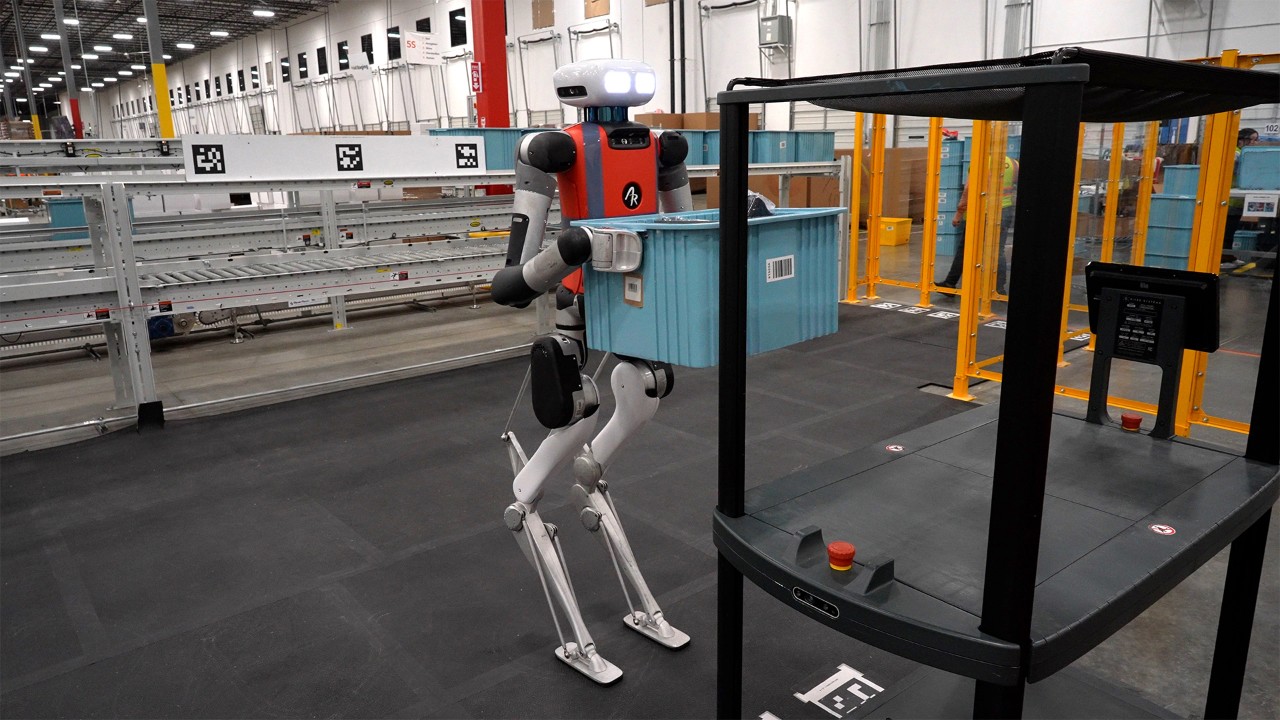
Digit robots are now successfully deployed, performing complex material-handling tasks in live operations.
GXO Logistics: World’s First Humanoid RaaS Deployment
Under an industry-first Robots-as-a-Service agreement, GXO is running Digit fleets in a Georgia fulfillment center. The robots pick totes, sort, and manage inventory alongside human crews, validating that skills learned in Isaac Sim carry straight into high-volume warehouse work.
Schaeffler: Precision Tasks in Automotive Manufacturing
The global motion-technology supplier Schaeffler uses the Mega NVIDIA Blueprint to test workflows before hardware ships. At Schaeffler’s Cheraw, South Carolina plant, Digit now loads and unloads washing-machine housings—proving that a single whole-body foundation model can handle delicate, high-tolerance jobs once thought beyond general-purpose robots.
These rollouts show that Digit’s OpenUSD-trained skills scale from logistics totes to metal stampings, giving Agility and NVIDIA a fast-growing partner ecosystem—and confirming that humanoid intelligence is ready for enterprise production.

Agility Robotics
Looking Forward: The Future of AI-Powered Humanoid Robotics
Agility Robotics envisions a near future in which humanoid robots like Digit become everyday teammates—stocking shelves in retail aisles, shuttling parts on manufacturing floors, and filling labor gaps in warehouses and last-mile hubs. To reach that goal, the company is developing adaptive learning systems that let each robot watch a task demonstrated once, then practice in simulation to master it autonomously.
By training larger, more capable whole-body control foundation models in GPU-powered Isaac Sim—and validating them in Omniverse digital twins—Agility expects Digit to adapt to fresh workflows or unfamiliar layouts in hours rather than weeks. As models generalize across industries and environments, deploying humanoid robots will shift from bespoke integration projects to a scalable, plug-and-play reality for widespread use in almost any environment.
“Isaac Sim running on NVIDIA GPUs lets us simulate years of real-world learning for Digit in just hours. That simulation speedup means we can train for all the conditions we might see on the factory floor.”
Pras Velagapudi
Chief Technology Officer, Agility Robotics
Agility Robotics
Learn more about accelerating automation with NVIDIA robotics solutions.