
Architecture / Engineering / Construction
Foster + Partners Integrates Real-Time Simulation to Transform Architectural Design
Foster + Partners
Objective
Foster + Partners harnesses NVIDIA® CUDA® and RTX PRO™ GPUs to accelerate design simulations and enhance creativity.
Customer
Foster + Partners
Use Case
Simulation / Modeling / Design
Products
NVIDIA RTX GPUs
NVIDIA OptiX
Key Takeaways
The Need for Simulation in Architectural Practice
Performance-based simulation has long been a bottleneck for even the most forward-thinking design firms. Foster + Partners—globally recognized for its decades-long leadership in sustainability and innovation—has long had the in-house capability to calculate daylight autonomy, solar radiation, and sky visibility, all critical factors in designing healthy, energy-efficient buildings. But, this was typically a slower process, as well as being expensive, and fundamentally out of sync with how quickly design decisions need to happen.
This challenge prompted the firm’s Applied R+D team to rethink the role of simulation in architectural practice. Foster + Partners wasn’t just building a faster analysis tool—it was laying the groundwork for a more integrated approach, allowing performance feedback, creative modeling, and design decisions to unfold simultaneously. In a profession where early choices have the greatest impact, bringing simulation into the same space and time as design isn’t just a convenience—it’s transformative.
Real-Time Feedback Brings New Standards in Design
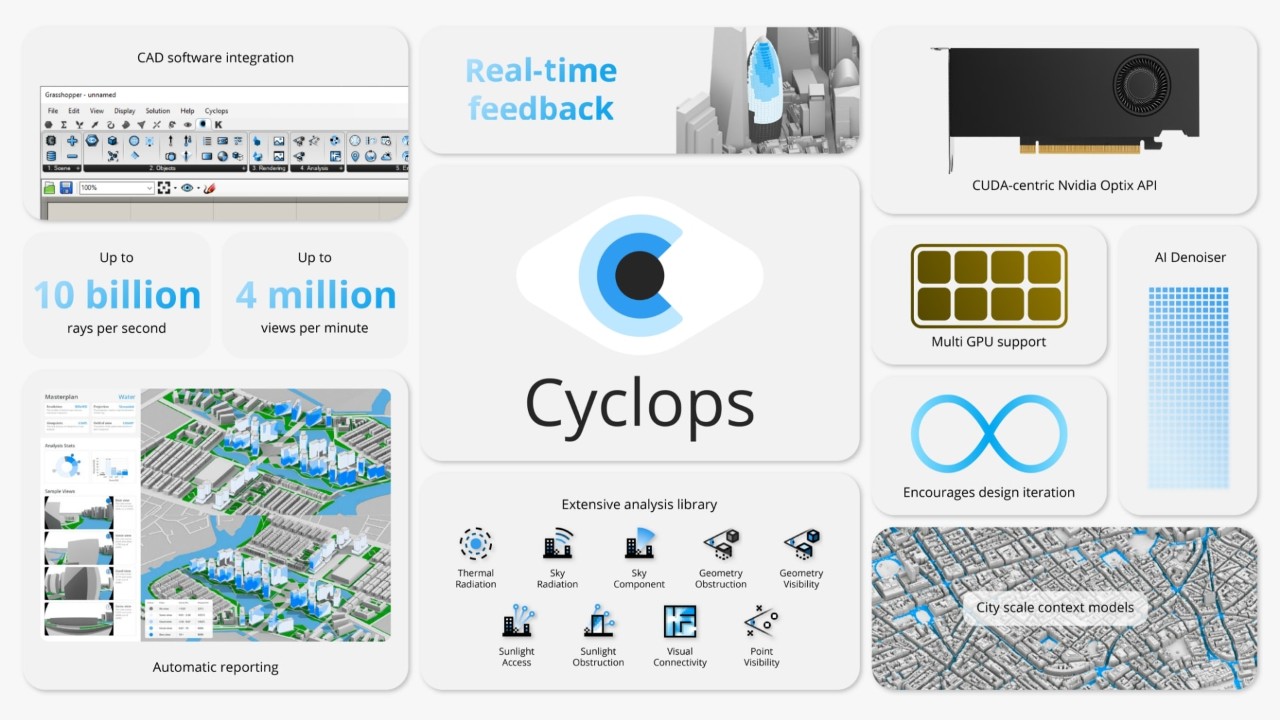
As a result, the firm’s Applied R+D team developed Cyclops, an in-house plug-in for leading 3D modeling application McNeel Rhino, and visual programming environment Grasshopper, commonly used for algorithmic design. Together, these platforms are widely used in architecture for early-stage concept development. Within this workflow, Cyclops radically changes the speed and scale of performance analysis.
At Cyclops’ core is CUDA, NVIDIA’s parallel computing platform that unlocks GPU acceleration for high-performance workloads. Built using CUDA C++ and NVIDIA’s OptiX™ ray-tracing engine, Foster + Partners’ Cyclops takes full advantage of NVIDIA RTX PRO GPUs to deliver real-time, physically accurate environmental feedback directly within the design environment. The same GPU architecture powering advanced rendering and AI is now accelerating architectural simulation—turning what used to be a consultant-driven process into something designers can control themselves.
Cyclops plugin in Grasshopper for radiation, sunlight and daylight analyses on multiple design options.
“The value of environmental feedback is highest at the beginning of the design process,” said Martha Tsigkari, Senior Partner and Head of Applied R+D at Foster + Partners. “That’s when your decisions have the most impact. But traditionally, simulation came too late, after major design moves were already locked.”
With Cyclops, that feedback loop has been compressed to near zero. Simulations like daylight autonomy, solar radiation, and sky components now run directly inside the modeling environment. Designers can test, adjust, and validate in real time during concept design sessions, live client workshops, and even rapid urban prototyping.
Accelerate decision-making with real-time environmental analysis.
This new level of interactivity doesn’t come at the expense of accuracy. Cyclops delivers results with spatial precision on par with CPU methods like Radiance, but 800 to 10,000 times faster using the NVIDIA RTX PRO 6000 Max-Q GPU. “We’re not using approximations—with GPUs, you get the best of both worlds: physical correctness and speed,” said Oscar Borgstrom, associate partner and design systems analyst at Foster + Partners.
These gains have been supercharged by NVIDIA’s latest professional GPU platform, RTX PRO Blackwell. When Foster + Partners tested Cyclops on the NVIDIA RTX 6000 Blackwell Max-Q Workstation Edition GPU, the results redefined its performance ceiling.
“The new NVIDIA Blackwell card has managed to outperform everything we have tested before. For example, when using it with Cyclops, it has performed at five times the speed of NVIDIA RTX 6000 Ampere Generation GPUs. Rendering speeds also increased fivefold, from 100 fps to 500 fps. This allows for tools like Cyclops to provide feedback on how well our design solutions perform in real time as we design them and results in intuitive, yet informed decision making from early conceptual stages,” added Marcin Kosicki, associate partner and design systems analyst at Foster + Partners.
These gains are reshaping the practice from the inside. Designers are no longer dependent on simulation specialists or disruptive export workflows. Sustainability becomes a creative driver, not a technical afterthought, and performance metrics become part of the language of design from the earliest stages.
Tsigkari sees Cyclops not just as a tool, but as a preview of where the entire AEC industry is heading.
“We’re approaching a moment where simulation, optimization, and even some aspects of design will be increasingly automated by AI and real-time tools,” she said. “If your competitive edge is based on hours of manual simulation, that’s going to vanish very quickly.”
Cyclops Opens New Possibilities in Production
Foster + Partners began investing in GPU development, CUDA programming, and in-house simulation tools long before these capabilities became widespread. These investments give the studio strategic agility—the ability to experiment, prototype, and deliver better results faster, all while sharing its breakthroughs with the wider industry.
Cyclops seamlessly fits into current environmental analysis workflows.
Foster + Partners hopes to raise the standard for environmental performance across the profession. Cyclops is freely available to the public—by openly releasing its tool, the company aims to encourage others to bring performance simulation into the heart of the design process.
“It’s not about keeping our tools secret,” said Tsigkari. “It’s about accelerating progress. We want a world where better design decisions are made faster, not just by us, but by everyone.”
With emerging interest in AI agents and surrogate models, the next generation of tools may go even further—proposing optimized geometries, flagging thermal risks, or reconfiguring building forms based on performance intent. For now, Cyclops offers a glimpse into that future where architects are empowered not just by intuition or experience, but by instant insight.
And with NVIDIA’s GPU technologies powering that insight—from CUDA to OptiX to RTX PRO and now NVIDIA Blackwell—that future is already in production.
“AI and GPUs will automate what used to be specialized knowledge. What will define you then is how fast and how creatively you can use that knowledge.”
Martha Tsigkari
Senior Partner, Head of Applied Research and Development
Accelerate advanced rendering architectural simulation with NVIDIA RTX PRO.