Financial Services
How Nasdaq Is Driving Faster Insights and Smarter Investment Decisions with Scalable AI Innovation
Objective
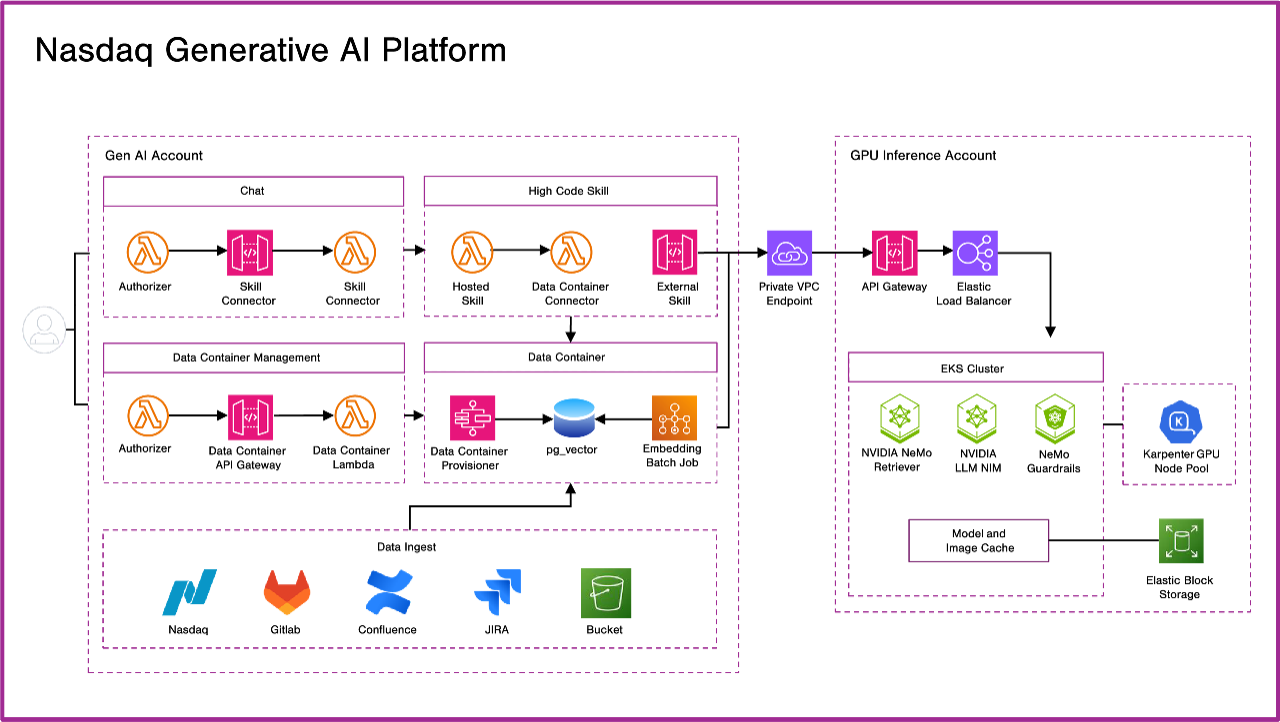
Nasdaq has been a leader in capital markets since 1971, supporting over 130 global marketplaces with advanced technology for trading, settlement, financial crime, and regulatory reporting. The company recently built an AI platform, focusing on improving performance, accuracy, and cost efficiency. The platform enhances Nasdaq’s generative AI capabilities by improving embedding and retrieval efficiency, which in turn boosts search capabilities, reduces expenses, and optimizes resource usage, resulting in faster and more accurate retrieval tasks. Built with NVIDIA NeMo™ Retriever and NVIDIA NIM™ microservices, part of NVIDIA AI Enterprise, Nasdaq’s AI platform is designed to be scalable, secure, and user-friendly. Employees of all skill levels can leverage AI effectively and innovate Nasdaq solutions.
Customer
Nasdaq
Use Case
Generative AI / LLMs
Products
NeMo Retriever
NVIDIA AI Enterprise
Using NVIDIA AI Enterprise, Nasdaq experienced:
Real-Time Feedback:
- NIM offers real-time performance insights, enabling the team to swiftly identify and resolve issues like slow data indexing and inaccurate responses.
30% Faster Response Times:
- The platform’s enhanced processing and retrieval capabilities significantly sped up interactions, making them more efficient.
30% Improved Accuracy:
- Chatbots and conversational interfaces saw a 30% boost in accuracy, minimizing the need for human intervention and enhancing user satisfaction.
Using AI to Enhance Operations, Services, and Products
Nasdaq’s AI strategy is aimed at enhancing both internal operations and external products. The organization is integrating AI at each product level to improve functionality and user experience while also transforming internal work processes to become more agile and self-reflective. By focusing on rapid internal testing and thorough customer-facing solutions, Nasdaq aims to achieve both operational efficiency and customer satisfaction.
“At Nasdaq, we are a technology platform company, and AI has the ability for us to unite all the different businesses and products,” said Michael O’Rourke, senior vice president and head of AI and emerging technology at Nasdaq. “AI will help bring together data from all our businesses and technologies, and help us build better products and services.”
As the team started to build and adopt AI into their workflows, they started to see some challenges, and this required a multi-faceted approach to address technical, governance, and user adoption issues.
Initially, the platform faced some challenges with processing speed and operational costs. Embedding operations were particularly slow, which was unacceptable for a high-performance environment. Additionally, as the platform gained more users, the need for increased model accuracy became crucial. And on top of that, the Nasdaq team wanted to ensure the AI solutions were accessible to all skill levels, scalable, and secure.
To address these challenges while enhancing its platform, Nasdaq used NVIDIA NeMo Retriever and NVIDIA NIM. These technologies played a crucial role in improving the platform’s performance, efficiency, and user experience.
“We found that the NIM architecture is extremely user-friendly, as it provides a straightforward way to quickly deploy AI models,” said Eric Reiser, senior director of software engineering.
As use of Nasdaq’s AI platform grew, the company faced escalating costs and high latency, especially in embedding operations. By implementing self-hosted GPU embeddings using NVIDIA NIM, Nasdaq significantly reduced expenses and optimized resource usage.
NeMo Retriever microservices enhanced search capabilities, leading to more accurate and relevant results. The platform’s flexibility, ease of deployment, and scalability allowed Nasdaq to efficiently manage large volumes of data and perform high-demand AI tasks with advanced technologies like NVIDIA L40 GPUs, ultimately enhancing its AI capabilities and overall operational efficiency.

How Nasdaq’s Global Hackathons Accelerated Its AI Platform Development
Nasdaq conducted a series of four global hackathons to serve as a proof of concept for its AI platform. These hackathons, each spanning three days per region, involved both coders and non-coders and focused on building chatbots and other AI applications.
The events generated hundreds of hacks, providing valuable data to build a thesis on the platform’s potential ROI. During the hackathons, teams tested the platform live, offering immediate feedback on features and performance. This feedback highlighted areas for improvement, such as accuracy and data indexing speed.
The hackathons not only accelerated development but also demonstrated the platform’s potential to significantly enhance daily efficiency and productivity across the company. Following the successful hackathon series, Nasdaq prioritized the implementation of the most impactful hacks, which dictated the entire roadmap for AI adoption.
The engineering department saw significant activity, with 50 hacks focused on enhancing internal processes, while customer service benefited from 30 hacks that created efficient chatbots. Marketing and legal teams also embraced the platform, with marketing taking the lead in its usage and legal focusing on managing risk and regulatory compliance.
The hackathons highlighted the need to move AI services into production immediately, leveraging insights from the proof of concept. This move resulted in a 30% improvement in speed, better results, and reduced costs. Key features requested during the hackathons included more access to data connectivity, integrations with other tools, and the ability to chat with the platform via an API layer. The platform was designed to be user-friendly, allowing for no-code data integration and easy linking of APIs.
Faster Response Times, Enhanced Accuracy With Enterprise and Business Data
To develop the platform, Nasdaq used NeMo Retriever, a collection of generative AI microservices enabling enterprises to seamlessly connect custom models to diverse business data and deliver highly accurate responses. It enabled the creation of sophisticated chatbots and other conversational interfaces, which were a key focus during the hackathons.
By leveraging NeMo Retriever, Nasdaq achieved:
- 30% Faster Response Times: The platform’s ability to quickly process and retrieve information was significantly enhanced, leading to faster and more efficient interactions.
- 30% Improved Accuracy: Chatbots and conversational interfaces became 30% more accurate, reducing the need for human intervention and improving user satisfaction.
“Improving accuracy had a big impact on groups,” said O’Rourke. “Moving to NeMo Retriever and NIM allowed us to build up more engagement with the platform, because it was coming back faster—so this meant our users can do more meaningful work, and use the platform as part of their daily workflows.”
When comparing its previous managed service embeddings with the NVIDIA NeMo Retriever embeddings, Nasdaq experienced reduced processing time per chunk, leading to faster responses and an improved user experience. This time savings also enabled more frequent data indexing, ensuring that agents and skills always have up-to-date information.
NIM was used to optimize the deployment and management of AI models, ensuring that the platform could handle high volumes of requests with minimal latency. Key benefits include:
- Predictable Costs and Scalability: The platform leverages the NVIDIA AI Enterprise subscription model, providing predictable costs and enabling Nasdaq to scale operations without financial uncertainty. This is essential for financial institutions that need to manage budgets and resources efficiently.
- Real-Time Feedback: NIM provided real-time insights into model performance, allowing the team to quickly identify and address issues, such as slow data indexing and inaccurate responses. This ensures that the system remains reliable and efficient, which is critical in financial services where data accuracy and timeliness are crucial.
“NVIDIA NIM and NeMo Retriever provided a more powerful platform than the capabilities we had previously used—it delivered improved speed that enhanced the user experience, and perhaps most importantly, it generated substantial long-term savings that justify the investment,” said Reiser.
Nasdaq experienced improvements such as enhanced productivity and improved user experience. By integrating NeMo Retriever and NIM, the team streamlined the development process, enabling them to focus on higher-value tasks. Users benefit from faster, more accurate, and more reliable interactions with the platform, leading to higher satisfaction and adoption rates.
The platform’s enhanced capabilities also provided valuable data and insights, helping the team make informed decisions and prioritize features based on user feedback.
“Improving accuracy had a big impact on groups. Moving to NeMo Retriever and NIM allowed us to build up more engagement with the platform, because it was coming back faster—so this meant our users can do more meaningful work, and use the platform as part of their daily workflows.”
Michael O’Rourke
Senior Vice President, Head of AI and Emerging Technology at Nasdaq
Expanding AI to Future Use Cases
The team plans to expand the use of these AI technologies across Nasdaq’s vast data ecosystem, which includes over 160 petabytes of data. Over 5,000 companies list securities on Nasdaq’s exchanges, and its technology powers 135 marketplaces in 55+ countries. This extensive reach highlights the potential of the platform to serve a global customer base, making it a powerful tool for financial institutions looking to expand their operations and services.
Nasdaq is exploring several future use cases to further enhance its platform with NVIDIA solutions. One key area is the use of NVIDIA NeMo Retriever extraction, which will allow Nasdaq to offload some of its bespoke regulatory pipeline processes. The team plans to use the multi-modal processing capabilities of the NeMo Retriever extraction to handle both text and image data more efficiently.
Another development is the extension of the platform beyond text with image generation and multimodal guardrails, which will enable users to generate content for images and charts. By running these models on a GPU cluster, they can significantly improve the quality and speed of content generation.
Additionally, Nasdaq is looking to enhance query performance with a GPU-based vector store using NVIDIA RAPIDS™ cuVS-accelerated vector stores. This will optimize the handling of large datasets, ensuring that their data stores remain efficient and responsive, even as platform usage grows. These advancements will further solidify Nasdaq’s position as a leader in financial technology, providing more robust and versatile services to its users.
Discover how NVIDIA NeMo Retriever and NIM can power AI initiatives.