NVIDIA DLSS 4.5 Delivers Major Upgrade With 2nd Gen Transformer Model For Super Resolution & 6X Dynamic Multi Frame Generation
Since its debut at CES 2025, DLSS 4 has set the standard for AI rendering with transformer-based Super Resolution and 4X Multi Frame Generation. Over 250 games and apps are already supported, making DLSS 4 with Multi Frame Generation NVIDIA’s most rapidly adopted gaming technology.
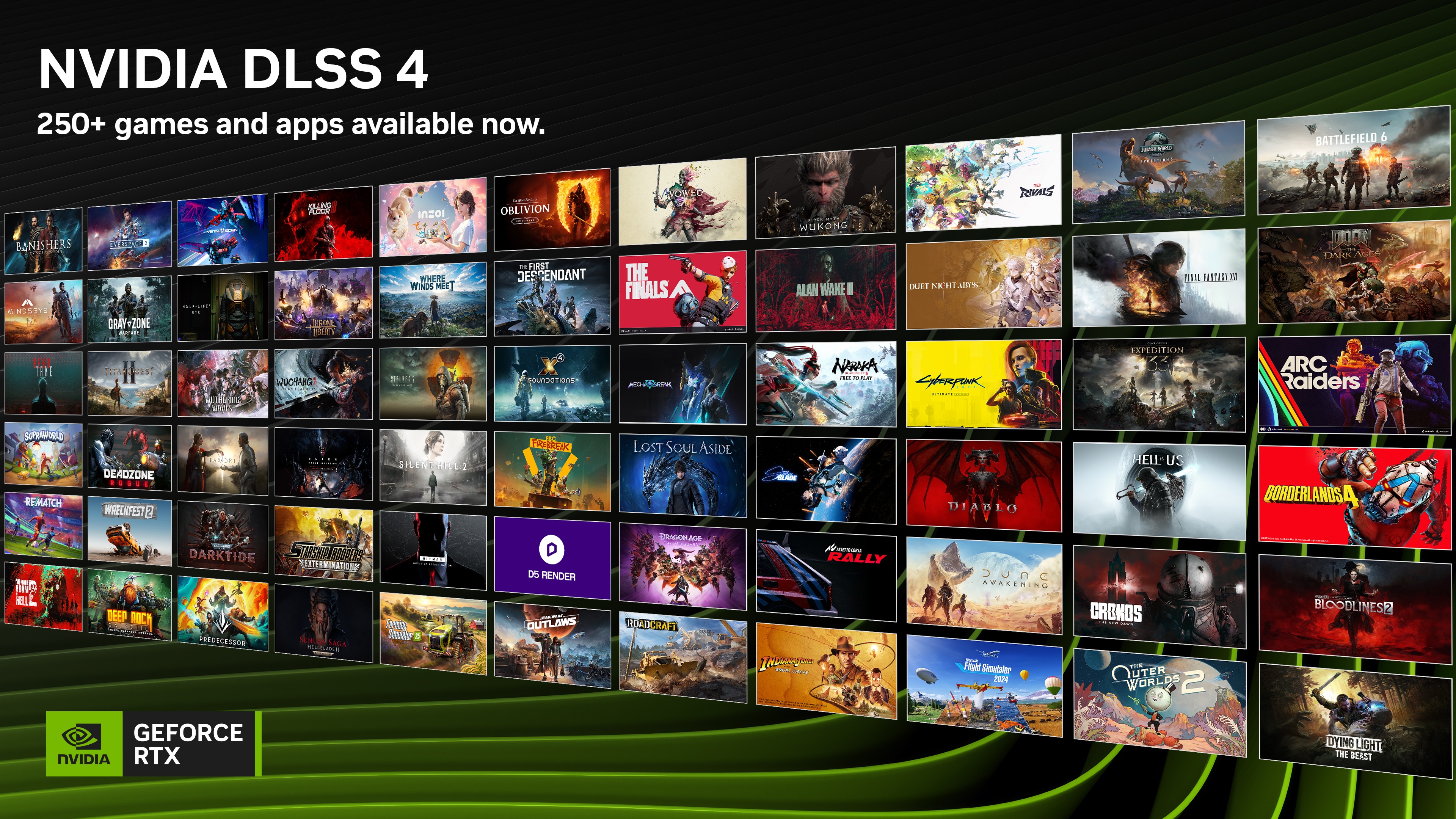
At CES 2026, we’re raising the bar with NVIDIA DLSS 4.5, introducing a 2nd generation transformer model for DLSS Super Resolution, delivering state-of-the-art image quality for all GeForce RTX GPUs in over 400 games and apps.
NVIDIA DLSS 4.5 also introduces Dynamic Multi Frame Generation and a new 6X Multi Frame Generation mode. When combined, DLSS 4.5 can generate up to five additional generated frames per traditionally rendered frame, dynamically boosting performance up to the refresh rate of your display, enabling 240+ FPS gaming with path tracing on GeForce RTX 50 Series GPUs.
All GeForce RTX owners can use the NVIDIA app to upgrade games and apps to DLSS 4.5 Super Resolution today, by installing our latest NVIDIA app update.
This Spring, NVIDIA DLSS 4.5 Dynamic Multi Frame Generation and 6X Multi Frame Generation will be released for GeForce RTX 50 Series GPUs.
NVIDIA DLSS 4.5 Super Resolution: Superior Image Quality For All GeForce RTX Gamers, Available Now
Building on eight years of research, including six years refining Convolutional Neural Networks (CNNs), we are introducing the first major upgrade of our transformer architecture with DLSS 4.5 Super Resolution. This second-generation model is our most sophisticated yet, utilizing five times the compute power of the original transformer model, having been trained on a significantly expanded, high-fidelity dataset. The model has a deeper understanding in every scene, and more intelligently uses game engine pixel sampling and motion data to deliver images that have better lighting, finer edges, and improved motion clarity.
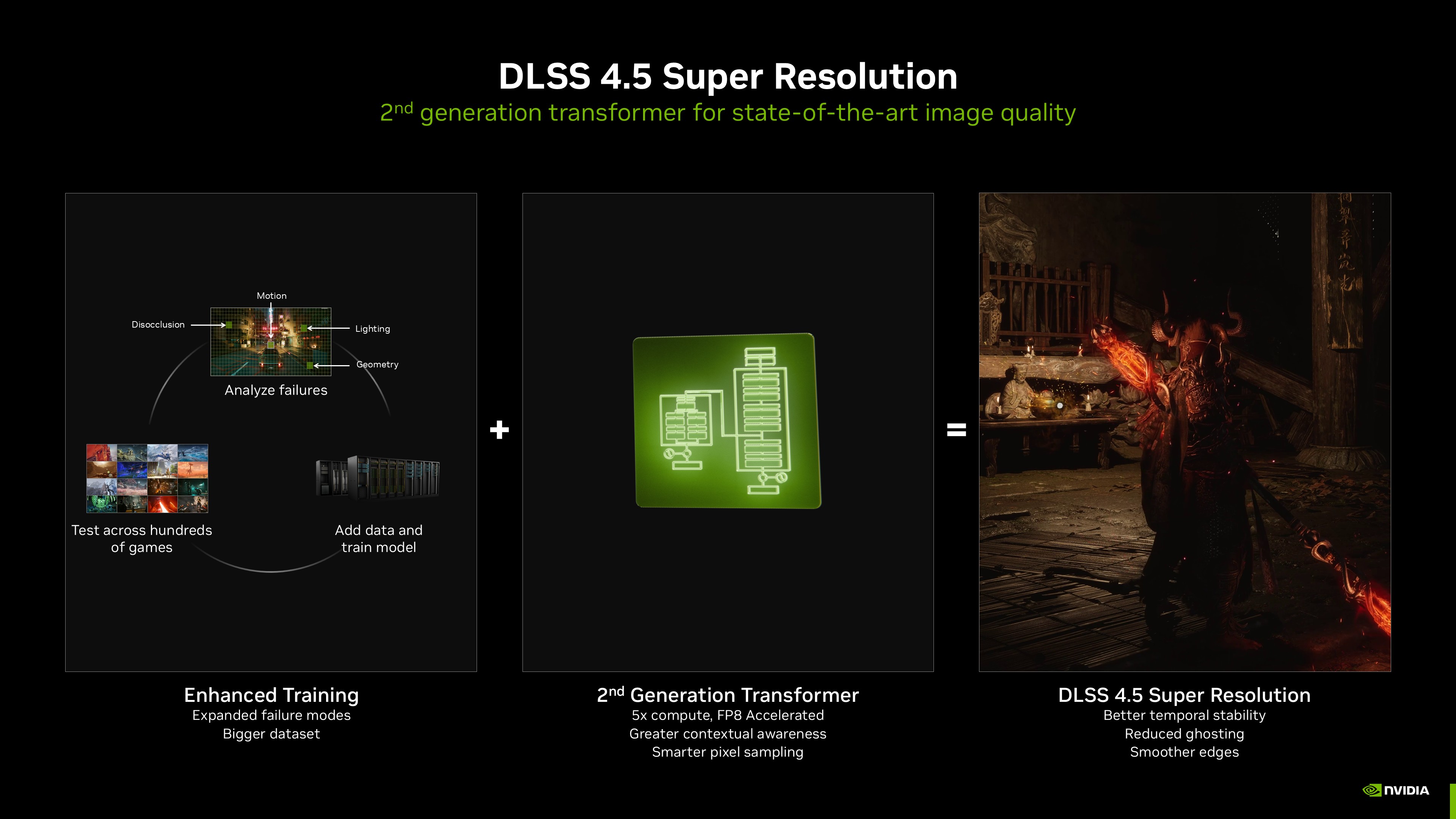
DLSS 4.5 Super Resolution: Forged by 8 years of continuous innovation
DLSS 4.5 achieves a breakthrough in lighting effects by solving a traditional challenge faced by Temporal Anti-Aliasing (TAA), and earlier super resolution models. Previous techniques operated in logarithmic space to dampen flickering, which unfortunately resulted in muted lighting, clipped details, and crushed shadows in high-contrast scenes. In comparison, DLSS 4.5 Super Resolution trains and infers directly in linear space, the game engine’s native ground truth. Because the new AI model is powerful enough to manage instability without compressing the data, it accumulates lighting with physical accuracy, allowing glowing neon signs and bright reflections to retain their full color range and detail.
DLSS 4 vs. DLSS 4.5 Super Resolution in Black Myth: Wukong
DLSS 4.5 Super Resolution takes full advantage of GeForce RTX 40 and 50 Series GPUs, which benefit from faster, more advanced Tensor Cores in our latest architectures. By leveraging FP8 precision capabilities, the hardware doubles inference throughput, allowing the 2nd generation transformer to run with a minor performance tradeoff compared to the first.
While DLSS 4.5 Super Resolution enhances image quality across all settings, including Quality and Balanced modes, the transformation is greatest in Performance and Ultra Performance modes, where fewer rendered pixels are available.
By leveraging the power of the 2nd generation transformer, Performance Mode is now comparable to, and can even beat, native image quality, while Ultra Performance has evolved into a truly viable mode for 4K gaming. Overall, DLSS 4.5 delivers a significant leap in image quality across the board, resulting in sharper anti-aliasing, reduced ghosting, and enhanced temporal stability.
In this example from The Elder Scrolls IV: Oblivion Remastered, the original transformer model for DLSS 4 Super Resolution exhibited ghosting in fast motion, in certain challenging areas. With DLSS 4.5 Super Resolution, fast-moving objects remain clearer, with drastically fewer trailing artifacts.
Reduced Ghosting at 4K in Performance Mode: Fast-moving objects remain clear, with fewer trailing artifacts
In this example from Indiana Jones and the Great Circle™, the original transformer model for DLSS 4 Super Resolution exhibited jaggy edges when the character walked across the screen. With DLSS 4.5 Super Resolution, edges are rendered with greater clarity and precision.
Sharper Anti-Aliasing at 4K in Performance Mode: Edges are rendered with significantly greater clarity and precision
In this example from Kingdom Come Deliverance 2, the original transformer model for DLSS 4 Super Resolution exhibited shimmering on the table. With DLSS 4.5 Super Resolution, the table remains crisp and stable in motion.
Enhanced Temporal Stability at 4K in Performance Mode: The image remains crisp and stable in motion
NVIDIA DLSS 4.5 With Multi Frame Generation: Maximize Smoothness With New 6X Mode
DLSS 4.5 delivers a leap in smoothness with the new 6X Mode of Multi Frame Generation. Powered by the superior image stability of our 2nd generation transformer model, along with improvements in frame pacing and image quality, DLSS 4.5 can generate five additional frames for every single natively rendered one, for a maximum 6X multiplier.
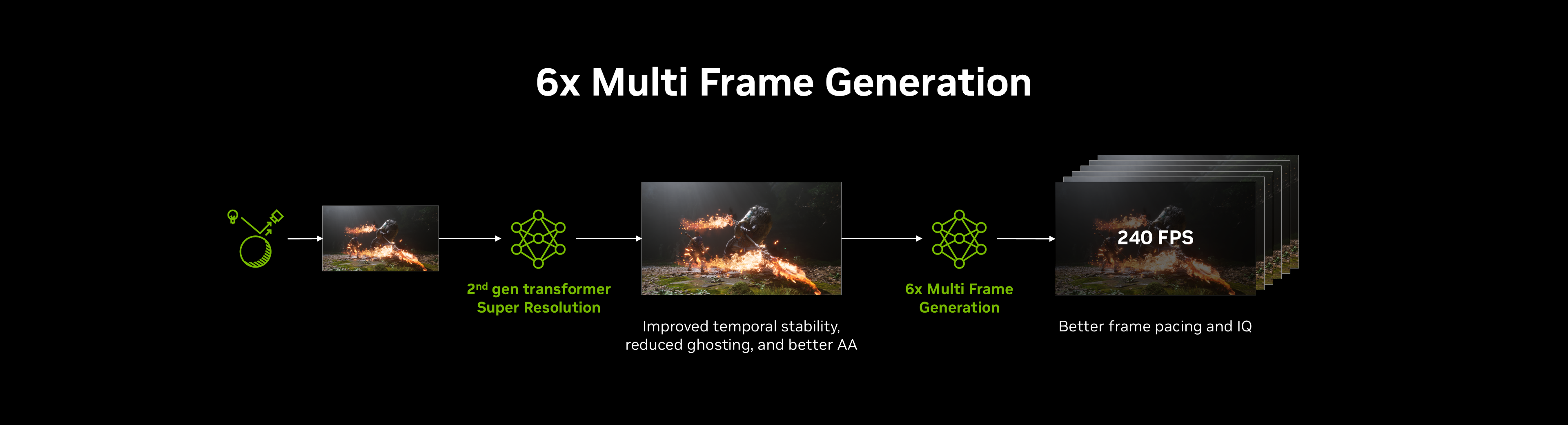
NVIDIA DLSS 4.5 Multi Frame Generation 6X Mode - Made possible by DLSS Super Resolution and DLSS Frame Generation improvements
This creates the smoothest path-traced gaming yet, unlocking the full potential of 240Hz and 360Hz monitors. On GeForce RTX 50 Series GPUs, the shift from 4X to 6X Multi Frame Generation increases 4K frame rates in path-traced titles by up to 35%. Combining this highly efficient Frame Generation model with NVIDIA Reflex low latency technology means DLSS 4.5 can generate these additional frames with minimal impact to responsiveness.
The upcoming Frame Generation model update also enhances in-game user interfaces by incorporating additional game engine data, improving visual quality and clarity of static user interface elements. In The Outer Worlds 2, Marvel’s Spider-Man 2™, Dragon Age™: The Veilguard, Starfield, and other titles, players will notice crisper minimaps and cleaner user interface elements.
Outer Worlds 2: Improved user interface elements with the new DLSS 4.5 Multi Frame Generation Model
NVIDIA DLSS 4.5 Dynamic Multi Frame Generation: Maximizes FPS To Monitor Refresh Rate For Optimum Performance
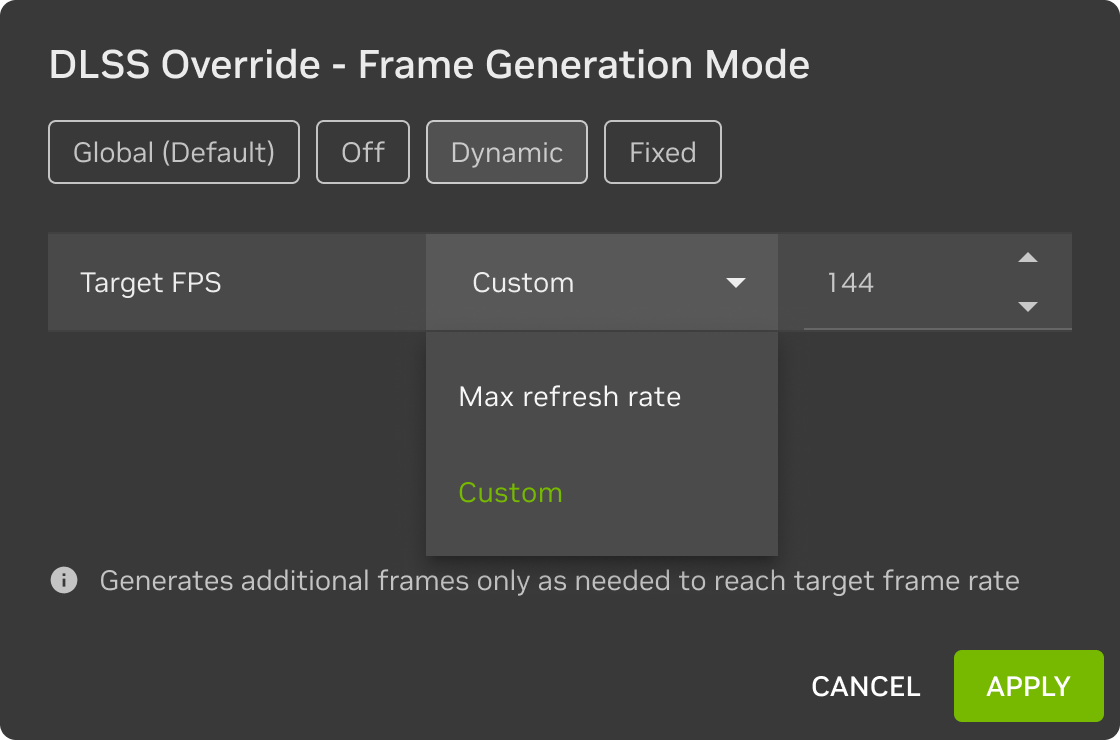
DLSS 4.5 also introduces Dynamic Multi Frame Generation, an intelligent system that functions like an automatic transmission for your GPU. Instead of sticking to a fixed multiplier, it automatically shifts between different frame multipliers to strike the perfect balance between frame rate, image quality and responsiveness. In other words, it only generates the frames needed to maximize your target frame rate, or the refresh rate of your display, be that 120Hz, 144Hz, 240Hz, or higher.
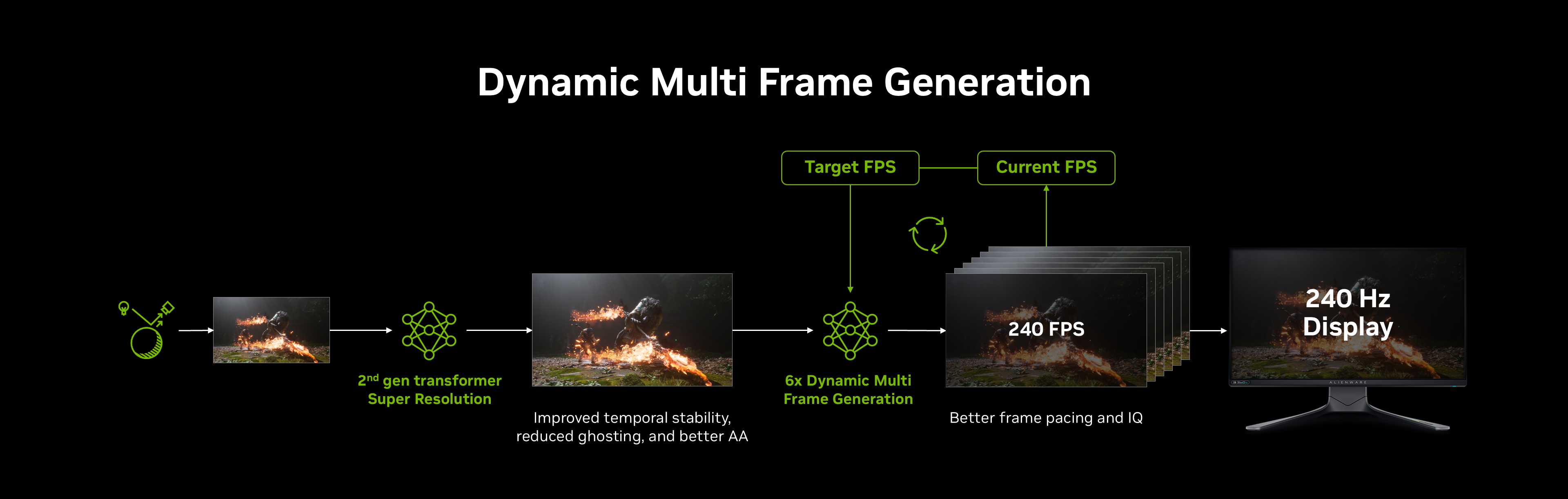
By continuously monitoring the gap between your GPU’s performance and your display’s maximum refresh rate, the system adapts in real-time. In graphically intense scenarios, it ‘upshifts’ and increases frame generation to bridge performance dips, ensuring your high-refresh display remains buttery smooth. Conversely, as the workload lightens, it seamlessly shifts the multiplier down to only compute what’s needed.
DLSS 4.5 Dynamic Multi Frame Generation maximizes frame rates on a 240Hz display
Upgrading To NVIDIA DLSS 4.5
Dynamic Multi Frame Generation, 6X Multi Frame Generation, and the 2nd generation transformer Super Resolution models are built to be backwards compatible with existing DLSS integrations. Upgrading and enhancing DLSS games to DLSS 4.5 takes just a few clicks in the NVIDIA app.
Available Now: With our latest NVIDIA app update, all GeForce RTX users can experience the new DLSS 4.5 Super Resolution model in over 400 titles. Simply select “DLSS Override - Model Presets” in the Graphics tab, and choose “Recommended”, which sets Preset M to DLSS Performance mode, Preset L to DLSS Ultra Performance mode, and Preset K to the remaining modes.
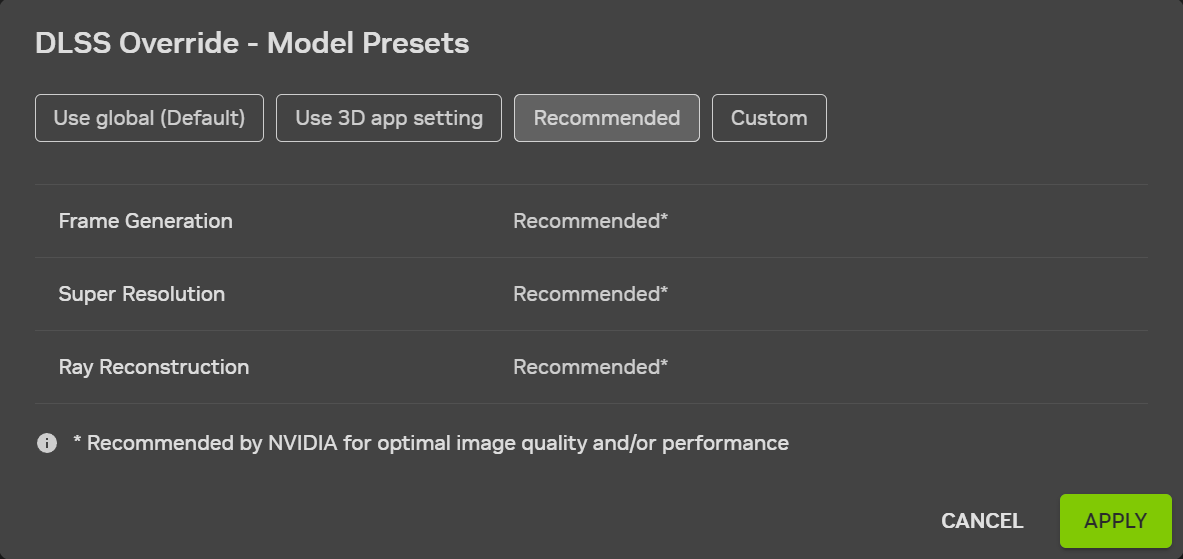
This new “Recommended” setting replaces “Latest” to better align with the two new DLSS 4.5 Super Resolution models: Model M is optimized for DLSS Super Resolution Performance mode, and Model L is optimized for 4K DLSS Super Resolution Ultra Performance mode. While both models are supported for both DLSS Super Resolution Quality and Balanced modes, and DLAA, users will see the best quality vs. performance benefits in Performance and Ultra Performance modes.
Please note that GeForce RTX 20 and 30 Series GPUs lack native FP8 support, so Models M and L carry a heavier performance impact for these GPUs. Those users may therefore prefer to remain on Model K (DLSS 4.0), for an optimal balance of performance and image quality. With the NVIDIA app's DLSS Overrides, you control the Model, and the balance between image quality and performance for your PC.
To verify that the intended model is enabled, turn on the NVIDIA app overlay statistics view via Alt+Z > Statistics > Statistics View > DLSS.
Coming Spring: GeForce RTX 50 Series gamers will be able to multiply performance with DLSS Dynamic Multi Frame Generation and the new Multi Frame Generation 6X Mode in over 250+ games and apps via the NVIDIA app this Spring.
NVIDIA DLSS 4.5: The Best Gets Better
Combining the 2nd generation transformer Super Resolution model, and Dynamic Multi Frame Generation up to 6X, DLSS 4.5 delivers unmatched image quality and an up to 35% performance boost for 4K 240Hz path-traced gaming.
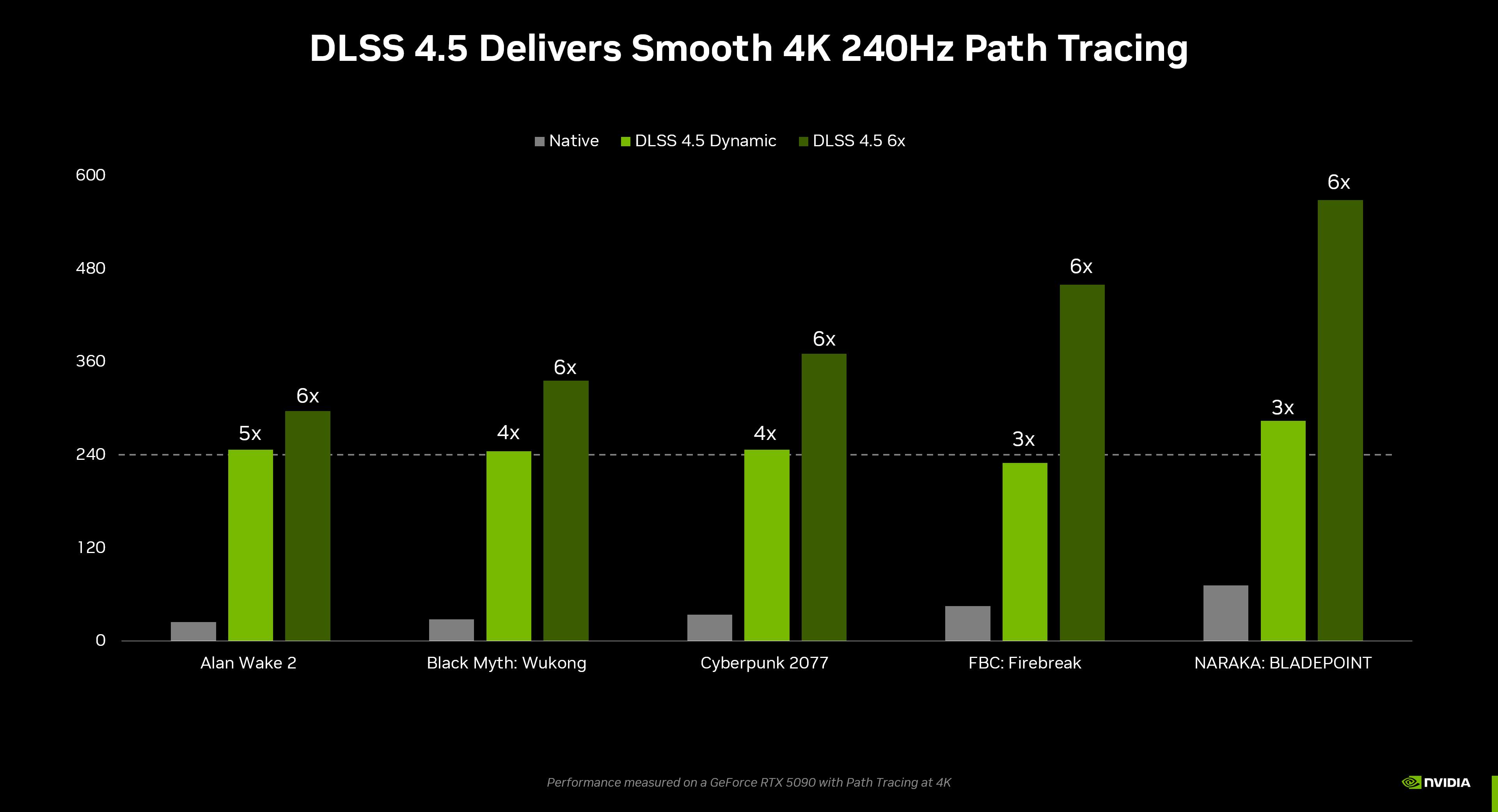
DLSS 4.5 Dynamic Multi Frame Generation and 6X mode
See the benefits in action for yourself in this clip from Black Myth: Wukong:
DLSS 4 vs. DLSS 4.5 in Black Myth: Wukong: Better image quality and faster gameplay at 240 frames per second
NVIDIA DLSS has transformed gaming by multiplying performance and increasing image quality through its ever-improving AI technology. DLSS 4.5 delivers even higher image quality and smoother frames, giving GeForce RTX desktop and laptop gamers new upgrades to make their games and apps even better.
Stay tuned to GeForce.com to learn about future DLSS developments, and in the meantime, check out our other CES 2026 announcements to see how we’re further improving your games and apps.