What Is OpenUSD?
Universal Scene Description is an open and extensible framework for describing, composing, simulating, and collaborating in 3D worlds.
What Is OpenUSD?
Invented by Pixar Animation Studios, Universal Scene Description (OpenUSD) encompasses a collection of fundamental components and capabilities that accelerate workflows, teams, and projects. OpenUSD is more than just a file format—it's an open-source framework that serves as a standard across industries, enabling the development of digital twins and AI in 3D worlds. Through the Alliance for OpenUSD (AOUSD), NVIDIA, Pixar, Adobe, Apple, Autodesk, and others promote the interoperability of 3D content with OpenUSD.
How OpenUSD Works

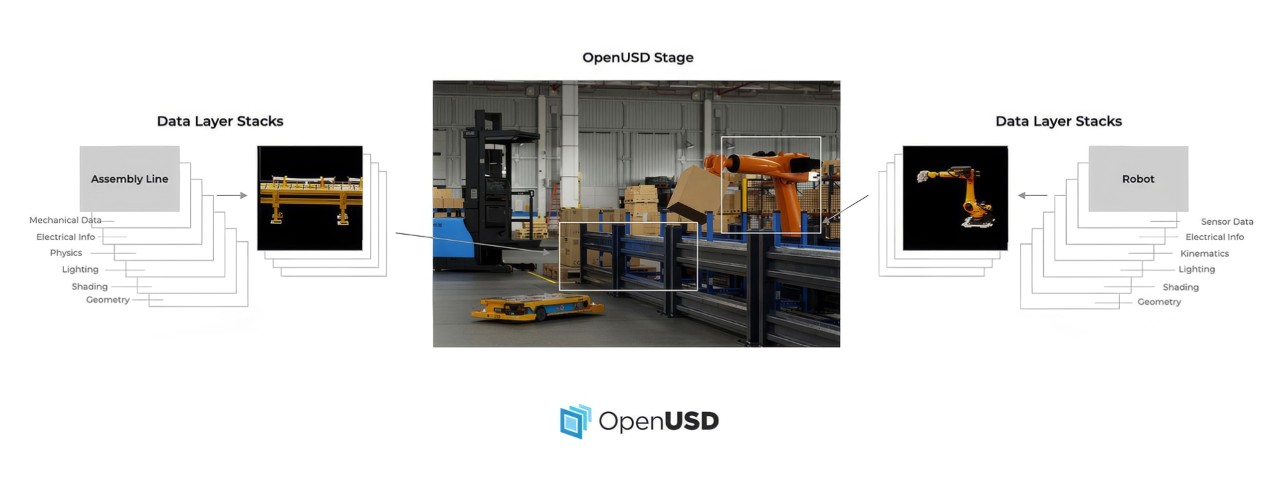
OpenUSD unifies multiple data layers into a single view for seamless collaboration across 3D tools and workflows.
OpenUSD unifies 3D data into one unified OpenUSD stage, and each 3D element is built with data layer stacks and composition arcs.
- OpenUSD Stage: All 3D elements come together in a hierarchy of “prims” (primitives, i.e., objects or elements) that include data layers.
- Data Layer Stack: Each data layer has a scene description, including attributes and relationships (such as physics, lightning, shading, and geometry).
- Composition Arcs: To assemble and layer multiple data layer stacks, 3D elements must scale in units of measurement. Key composition arcs include references and variant sets, which store multiple variations of a component without duplicating data.
OpenUSD scales from individual assets to large-scale industrial environments through effective asset structuring and simulation-ready standards.
- Asset Structuring: Well-designed asset structures break down 3D content into smaller, manageable components that can be easily referenced and reused, improving both reusability and performance by loading only necessary components when needed.
- Simulation-Ready Standards: Simulation-ready (SimReady) assets ensure 3D scenes are physically accurate and incorporate real-world properties, behaviors, and data bindings needed for industrial simulations and physical AI training.
The multi-part specification being developed in the Alliance for OpenUSD, starting with Core Specification 1.0, formally defines how OpenUSD works, ensuring consistent behavior across all implementations.

Quick Links
What Are the Benefits of OpenUSD?
Extensible
OpenUSD provides an open framework and ecosystem with SDKs for composing, editing, querying, rendering, collaborating, and simulating within 3D virtual worlds.
Non-Destructive
OpenUSD enables non-destructive workflows in scene creation and asset aggregation so teams can iterate together.
Collaborative
OpenUSD leverages a file-system-agnostic document model that can support any data storage and location, enabling aggregation of varied data sources.
Standardized
OpenUSD is evolving under the open governance of the AOUSD as a standard of standards to aggregate data sources across domains and industries.
Challenges and Solutions
Streamlining 3D Development Pipelines
OpenUSD’s unique and broad extensibility requires a level of investment and learning to maximize efficiency for asset structuring and 3D pipeline development in the long term.
Solutions
- The Learn OpenUSD learning path is a fully open -source, customizable training for 3D developers.
Standardization Across Domains
As OpenUSD continues to be adopted across new industries, developers can contribute to the growing open source ecosystem of extensions and features.
Solutions
- The Alliance for OpenUSD (AOUSD) enables open governance and community-driven standardization, ensuring the OpenUSD framework evolves as a standard of standards to aggregate data sources across domains and industries.
Data Compatibility Across 3D Assets
Ensuring OpenUSD compatibility enhances data quality and delivers new functionality to 3D assets, like conceptual mapping and ETL (Extract-Transform-Load).
Solutions
- The OpenUSD Exchange SDK accelerates the development of data exchange solutions and empowers developers to create high-quality OpenUSD data.
Templated Process for Complex Physical AI Workflows
Simulation-ready assets, defined by SimReady specifications, provide an open, standardized workflow for digital twin creation, streamlining complex physical AI workflows.
Solutions
- The SimReady Standardization Workflow provides templated processes, validation paradigms, and quality gates to assemble cross-functional teams and accelerate specification development efficiently.
NVIDIA’s Contributions to OpenUSD
NVIDIA cofounded AOUSD with Pixar, Adobe, Apple, and Autodesk and actively contributes to expanding the development of OpenUSD to build large-scale, physically accurate digital twins.
Use Cases for OpenUSD


Next Steps
Start Developing With OpenUSD
Develop with OpenUSD to create physically accurate 3D workflows and assets used for digital twins and training physical AI models.
Learn OpenUSD
Accelerate your OpenUSD workflows with this free, open source curriculum for developers and 3D practitioners.
Contribute to USD
Shape the standards and evolution of USD through the Alliance for OpenUSD (AOUSD).