
Higher Education / Research
A Simulation-First Approach Gives More UT Austin Students Hands-on Robot Training
Objective
UT Austin’s humanoid soccer team, UT Austin Villa, reached the semifinals of RoboCup 2026 in Incheon, South Korea, finishing fourth of 22 teams in the adult-size humanoid league. Its robots learned to walk in simulation before they ever took the field, training on shared GPUs at the Texas Advanced Computing Center (TACC) with NVIDIA’s Isaac open robotics platform. This simulation-first approach runs through Texas Robotics, from first-year students programming small autonomous cars to Ph.D. researchers training humanoids: build and test robot skills in simulation, then put them to work on real robots. For any university with more robotics students than robots, it’s a model for turning limited hardware into hands-on experience for more students.
Customer
The University of Texas at Austin, Texas Robotics
Partner
Texas Advanced Computing Center (TACC), Dell Technologies
Topic
Robotics
Physical AI
Key Takeaways
- UT Austin team placed 4th of 22 teams at the RoboCup 2026 tournament, with walking and kicking skills trained in simulation.
- About 55% better high-speed path tracking than a leading baseline for a 1/5-scale off-road truck, pretrained in simulation and tuned with just 5 minutes of real driving per terrain.
- 15 research labs and 110 faculty and students now share simulation-ready GPUs.
Scaling Robotics Beyond the Number of Robots in the Lab
Texas Robotics brings together 19 core faculty, 40 affiliated faculty, and about 400 students, postdocs, and researchers from UT Austin’s departments of computer science, electrical and computer engineering, aerospace engineering, and mechanical engineering. Students work hands-on from their first year, on everything from small autonomous cars to humanoids.
But robots are expensive and scarce. Every physical experiment takes robot time and a reset, and a failed test can break hardware.
Simulation gets around that. Students can practice with many virtual robots at once, and a crash breaks nothing. But realistic simulation needs the right graphics processing units (GPUs). To show a robot what its cameras and sensors would really see, simulators such as NVIDIA Isaac Sim™ use GPUs built for ray tracing, which models how light bounces around a scene.
Texas Robotics needed simulation-ready GPUs that every lab and course could use, and a dependable path from simulation to real robots.
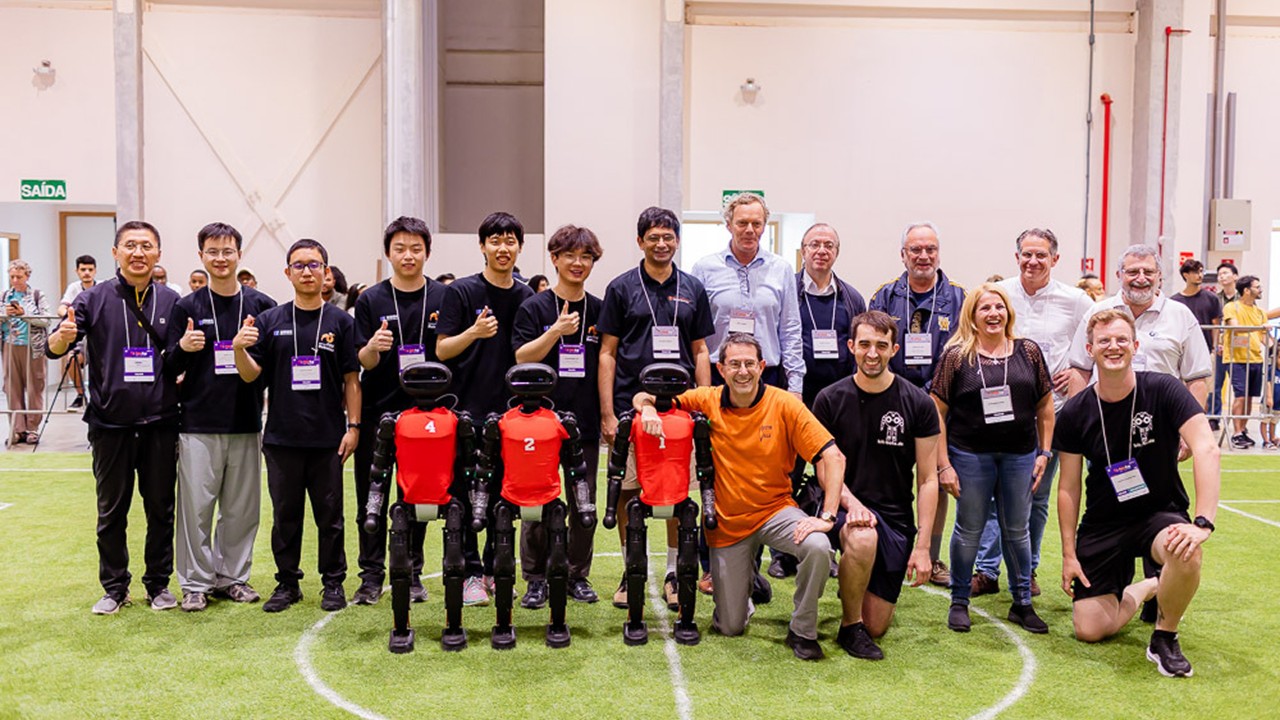
UT Austin Villa

UT Austin Villa
UT Austin’s humanoid soccer team at RoboCup 2026.
With the force-adaptive controller, the robot stably pushes the object using its end-effector.
Training Robot Skills in Simulation and Proving Them on Real Robots
Texas Robotics added eight Dell-built nodes to TACC’s Stampede3 supercomputer, each outfitted with eight NVIDIA RTX PRO™ 6000 Blackwell Server Edition GPUs. It gets priority through its own queue, and TACC runs scheduling, storage, and security. On those GPUs, students use NVIDIA Isaac Sim, an open simulation framework, to recreate robots, tasks, and surroundings in simulated 3D environments, and NVIDIA Isaac™ Lab, an open robot training framework, to train robot skills across massively parallel simulations. Both are available to any student or developer on GitHub. What students train then moves to real robots, many of which carry NVIDIA Jetson™ onboard computers.
Three projects show how that works at UT. Each starts in simulation on the shared GPUs and ends on a real robot:
Humanoid walking. For humanoids, walking comes first. Students train walking policies, the control programs that tell a robot how to move, for the team’s Booster T1 humanoid robots in Isaac Lab. They shape rewards across many simulated robots at once, then transfer the policy to the real machine. “There’s just no way I would be able to run these experiments at scale without these compute nodes,” said Alex Lu, a sophomore computer science major training humanoid walking policies. Those skills went with the team to RoboCup, where an NVIDIA Jetson Orin™ on each robot runs its perception models. The team’s own debrief pointed toward a need for more simulation, not less: Testing its game logic more thoroughly in simulation would have saved debugging time at the event.
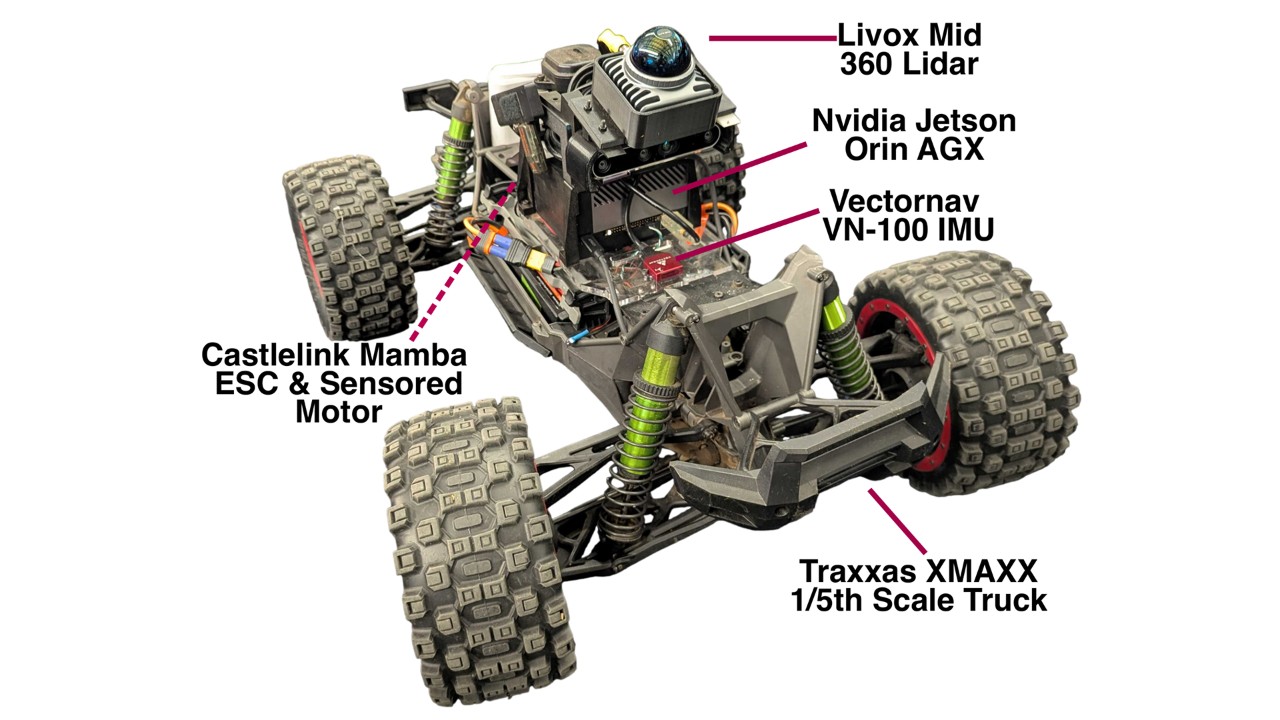
Off-road driving at speed. Simulation matters even more when practicing on a real robot is risky. Researchers used the nodes to develop OptCar, a high-speed control method for UT’s AlphaTruck, a 1/5-scale off-road research vehicle, described in a paper accepted to the 2026 Conference on Robot Learning (CoRL). They pretrained the driving model in simulation, including NVIDIA Isaac Lab, to cover aggressive, high-slip driving that’s difficult to collect safely, then adapted it with about 5 minutes of real driving per terrain. Running on an NVIDIA Jetson AGX Orin with NVIDIA TensorRT, it cut tracking error at high speed by about 55% compared with a fine-tuned baseline model.
First-year autonomous cars. First-year students follow the same process on smaller robots. In the Freshman Research Initiative’s Autonomous Driving stream, students work in pairs on real 1/10- and 1/5-scale autonomous cars, train their policies on the TACC nodes, and deploy them on the cars’ NVIDIA Jetson Orin NX computers, using both simulation and the real car. Demand for that start is steep: The Texas Robotics Honors Program, believed to be the nation’s first robotics program to admit students as freshmen, drew 3,284 applicants for 118 spots in 2025–26.
OptCar demonstrates the high-speed off-road autonomy precision in closed-loop control for a target vehicle while remaining robust across changing terrains.
UT Austin Villa
Opening Robotics Research and Education to More Students
For Joydeep Biswas, associate professor of computer science and associate director of Texas Robotics, the biggest win is access. Before the nodes, a researcher’s access to current GPUs depended on their own lab’s resources. Now 15 research labs and 110 faculty and students share them. More capacity has also widened what researchers are willing to try. “Having access to more resources means we can be more ambitious, particularly for high-risk-high-reward experiments with uncertain outcomes,” Biswas said. “I don’t know what’s going to happen, but I can still run it.”
“Learning complex behaviors directly on robots is challenging, and can take a lot of time and wear out the robots. As a result, learning first in simulation is often essential. But effective learning requires high-fidelity simulators that only run on high-end GPUs. Having access to a pool of shared NVIDIA GPUs enables UT Austin students to learn about and conduct cutting-edge research on robot learning, including advanced humanoid platforms and other mobile manipulators.”
Dr. Peter Stone
Head of the UT School of Computing at UT Austinn
Simulation Expands Access When Robots Are Scarce
The same infrastructure supports UT’s next big effort. Biswas directs the Center for Human and Robot Co-Adaptation, a five-year, $30 million NSF Science and Technology Center that brings together 39 researchers from six universities and industry partners, including NVIDIA, to study how robots and people adapt to each other in homes, hospitals, and other everyday settings.
The Texas Robotics nodes were part of the computing resources described in its proposal, and center researchers are already using Isaac Sim, with detailed 3D scans of real environments, to simulate mobile manipulation tasks in human spaces. The center also plans open source AI and robotics curricula.
UT Austin’s experience points to practices any robotics program can start with:
- Start where failure is cheap. Develop and test robot skills in Isaac Sim and Isaac Lab before committing robot time
- Share simulation-ready GPUs. Pool computing so every lab and course can use it, not just the best-funded ones.
- Write down the on-ramp. At UT, a graduate course wrote a public guide to running Isaac Lab on the shared GPUs, turning one course’s setup into a path every new user can follow.
- Keep the robot in view. Pair simulation with an onboard computer like Jetson, so trained skills reach a physical robot.
UT Austin Villa reached the RoboCup semifinals with robots that learned skills in simulation before ever setting a soccer boot to the pitch. For universities short on robots, that’s the case for doing more of the practicing in simulation.
“Every robot needs an intelligent brain, and the safest place to build and test one is in simulation, where AI can fail and learn before it ever touches the real world. Texas Robotics puts that work in students’ hands from their first year, and that’s how universities will train the people who build physical AI.”
Deepu Talla
Vice President of robotics and edge AI at NVIDIA, who earned his Ph.D. in electrical and computer engineering at UT Austin
Train and refine robot policies using reinforcement learning and imitation learning with NVIDIA Isaac Lab.