
Robotics and Edge AI
How Serve Robotics Achieved 99.8% Success for Last-Mile Autonomous Delivery
Serve Robotics
Objective
Serve Robotics is pioneering autonomous sidewalk delivery with over 1,000 physical AI-powered robots serving over 2,500 restaurants across five major cities.
The last-mile delivery industry has long struggled with inefficiency and rising costs. Traditional delivery methods too often rely on two-ton cars to transport two-pound meals, creating unnecessary traffic congestion and emissions. Serve Robotics, a pioneer in autonomous sidewalk delivery, set out to revolutionize urban logistics with AI-powered robots that navigate city sidewalks with unprecedented precision and reliability.
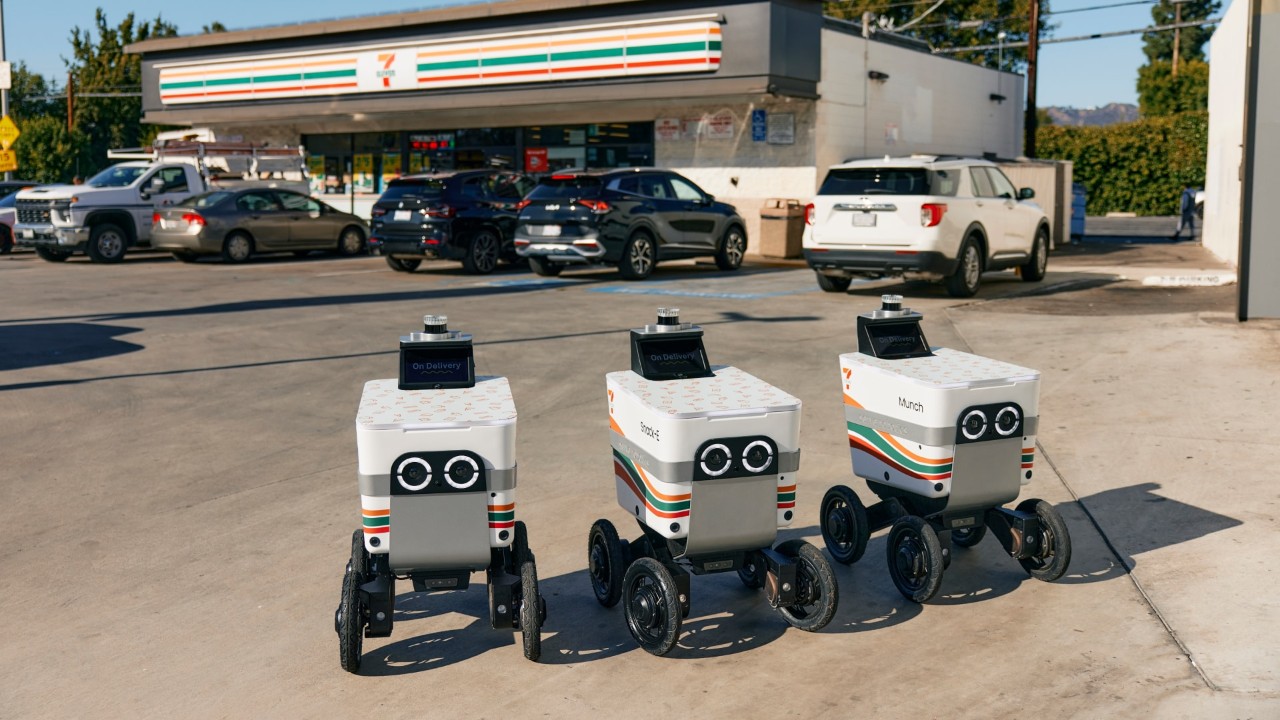
Since spinning off from Uber in 2021, Serve Robotics has built one of the largest autonomous robot fleets operating in public spaces. The company's third-generation delivery robots are simulated in NVIDIA Isaac Sim, an open-source photorealistic robotics simulation platform, and powered by NVIDIA Jetson Orin edge AI platforms. Serve robots have completed over 100,000 deliveries across Los Angeles, Miami, Dallas, Atlanta, and Chicago.
Customer
Uber Technologies
Partner
Serve Robotics
Use Case
Robotics
Products
Key Takeaways
- 99.8% delivery completion rate across 100,000+ autonomous deliveries powered by NVIDIA edge AI platforms
- 5x compute improvement with Jetson Orin-powered video processing in third-generation robots
- Jetson Orin’s efficient edge AI architecture powers 12+ hours of battery life on a single charge
Navigating Complex Urban Environments
The urban sidewalk environment presents unique navigation challenges requiring reliable, operationally safe systems with cost-effective hardware and software solutions. Unlike deployments in controlled warehouse environments, Serve's robots need to navigate unpredictable outdoor conditions, including potholes, pedestrians, and unusual obstacles, making advanced sensor simulation capabilities essential for testing and validation.
Serve Robotics faced significant technical hurdles that threatened to limit autonomous delivery performance. The company struggled with CPU compute limitations that prevented real-time autonomy. In addition, power consumption constraints were impacting battery life, making all-day field operations difficult to achieve.
To realize their autonomous delivery ambitions, Serve needed to upgrade its computing platform and optimize its software architecture.

Serve Robotics
Serve Robotics
Compact, High-Performance Compute for All-Day Use
To address these challenges, Serve Robotics partnered with NVIDIA to implement a comprehensive robotics development platform. The company leveraged Isaac Sim—NVIDIA's robotics simulation platform built on NVIDIA Omniverse — to validate autonomous performance at scale through thousands of simulated scenarios and synthetic data generation. This simulation-first approach allowed Serve to test edge cases and refine algorithms before real-world deployment.
For the hardware foundation, Serve implemented NVIDIA Jetson platforms progressing from Xavier to the more powerful Orin AGX as their robots evolved. NVIDIA's software-compatible stack enabled seamless migration between hardware generations while maintaining development momentum. The Jetson platform is optimized for robotics workloads and enhanced with Jetpack development tools and TensorRT inference optimization. This combination provided the high-performance, low-power edge AI computing that Serve required for all-day autonomous operations.
Serve Robotics
Delivering Breakthrough Results at Scale
Serve’s third‑generation robots gained a 5× compute boost by moving from Xavier to Orin, adding efficient hardware‑accelerated video and enabling 12+ hours of battery life per charge.
Since 2021, they have carried out 100,000+ autonomous deliveries with a 99.8% completion rate and averaged over 40% quarter‑over‑quarter growth since Q1 2022. The fleet now serves 2,500+ restaurants across five major cities and logs about 1 million miles of data monthly—nearly 170 billion image‑LiDAR samples—to continuously improve robot learning, HD maps, and navigation.
Scaling Autonomous Delivery Innovation
Following Serve's acquisition of Vayu Robotics, the company is integrating AI foundation models with its proven autonomy stack to enable interpretable, foundation-model-driven robot navigation. This combination of real-world sidewalk data and advanced simulation capabilities positions Serve to accelerate expansion into new markets while maintaining operational excellence.
As the company prepares to deploy 2,000 robots by the end of 2025, Serve's NVIDIA-powered platform demonstrates how physical AI can transform urban logistics and redefine sustainable last-mile delivery.
"Serve is on track to deploy 2,000 robots and become one of the largest fleets of autonomous robots in public spaces by the end of 2025. Our rapid progress and technology leadership would not be possible without our partnership with NVIDIA."
Serve Robotics
Ali Kashani
Co-Founder and CEO
Explore NVIDIA Isaac Sim to validate your autonomous systems at scale through photorealistic simulation and synthetic data generation.