AI-Powered Multi-Camera Tracking
Track and identify objects anonymously across cameras for city, warehouse, factories, and retail operations.
Workloads
Computer Vision / Video Analytics
Edge Computing
Robotics
Industries
Smart Cities / Spaces
Retail/Consumer packaged goods
Manufacturing
Healthcare and Life Science
Business Goal
Return on Investment
Risk Mitigation
Why Multi-Camera Tracking?
Imagine a world where factories run automatically with exceptional safety and efficiency, retail spaces are optimized for the shopper experience, and public spaces like hospitals, airports, and campuses are safer and more streamlined. These spaces are too large for a single camera to cover, so they’re typically monitored by hundreds of overlapping cameras. Following objects and measuring activity accurately across cameras and space is called multi-camera tracking, letting you more effectively monitor and manage your spaces.
Multi-camera tracking matters because it turns a collection of isolated camera feeds into a unified, intelligent sensing system. By linking observations across views, it reduces blind spots, improves incident detection, and enables richer analytics like crowd flow, dwell time, and cross-zone behavior. This isn’t possible to do reliably from a single viewpoint. In practice, this means better safety responses, smarter staffing and layout decisions in retail, and more efficient operations in large facilities.
Multi-camera tracking lets you:
- See everything across your site with a single connected view.
- Respond to security and safety issues faster.
- Use movement patterns to improve layouts and operations.
- Cut costs by automating routine monitoring while still covering more ground.
In this multi‑camera warehouse example, overhead and side‑view cameras track workers, forklifts, and AMRs across the facility — providing real‑time situational awareness of every aisle.
How Industries Are Using Multi-Camera Tracking
Manufacturing and warehouse automation: Improve your shop floor operations by optimizing routes for autonomous robots, equipment, and workers. AI-powered analytics help identify congestion, bottlenecks, and risks, allowing for data-driven decisions that enhance productivity, worker safety, and robot safety.
Retail store layout optimization: By analyzing customer navigation throughout your store, you can reconfigure aisles and product placement to maximize sales and revenue. Multi-camera tracking helps identify bottlenecks, track customer behavior, and simulate layout scenarios to predict impact on sales and customer experiences.
Smart cities : Tap into multi-camera tracking to monitor traffic flow and pedestrian movement across intersections, transit hubs, and public venues. This helps city operators reduce congestion, improve public safety, and optimize urban planning decisions.
In-hospital patient care: Access continuous monitoring of patients in hospitals for an added layer of safety and security. The solution enables real-time alerts and notifications, ensuring prompt attention and care when it’s needed.
Technical Implementation
Architecture Diagram
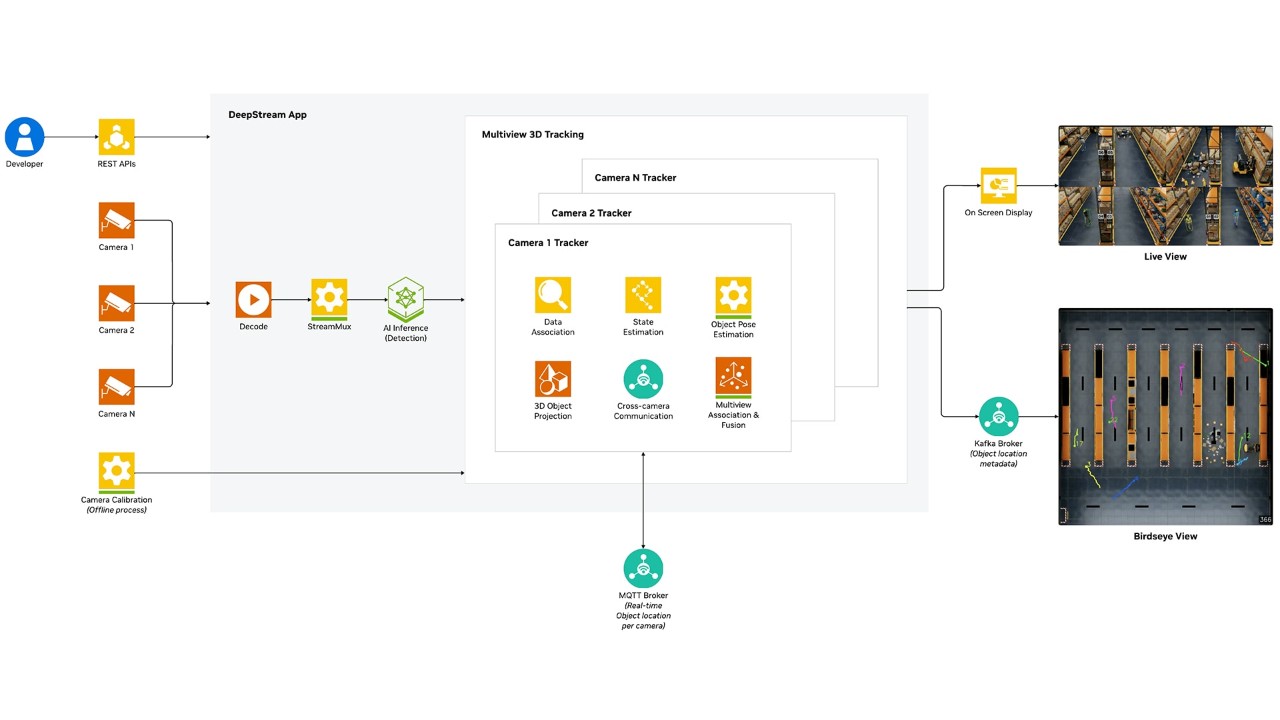
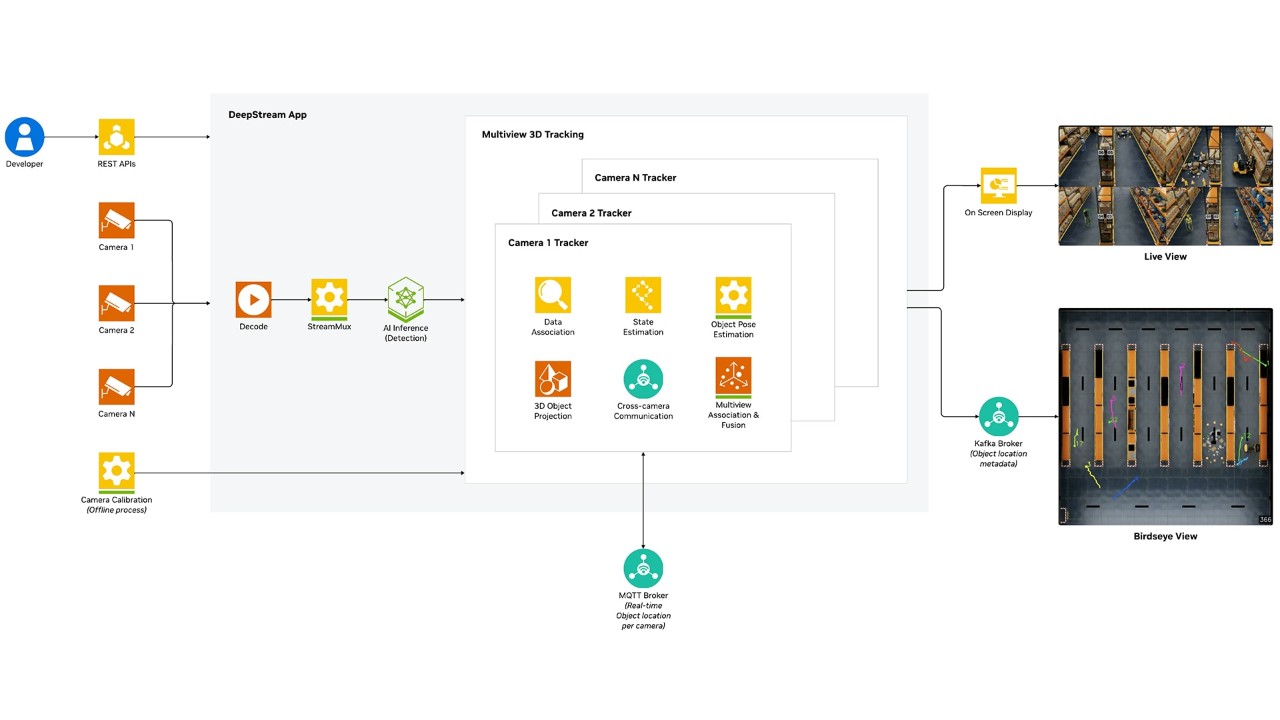
The NVIDIA DeepStream Multi-View 3D Tracking (Mv3DT) architecture is designed to streamline the transition from single-camera to multi-camera tracking within a unified containerized application.
- Ingestion and Inference: Start with your existing DeepStream pipeline or use the provided reference application. A key advantage of Mv3DT is that standard DeepStream pipelines can be easily upgraded to support multi-camera tracking. The system is flexible, supporting both 2D and 3D AI detectors for initial object detection.
- Multi-View 3D Tracking Core: This is the engine of the system. For every camera — Cam 1 to Cam N — it performs 3D object projection, state estimation, and Pose Estimation.
- Fusion and Synchronization: The trackers use cross-camera communication through an MQTT Broker, handling real-time location per camera . This allows for multi-view association and fusion, ensuring that data from different angles is merged into a single, accurate entity.
- Output and Visualization: The system provides dual outputs:
- Live View: An On-Screen Display (OSD) overlaying tracking data on the original video feed.
- Birdseye View: A 2D planar map powered by a Kafka Broker, which streams object location metadata to the visualization tool.
With the NVIDIA Blueprint for video search and summarization (VSS), you can build video analytics AI agents that not only understand visual content, but also perform advanced multi‑camera tracking. Powered by DeepStream, these agents can follow the same object as it moves through multiple synchronized camera views. This preserves a consistent identity and enables richer cross‑camera insights such as end‑to‑end paths, dwell times, and unique counts.
Quick Links
Getting Started
To build and customize an AI-powered multi-camera tracking solution using DeepStream Mv3DT, follow these four phases:
- Set Up (Prepare Environment): Install overlapping cameras, ensuring critical areas are covered by at least two views to handle occlusions effectively.
- Verify (Test Reference App): Run the Mv3DT reference application with synthetic data to verify the software stack (DeepStream SDK, MQTT, and Kafka brokers) is functioning.
- Calibrate (Auto-Calibration): Perform the Offline Camera Calibration process using the Auto Magic Calibration (AMC) tool to generate the projection matrices required by the tracking core.
- Deploy and Customize: Integrate Mv3DT into your own pipeline, visualize the real-time 3D tracking, and use DeepStream Copilot to rapidly tailor the application code to your needs.
Frequently Asked Questions
You can achieve facility-wide visibility by using DeepStream’s multi-camera tracking to unify data from multiple standard IP cameras. This system coordinates overlapping fields of view to maintain a consistent identity for each person or asset as it moves between cameras, outputting unified 3D location data. It scales easily on NVIDIA hardware, ranging from edge devices to data center GPUs.
Yes, vision-based tracking offers a tagless alternative to traditional RTLS technologies like Wi-Fi, Bluetooth beacons, UWB, or RFID. Instead of requiring people or assets to carry devices, camera-based systems track objects directly using computer vision. NVIDIA DeepStream's multi-camera tracking outputs real-time 3D coordinates in a global reference frame, providing location data comparable to tag-based systems without the hardware cost per tracked object, battery maintenance, or requirement that objects carry tags.
DeepStream's Multi-View 3D Tracking maintains consistent object IDs by using a distributed protocol where cameras with overlapping fields of view automatically negotiate and propagate global IDs using lightweight MQTT messaging. When an object appears in a new camera's view, the system matches it against tracklets from neighboring cameras using 3D position correlation — no central server required. The system also includes automatic error correction for cases where IDs are missed or incorrectly assigned during handoffs.
DeepStream supports flexible deployment options across edge devices, data centers, or hybrid configurations. The system’s distributed design processes data locally rather than streaming all video centrally, reducing bandwidth requirements and allowing you to scale camera count without creating performance bottlenecks.
NVIDIA DeepStream is detector-agnostic, supporting any model that produces bounding boxes. You can use standard architectures like YOLO and Faster R-CNN, models trained with the NVIDIA TAO Toolkit, or your own custom models. Because tracking operates downstream from detection, you can select or swap whichever detector best fits your specific use case.
Get Started
Build This Use Case
Accelerate the development of your multi-camera tracking AI application.
Related Use Cases