
Industrial and Manufacturing Sector
Foxconn Industrializes Intelligence and Scales the Future With AI Factories
Objective
Foxconn, the world’s leading Tier-1 electronics manufacturer, aimed to transform its global production ecosystem into a fully autonomous, self-learning "AI factory." Managing over 200 facilities, the company faced the challenge of orchestrating massive multi-tenant AI workloads across manufacturing, electric vehicles, and smart cities. To achieve this, Foxconn deployed an end-to-end intelligent production ecosystem powered by NVIDIA DGX SuperPOD™, NVIDIA-Certified GB300 NVL72 systems, and NVIDIA RTX PRO™ Servers. By developing its proprietary FoxBrain large language model and specialized platforms like Genesis and CityGPT on this infrastructure, Foxconn transitioned from data analysis to real-time, agentic decision-making, significantly improving operational efficiency and establishing a scalable blueprint for AI industrialization across Asia.
Customer
Foxconn
Topic
Generative AI / LLMs
Key Takeaways
- 2.48x faster training on 120B models on DGX GB200 vs. legacy1
- 1 trillion tokens processed on DGX GB200 in 12 days2
- 25% reduction in production scheduling hours, and 50% reduction in engineering workload
- 20+ major defect root causes addressed in SMT (Surface Mount Technology) production line with >90% correction rate
- 200+ facilities managed via NVIDIA Mission Control
- Rapid duplication of production lines with ultra-low latency with NVIDIA RTX PRO
1 Vs. H100 baseline (Foxconn-measured; consistent with NVIDIA MLPerf Training v5.0: 2.5x NVIDIA Blackwell vs. NVIDIA Hopper™ on Llama 3.1 405B)
2Based on Foxconn’s DGX SuperPOD training job telemetry
Transforming Manufacturing Into Intelligence
As the world's leading Tier-1 electronic manufacturer, Foxconn provides sophisticated hardware and software integration powering the world's most recognizable consumer electronics, electric vehicle platforms, and AI-driven smart city infrastructure. Today, the company is undergoing a fundamental transformation: moving beyond assembly to the manufacturing of intelligence. Foxconn’s vision is to build an end-to-end, self-learning ecosystem where intelligence is a primary output. Foxconn aims to move AI into the realm of real-time autonomy, ensuring that every process—from the production line to urban management—is powered by specialized agents capable of making independent, intelligent decisions.

Foxconn Global Headquarters

Foxconn’s AI factory.
From Open Source Models to Specialized GPTs
The creation of Foxconn’s intelligence begins with the aggregation of massive, high-fidelity industrial datasets paired with a strategic post-training and domain fine-tuning approach. Foxconn identifies best-in-class open source foundation models—including Llama, Gemma, NVIDIA Nemotron™, and other state-of-the-art open models—and brings them into a centralized high-performance environment. By incorporating its proprietary data into these architectures, Foxconn developed FoxBrain, its flagship large language model (LLM). This process involves large-scale distributed training on multiple data modalities, including vision, speech, and language, to ensure the model understands the unique linguistic and technical nuances of Foxconn’s global operations.
Once the base FoxBrain LLM is established, Foxconn performs additional rounds of pre-training and fine-tuning on massive datasets of domain-specific industrial, urban, and healthcare data. This tiered development results in a suite of specialized platforms: Genesis Platform for smart manufacturing workflows and CityGPT for urban management and citizen services. Foxconn’s development approach balances the broad reasoning capabilities of global foundation models with the precision required for mission-critical industrial tasks, enabling AI to move from general conversation to real-time industrial action.
Establishing a Validated Foundation for Global Scale
At the heart of Foxconn’s AI factory is a strategic combination of NVIDIA DGX SuperPOD and NVIDIA-certified partner solutions. "NVIDIA DGX SuperPOD provides the validated blueprint and predictable performance we need for mission-critical development. It serves as the ‘Super Brain’ where we train and refine our most complex models using the full power of the NVIDIA AI software stack," says Kathy Yang, Head of AI Software Business at Foxconn.
To bridge the gap between foundation models and industrial applications, Foxconn leverages the NVIDIA NeMo framework to fine-tune FoxBrain for complex manufacturing, vision, and robotics tasks. Once FoxBrain and its specialized GPT platforms are proven and optimized on the DGX architecture, Foxconn scales enterprise-wide through the NVIDIA-certified systems. This ecosystem is productized through VisionBay.ai, a Foxconn subsidiary and an NVIDIA Cloud Partner. More than just a GPU provider, VisionBay.ai delivers AI-as-a-service by combining high-performance computing with Foxconn’s proprietary GPT platforms, purpose-built to meet the needs of its three strategic platforms: Smart Manufacturing, Smart EV, and Smart City. This enables governments and enterprises across Asia to accelerate AI training, fine-tuning, and inference at scale.
“NVIDIA DGX SuperPOD provides the validated blueprint and predictable performance we need for mission-critical development.”
Kathy Yang
Head of AI Software Business, Foxconn
Breakthrough Performance and Speed With AI Supercomputing
The transition to the NVIDIA DGX SuperPOD has redefined Foxconn’s training capabilities. Leveraging the NVIDIA Blackwell architecture with NVIDIA NVLink Switch, the cluster functions not as a collection of individual GPUs, but as one giant, unified superchip. “We achieved a 2.48x training speedup on our 120B parameter models compared to prior H100-based solutions.3 This performance jump is a key result of the massive increase in peak throughput, which now hits 4,900 TFLOPS,”4 said Yung-Hui Li, Founding Director of AI Research Center at Hon Hai Research Institute at Foxconn.
For its largest training jobs to date, Foxconn processed a staggering 1 trillion tokens in just 12 days.5 This high throughput is critical for training the FoxBrain vision-language model, built by continuing training from the FoxBrain LLM and fusing industrial data with multimodal reasoning. NVIDIA NVLink Switch allows 72 GPUs to act as a single rack-level acceleration domain with almost zero wasted energy, ensuring that sustained training throughput remains exceptionally high, even for the most demanding generative AI workloads.
“By utilizing the NVIDIA Blackwell-based DGX SuperPOD, we achieved a 2.48x training speedup, enabling us to process one trillion tokens in just 12 days to power our global AI factory.”
Yung-Hui Li
Founding Director of AI Research Center at Hon Hai Research Institute, Foxconn
3As measured by Foxconn. Consistent with NVIDIA’s published MLPerf Training v5.0 results (2.5x NVIDIA Blackwell-vs-Hopper time-to-train on Llama 3.1 405B at the same 8-GPU scale; up to 3.2x with FP4 in MLPerf v5.1)
4As measured by Foxconn, per NVIDIA Blackwell GPU using BF16/FP16 sparse Tensor Core throughput; NVL72 rack-level peak is 1.44 ExaFLOPS at FP4 based on the NVIDIA DGX GB200 datasheet
5As measured on Foxconn’s DGX SuperPOD running training job telemetry

Foxconn’s DGX SuperPOD with DGX GB200 systems
Streamlining Complex Workloads Across the Factory Network
Operating an AI computing cluster of this magnitude requires sophisticated orchestration. Foxconn utilizes NVIDIA Mission Control to manage its rack-scale environments, serving as the nerve center for real-time monitoring and unified services that streamline AI provisioning. It also provides visibility, control, and built-in resiliency across the cluster for optimal utilization and uptime. In a global operation where downtime is measured in millions of dollars, this centralized control is indispensable.
“By automating the operations of highly demanding, massive-scale infrastructure, NVIDIA Mission Control allows Foxconn to scale efficiently without a linear increase in IT overhead,” said Kathy Yang. “Furthermore, the integration of NVIDIA Run:ai and NVIDIA NIM microservices ensures optimized agents can be deployed across 200+ facilities with cloud-like flexibility.” This unified management stack creates a seamless pipeline from the research institute to the production line, bridging the gap between heavy-duty training and responsive edge inference.
“NVIDIA Mission Control gives us the agility to orchestrate complex AI workloads across 200+ facilities, ensuring maximum infrastructure efficiency with cloud-like flexibility.”
Kathy Yang
Head of AI Software Business, Foxconn
Real-Time Autonomy and Scalable Productivity
For a global titan like Foxconn, even fractional improvements in efficiency translate into millions of dollars in savings. To transition trained models into active decision-makers, Foxconn integrates NVIDIA Dynamo. This inference software enables specialized platforms like Genesis Platform and CityGPT to execute real-time conversational and decision-making tasks with ultra-low latency. Measured through Overall Equipment Effectiveness (OEE)—the gold-standard manufacturing KPI evaluating availability, performance, and quality—Foxconn has realized significant gains across its scaling use cases.
In high-volume, mission-critical environments like injection molding, setpoint optimization has reduced engineering workload related to process changeovers by 50%. The company also deployed CNC 360, an AI system that optimizes the complex machine code used to carve metal and plastic parts. By fine-tuning these instructions in real time to ensure maximum precision and throughput, CNC 360 delivered a measurable percentage in cycle time reduction. Beyond machinery, AI has transformed production planning: Automated Production Scheduling (APS) reduced labor hours for plant scheduling by 25%. Root cause analysis on SMT production line addressed 20+ major defect root causes with >90% correction rate. These gains demonstrate the power of tokens as the new currency, where interaction data fuels a flywheel of smarter factories.
“The DGX SuperPOD serves as our AI 'Super Brain,' driving agentic workflows that have delivered significant efficiency improvement and a 25% reduction in production scheduling hours.”
Kathy Yang
Head of AI Software Business, Foxconn

Foxconn agents power interactive AI coaches to help train new employees.
Bringing Agentic Workflows to the Production Line
Foxconn’s strategy extends AI capabilities to the edge of the factory floor, where real-time intelligence is required to design, validate, and operate increasingly complex manufacturing systems. As part of its strategic buildout of AI-powered manufacturing capabilities, Foxconn has acquired a significant number of NVIDIA RTX PRO 6000 servers to support high-fidelity simulation, real-time decision-making, and agentic AI workflows across its global manufacturing operations.
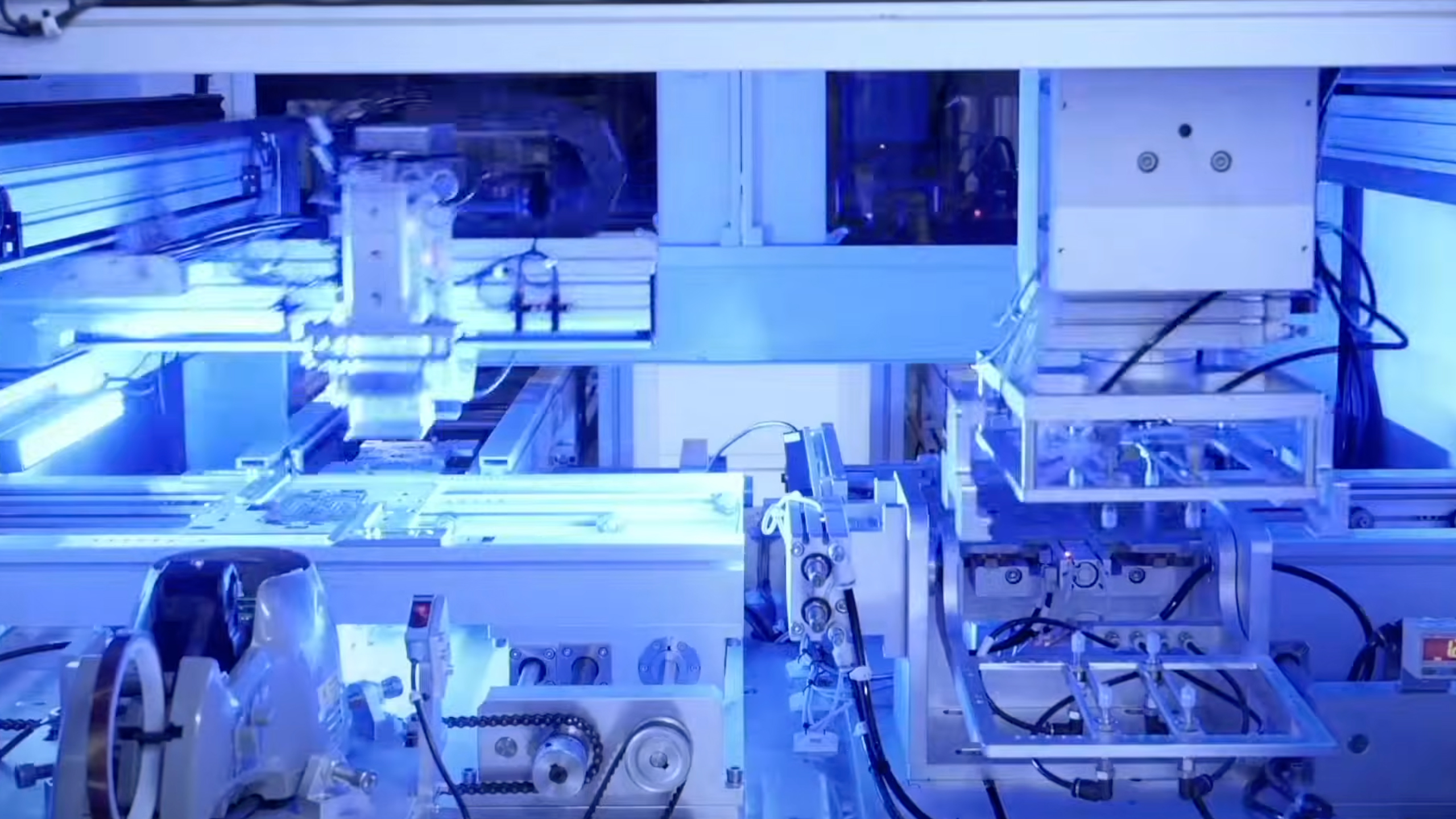
By running manufacturing digital twins and agentic AI workflows on these RTX PRO Servers, Foxconn brings specialized AI intelligence directly to the point of action. This enables real-time decision-making tasks—such as SMT defect root-cause analysis—to be executed directly on the factory floor. Leveraging the NVIDIA AI Enterprise software platform, together with NVIDIA Omniverse and NVIDIA Isaac, Foxconn can simulate autonomous mobile robots (AMRs), industrial manipulators, and complex production environments within high-precision digital twins before physical deployment.
“By leveraging NVIDIA RTX PRO servers to run Omniverse and Isaac, we’ve achieved a 'factory-born digital' workflow that allows us to rapidly duplicate production lines globally while ensuring ultra-low latency for every agent.”
Leo Guo
General Manager of Technology and Automation Robotics Group, Foxconn
Leading the Era of AI Industrialization
The Foxconn AI factory is expanding with new regional hubs in Kaohsiung, Taiwan. Together with NVIDIA, Foxconn is co-developing an AI Token Ecosystem and Open Agent Framework, empowering other enterprises to build customized intelligent agents on Foxconn’s platforms. By realizing AI industrialization at scale, Foxconn is manufacturing the future of global industry.
NVIDIA DGX SuperPOD offers leadership-class accelerated infrastructure and scalable performance for the most challenging AI workloads—with industry-proven results.